
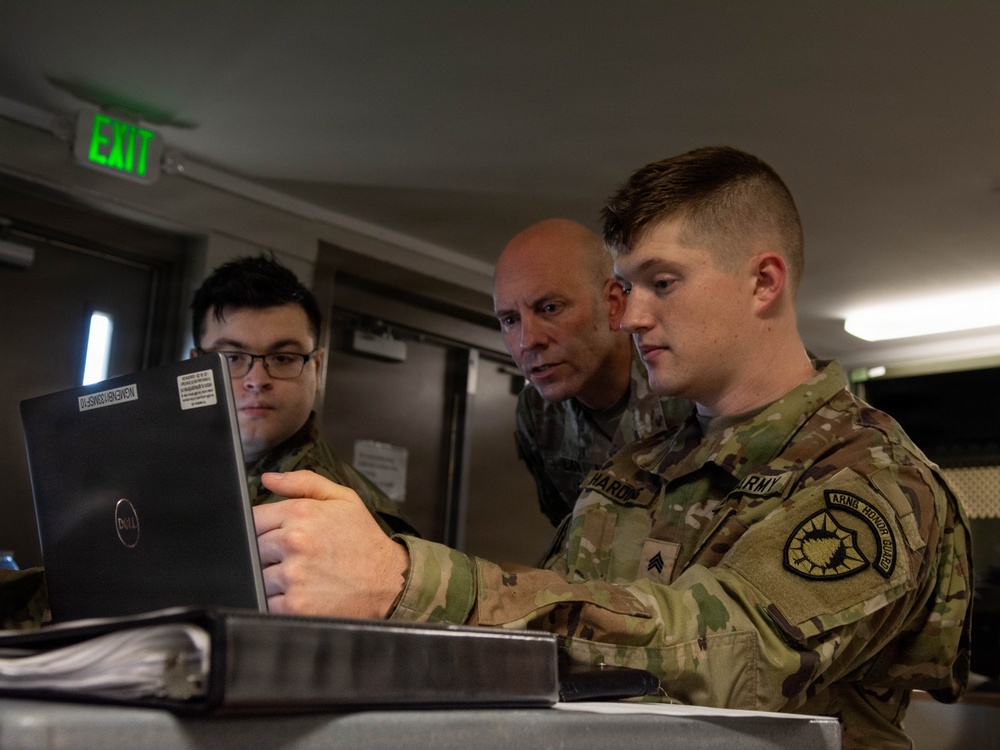
Photo By Sgt. 1st Class Alyson Pelletier | Soldiers assigned to the 133rd Engineer Battalion, Maine Army National Guard, monitor...... read more read more
Static squelches from a hand radio. A message is immediate: “EXERCISE-EXERCISE- EXERCISE,” the radio filtered voice says. “Soldier down at…” as the rest of the message is communicated, Soldiers with the 133rd Engineer Battalion, Maine Army National Guard, get to work responding to an emergency response training scenario. Some of the Soldiers verify the information, others write on a white board with live updates, and others look at a map to verify the location, who is nearby to respond, and how to best get to the Soldier needing help.
“We have a great mission,” said Maj. Patrick Rand, executive officer for the 133rd Engineering Battalion. “We are assigned as the headquarters element for a chemical, biological, radiological, and nuclear response element…We provide command and control for three technical support forces that are assigned to us.”
The technical support forces are the 50th Chemical Company from the New Jersey National Guard, responsible for mass decontamination and chemical reconnaissance; the 127th Medical Company Area Support from the Alabama Army National Guard, responsible for mass casualty support including decontamination operations; and the 1020th Engineer Vertical Construction Company from the Louisiana Army National Guard, assigned as urban search and rescue specialists. The 133rd’s ability to provide command and control for the specialized response teams to respond is key for mission success during Guardian Response 26, a large-scale chemical response element culminating exercise designed to test readiness in a realistic operational environment.
“Command and control is about managing chaos,” said Cpt. Timothy Kelley, officer in charge of the tactical command post. “You can’t just send a unit out and tell them to conduct task x-y-z and expect things to go well. There needs be some overarching leadership to any organization or any mission, and that’s what we provide.”
Managing everything from personnel administration, intelligence, and communications to logistics and operations, the 133rd serves as the central hub of the technical support force’s response capability. Every section must integrate and communicate effectively, as seamless coordination is essential to saving lives in a real-world emergency.
This task force is not training for training’s sake. It is part of a two-year rotational mission assigned to respond to a national emergency requiring military support to civilian authorities, with deployments that could last anywhere from weeks to months.
“Picture an urban area anywhere in the United States that potentially had the worst day of their life, which could be a nuclear detonation, chemical spill, train derailment or anything like that,” said Rand. “We could be called upon to provide command and control for three technical support forces.”
The scene Rand described is brought to life during this year’s Guardian Response scenario at the Muscatatuck Training Center: a nuclear detonation. Formerly a self-sufficient town with a subway system, schoolhouse, prison, and hospital, the site is now an advanced urban training area for emergency response training, including a flooded zone, rubble piles, scattered debris and more, all of which simulate various environments teams may encounter in a real-world emergency response.
While 133rd Soldiers in the tactical operations center analyze maps, rosters, and inventories in an office miles away from ground-zero, the specialized units set up decontamination tents and quarantine zones, rescue the injured, and triage casualties. Meanwhile, a few 133rd Soldiers are closer to the area in a forward tactical command post - a small, raised trailer - with a generator humming and a communications tower outside.
“Our [technical support forces], they’re right near that heavy impact zone where radiation’s spiked up a bit and they’re pulling people out of rubble piles, and that’s where the tactical command post is located,” said Kelley. “Our command post could be hundreds of miles away, trying to maintain communications at that distance with the complexities of this mission would be virtually impossible, so you really need something in-between to gather information, filter it, vet it and make sure it makes sense before passing it on to higher command.”
Now, in their second year, Guardian Response 26 brought together multiple units and capabilities to train for complex CBRN response operations while evaluating how effectively the force could integrate under pressure. For the Maine National Guard’s 133rd Engineer Battalion, this exercise not only provided an opportunity for training in a unique environment, but also bolstered the skills of their Soldiers and leaders.
“Overall, it’s improved morale and resilience and readiness; its teaching a lot of folks a lot of new skills. At the very least it’s teaching them how to communicate and integrate with other forces,” said Kelley. “We’ve got so many better officers and NCO’s as a result of being out here.”
| Date Taken: | 06.12.2026 |
| Date Posted: | 06.18.2026 09:25 |
| Story ID: | 567581 |
| Location: | INDIANA, US |
| Web Views: | 106 |
| Downloads: | 0 |

This work, Commanding Chaos, by SFC Alyson Pelletier, identified by DVIDS, must comply with the restrictions shown on https://www.dvidshub.net/about/copyright.


No keywords found.





