
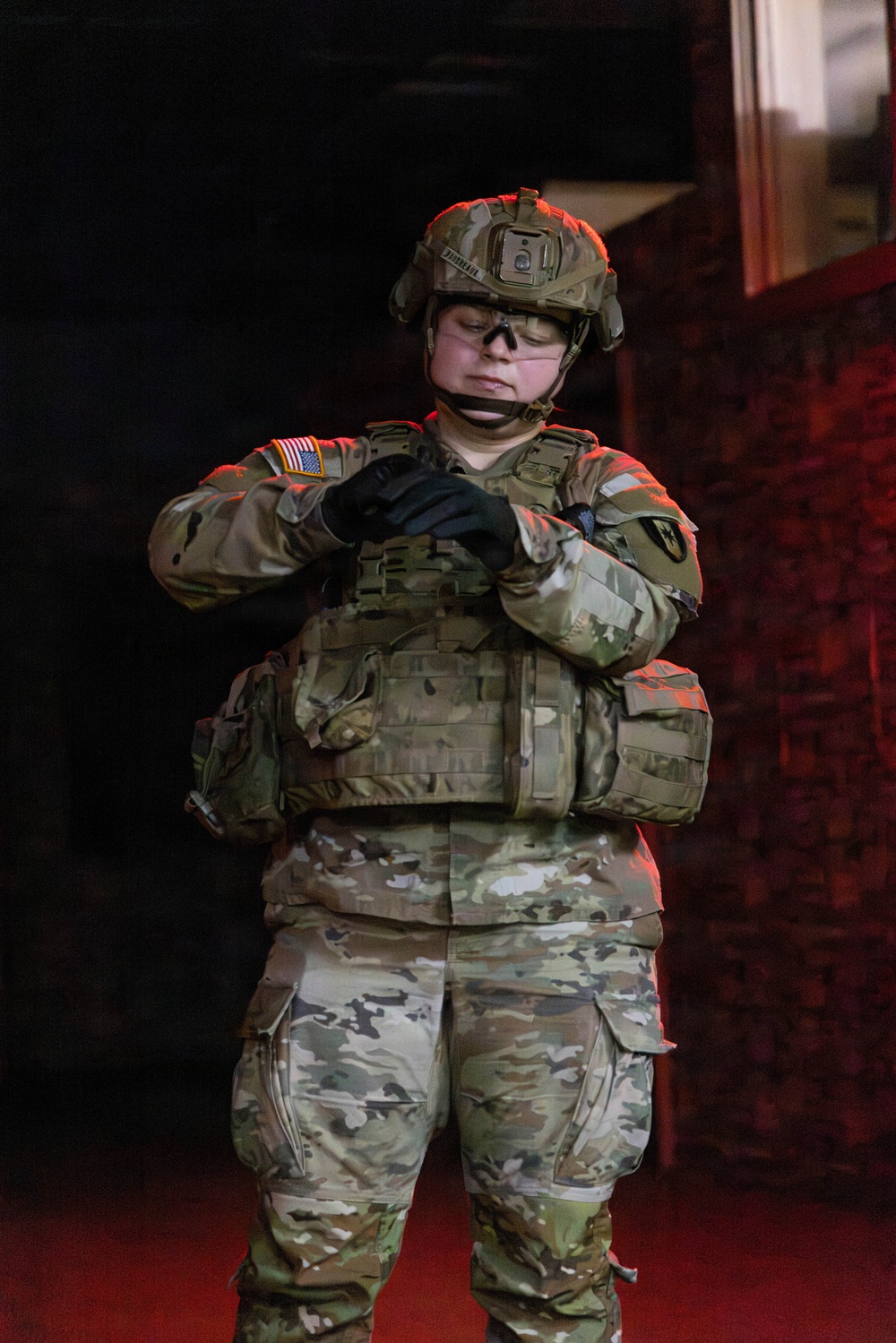
Photo By Spc. Rebeca Soria | U.S. Army Sgt. Brooke Boudreaux assigned to Headquarters and Headquarters Company,...... read more read more
 Subscribe
FORT STEWART, Ga. — “Return fire! Apply self aid! Get to cover!” screamed a medic assigned to the 3rd Infantry Division as he tried to make his way to the wounded Soldier on the battlefield. Waiting for fire superiority, while it only took minutes, felt like it had been hours since he saw the wounded Soldier fall down. With sweat dripping down his face and his heart racing, he was finally able to move and he rushed to the Soldier’s aid, hastily applying the tourniquet to the Soldiers’ left leg as high as he could to stop the bleeding.
The lights suddenly come back on and the simulated noise stops playing as an instructor comes forward to talk through the scenario that just played out. This is just one of the multiple ways that the Medical Simulation Training Center can prepare Soldiers for any future combat situations they might find themselves in. The Fort Stewart Medical Simulation Training Center has transformed from a little-known training resource into the Army's highest-rated Regional Medical Simulation Training Center, earning recognition as the top facility among 25 centers worldwide.
According to leaders at the Medical Center of Excellence, Fort Stewart currently holds the No. 1 ranking among Regional MSTCs across the Army, surpassing facilities in Germany, South Korea and throughout the active-duty, Reserve and National Guard components. "There are 25 Regional Medical Simulation Training Centers worldwide," said Staff Sgt. Tyler Beaudry, assigned to the Headquarters and Headquarters Battalion, 3rd Infantry Division. "We're number one [according to] the Medical Center of Excellence."
The distinction reflects years of deliberate cultural change, rigorous instructor selection and a commitment to preparing medics for the realities of future large-scale combat operations.
"When I first got there, the team initially had already done a lot of work from where it previously was," Beaudry said. "There was a team already changing that culture and fostering the importance of identifying our shortcomings and truly preparing medics for future conflicts."
One of the center's most significant changes involved redefining who could serve as an instructor. Rather than accepting personnel based solely on availability, leaders implemented an interview process designed to identify medics with strong medical foundations, tactical expertise and a passion for teaching.
"If you didn't pass an interview or have a really strong foundation of medicine and tactical medicine, you just weren't hired," Beaudry said. "We're trying to develop better medics within our division and across the southeast, because we are a regional facility."
That emphasis on instructor quality has become a defining characteristic of the organization.
"I think the interview process for choosing the instructors is a very big portion of why we're the best," said Sgt. Brooke Boudreaux, assigned to Headquarters and Headquarters Company, 14th Field Hospital, 16th Hospital Center, 44th Medical Brigade, XVIII Airborne Corps. "You have instructors who really want to be there rather than the units just picking them to send them."
The center trains Soldiers from across the Army, welcoming participants from installations throughout the United States and overseas.
"We've had people from Fort Bragg, we've had people from South Korea, we've had all your Compo 2 and 3s from all across the country," Beaudry said. "With that you have to have that strong foundation of instructors who are dedicated, want to teach people and can convey it down to the lowest level so everyone understands." Instruction is grounded in evidence-based medicine and standardized guidelines.
"By coming to the Medical Simulation Training Center, the difference is there are actual standards for the teaching," Boudreaux said. "You're strictly following the Committee of Tactical Combat Casualty Care guidelines and the Clinical Practice Guidelines."
Beyond technical proficiency, instructors seek to develop critical thinking and sound clinical judgment.
"We've seen that this approach allows us to foster clinical judgment and critical thinking," Beaudry said. "We want you to fail here so you don't have to live with preventable deaths downrange."
The center continuously adapts its curriculum by incorporating lessons learned from current conflicts and emerging battlefield trends. Leaders are also expanding training opportunities through initiatives such as enhanced Combat Medic sustainment programs, prolonged field care instruction and the future implementation of the Delayed Evacuation Casualty Management course, which covers long term field care for casualties that cannot be evacuated immediately.
Training environments continue to evolve as well. Instructors are constructing urban operations and trench-style simulation areas designed to replicate conditions medics may encounter during large-scale combat operations.
"We're trying to get ahead of that curve," Beaudry said. "We're taking from what's developing and trying to better ourselves, so we're not learning on the fly." Equally important is the center's commitment to self-improvement. Daily course critiques allow instructors to identify weaknesses, adjust teaching methods and remain accountable to their students.
"We have daily course critiques," Beaudry said. "If students clearly aren't understanding something, then we've got to figure out why and how to teach this group, because each individual is different with learning."
For Fort Stewart's instructors, maintaining the top ranking is less about recognition and more about expanding the center's impact. "Maybe one person learns something, goes back to their unit and starts training their people," Beaudry said. "We engaged one person, created a memory for them, and they went back and taught 24 people."
By investing in its instructors, embracing innovation and focusing on realistic, relevant training, the Fort Stewart Medical Simulation Training Center is shaping the next generation of Army medics — and setting the standard for medical readiness across the force.
| Date Taken: | 06.12.2026 |
| Date Posted: | 06.15.2026 12:15 |
| Story ID: | 567574 |
| Location: | FORT STEWART, GEORGIA, US |
| Web Views: | 154 |
| Downloads: | 0 |

This work, Fort Stewart is the No. 1 Medical Simulation Training Center in Army, by SPC Rebeca Soria, identified by DVIDS, must comply with the restrictions shown on https://www.dvidshub.net/about/copyright.


No keywords found.




