
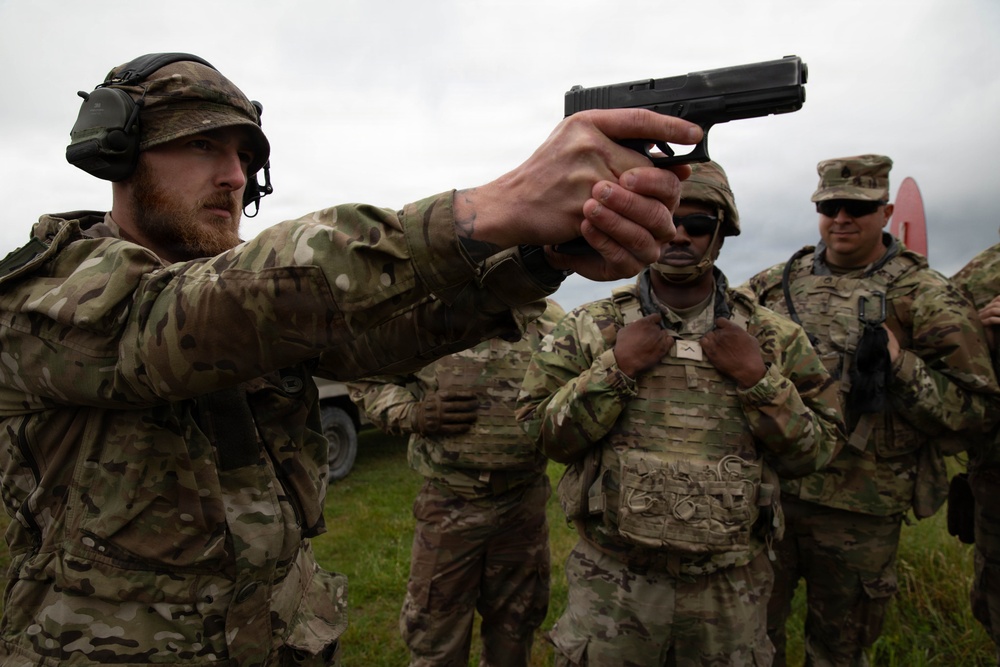
Photo By Staff Sgt. Emilie Lenglain | U.S. Army Soldiers assigned to Alpha Company, 8th Brigade Engineer Battalion, 2nd...... read more read more
 Subscribe
Bemowo Piskie, POLAND- U.S. Army Soldiers from Alpha Company (A Co.), 8th Brigade Engineer Battalion (8th BEB), 2nd Armored Brigade Combat Team (2 ABCT), 1st Cavalry Division (1st CAV) arrived at the Bemowo Piskie Training Area range, heard nearby SA80 rifle fire, and were greeted by a British Army conducting officer from the Light Dragoons for close-quarters battle (CQB) training on June 11, 2026.
“The British Army, Light Dragoons, range safety volunteered instruction time during their own training to educate myself and my soldiers on the British SA80 rifle and Glock 17 pistol systems,” said Staff Sgt. Robert Ermer, assigned to A Co, 8th BEB, 2nd ABCT, 1st CAV. “His instruction was highly informative, professional, and delivered with exceptional clarity.”
The British soldiers asked questions to learn how U.S. troops compared the British Army’s SA80 rifle to the U.S. Army’s M4 rifle.
Out of curiosity, both forces realized that the two rifles actually used the same ammunition and magazines.
A detail that could help if ever on mission with one another.
They were able to receive instruction on inserting a magazine, pulling the charging handle back, and releasing the magazine.
A couple noticeable differences between the two rifles are that the British Army’s SA80 magazine is located behind the trigger and is heavier than the U.S. Army’s M4 rifle.
“I gained practical knowledge of how our NATO allies operate their equipment and the differences in their weapons’ handling and capabilities,” said Ermer.
The British were shooting CQB in preparation for Military Operations on Urban Terrain (MOUT) training they will be conducting next week.
Stationed in Poland, the 8th BEB Soldiers are not often required to fire at close range—close-quarter marksmanship ranges are typically run by infantry units.
However, even though engineers don’t frequently use CQB ranges, they do receive CQB and MOUT training.
“We learn CQB with the 8th BEB,” said Pfc. Ryan Kolb, assigned to A Co, 8th BEB, 2nd ABCT, 1st CAV. “Engineers do urban breaching, so we’ll use different means of breaching to go through doors and walls to gain better access to urban areas and engage through them.”
Kolb continued that CQB is important for military units when operating in more urban areas.
“We fight through buildings and streets, where we’re not going to shoot more than 20 to 50 meters," said Kolb. "So, it’s good to know what your rifle can do in that close range and if your rifle goes down, switch to your pistol and carry on."
Something unique about the British Army’s CQB range is that after they fired their rifles, they would switch to their pistol.
The U.S. Soldiers were able to try out each weapon system individually and not necessarily go through the same shooting scenario as the British troops, but they were still very enthusiastic to get hands-on the weapon systems and put rounds down range.
Of the joint training, the British Army range safety of the Light Dragoons said, “Working alongside our American counterparts gives us the opportunity to share tactics, learn from one another, and build the trust that is essential for success on operations. The stronger we train together, the stronger we fight together.”
This is exactly what they did and have been doing in the Bemowo Piskie Training Area for years as U.S., British, Romanian, and Croatian troops have been training to maintain readiness along the alliance’s eastern flank.
“This exposure improved my understanding of coalition tactics and was a critical chance to build cohesion and strengthen bonds with our allies,” said Ermer. “That trust and familiarity will directly enhance our ability to operate together effectively.”
| Date Taken: | 06.12.2026 |
| Date Posted: | 06.12.2026 10:35 |
| Story ID: | 567560 |
| Location: | PL |
| Web Views: | 404 |
| Downloads: | 0 |

This work, U.S. Army engineers learn from the British Army about close-quarters battle in Poland, by SSG Emilie Lenglain, identified by DVIDS, must comply with the restrictions shown on https://www.dvidshub.net/about/copyright.


No keywords found.




