
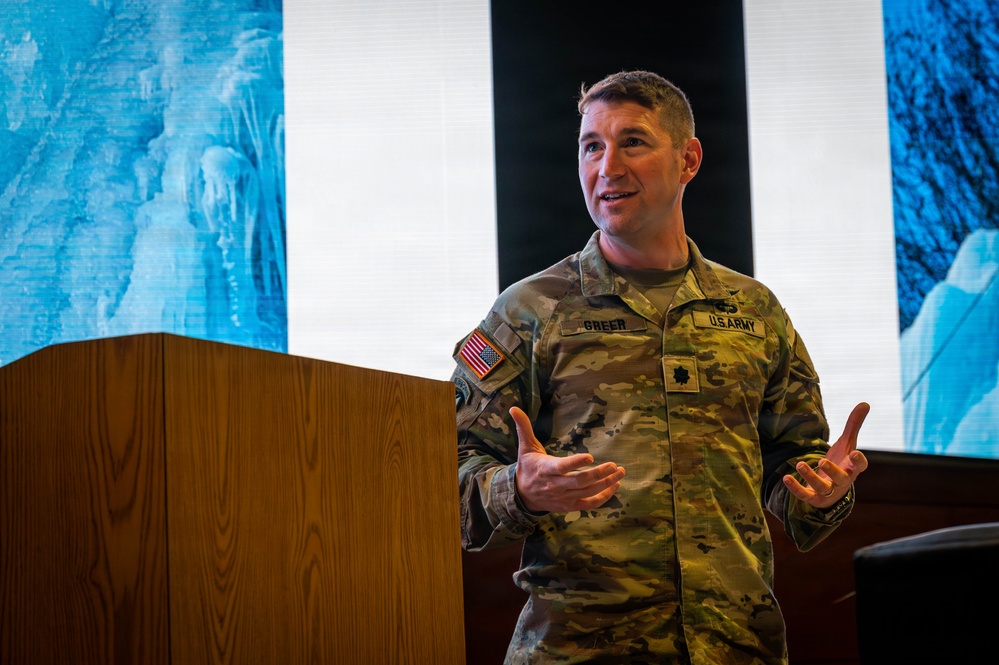
Photo By Senior Airman Raina Dale | U.S. Army Lt. Col. Devon Greer, 11th Airborne Division Surgeon, speaks during the...... read more read more
 Subscribe
JOINT BASE ELMENDORF-RICHARDSON, Alaska– With the combined efforts of the 673d Medical Group and 11th Airborne Division surgeon cell, the Below Zero Medical Conference was hosted June 1 through 4, 2026 at the Arctic Warrior Event Center on Joint Base Elmendorf-Richardson, Alaska.
In recent years, JBER has hosted the BZMC to identify and discuss innovative ways to effectively execute medical treatments within arctic environment because colder weather affects gear, people and timeliness when treating injured patients. During the event, presenters and attendees addressed medical “gaps” in attempts to bridge temperate remedies and tailor them to the cold atmosphere.
“ I don't think people are paying enough attention to operating in this climate because we've been so busy in hot-weather climates for 20, 30 years,” said U.S. Air Force Maj. Brenden Stokes, a critical care nurse assigned to the 673d MDG. “We neglect the principles for operating in cold weather because we think that it’s somehow transient, right? It's not something that we have to deal with all the time, and it's not something that everybody has to deal with.”
The BZMC is an annual seminar open to Department of War-affiliated military members, civilian employees and contractors interested in either learning or contributing to the matter of arctic medicine. For attending guests, the conference offers the chance to learn from subject-matter experts who share ideas in overcoming the hurdle which is the arctic. The symposium allows attendees to take a concept or connection they made, pay it forward to their units and apply it to something they may be working on, said Stokes.
“It’s really important for the world as a whole, not just the military, but civilians also, to understand the limitations and capabilities of our equipment, medications and abilities in arctic environments and very cold temperatures,” said U.S. Army Maj. Patrice Colston, 11th Airborne Division surgeon cell physician assistant and medical planner.
Materials such as plastics and metals that contain liquids create limitations for medics in freezing conditions, added Colston. At the conference, medics presented feasible solutions for injuries typically dealt with in warmer areas and adjusted them to sub-zero climates.
“We need to understand the best practices for taking care of [patients] when it comes to preventing injuries, treating them and getting after any gaps,” said Stokes. “We'll never reach perfect, but that doesn't mean we should stop moving forward and try.”
| Date Taken: | 06.11.2026 |
| Date Posted: | 06.11.2026 19:07 |
| Story ID: | 567516 |
| Location: | ALASKA, US |
| Web Views: | 143 |
| Downloads: | 0 |

This work, Below Zero Medical Conference, by SrA Raina Dale, identified by DVIDS, must comply with the restrictions shown on https://www.dvidshub.net/about/copyright.


No keywords found.




