
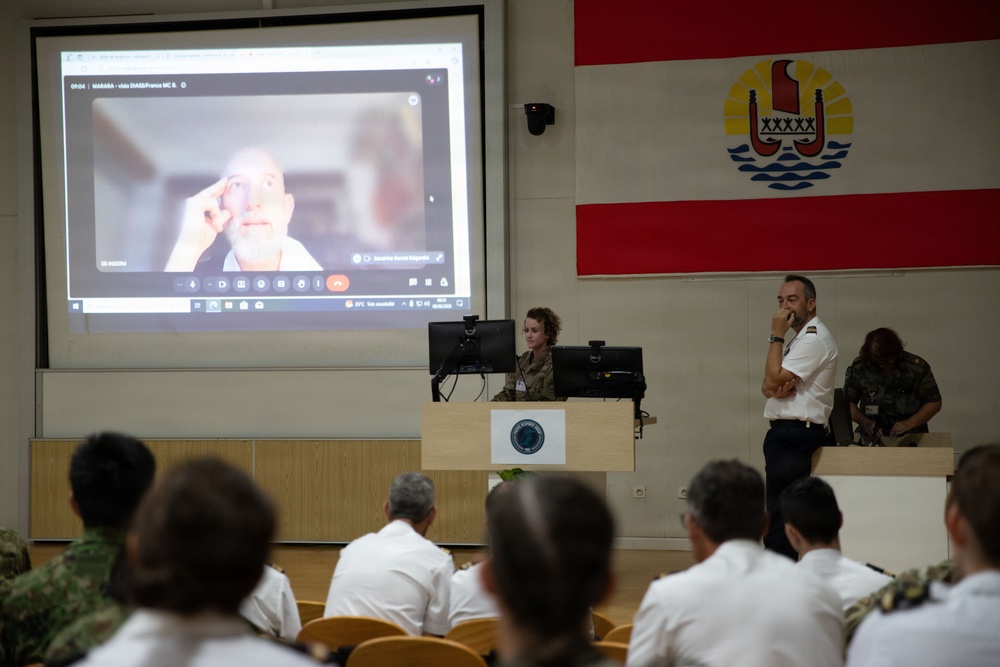
Photo By Staff Sgt. Sarah Tanwyn | A French general teaches new blood products and methods with medical professionals...... read more read more
TAHITI, French Polynesia — Nestled within Marara 26, a French-led joint, multinational training exercise focused on humanitarian assistance and disaster response (HA/DR) within the Pacific, is a medical symposium which has brought medical personnel from multiple countries together to share their knowledge.
The simulated scenario for exercise Marara 26 is a large natural disaster impacting several smaller islands in French Polynesia. The exercise allows medical professionals from the participating nations to practice coordinating assistance and response to the many areas of immediate concern caused by a large-scale natural disaster.
“We know that if we have a big problem, a big natural catastrophe or any kind of HA/DR situation, we will not be able to do it alone, and probably all our allies in the Pacific- big allies and also the independent countries that are just around us, probably will come to help us,” the French Senior Flight Surgeon in Tahiti explained regarding the importance of including a multinational medical symposium in the exercise. “If there is any kind of problem within the Pacific, we have a way, we have means and forces who are trained for this so we could also help our allies and all the countries.”
During this medical symposium, medical professionals from the United States Armed Forces, French Armed Forces, Canadian Armed Forces, Pacific Response Group and Japanese Self-Defense Force made presentations and shared information on their medical processes and capabilities. They shared advances in medical transportation, blood products, and operational organization to align methodologies across the different forces.
Col. Anna Grodecki, the Navy Surgeon, or medical advisor, to the Royal Canadian Navy, agrees that there are immense benefits to being able to connect and learn from partner nations.
“When we are here in person talking about our individual challenges, we can talk about the less sanitized challenges, which are so very important for us, for the medical support people to learn from each other (and from) some of the misses that happen. Some of the things that don’t work that perhaps Canada wanted to try, but that they didn’t work for this country or that country and why, so we can already slightly adjust some things,” said Colonel Anna Grodecki.
“For me, this is one of the key things because we are here with so many different nations which have very different kinds of militaries. I mean, in Canada and the U.S., we think of each other as being very similar, but just the scale of our militaries is tremendously different. And yet, the challenges are not that dissimilar, so we are all kind of working towards the same goal for our own personnel to be able to support them whether it’s at home, or whether it’s far forward.”
Amongst allies in agreement, Lt. Col. Stephanie Grotzke, a physician from the functional specialty section of the 322nd Civil Affairs Brigade, further reinforced the multilateral commitment to people and partnerships.
“We are increasing our interoperability between our partner forces. What we are learning is how we can be able to work together as a cohesive force, with a multinational, multilateral approach for a common cause,” said Grotzke. “Whether it’s a cyclone here versus a cyclone in Hawaii or the Aleutian Isles, it’s the same thing. So what we can gain from this exercise is how we can intermesh. And if we can’t intermesh, what are we able to do to improve?”
While the cyclone in the scenario for Exercise Marara 26 is fictional, it is meant to prompt all participating forces to evaluate their skills and learn from each other. In sharing successes and lessons from previous exercises, this event helps solidify the collaborative processes needed to react effectively to a medical crisis in a complex world.
| Date Taken: | 12.31.1969 |
| Date Posted: | 06.11.2026 14:09 |
| Story ID: | 567402 |
| Location: | PF |
| Web Views: | 23 |
| Downloads: | 0 |

This work, Increasing Interoperability in Medical Care During Marara 26, by SSG Sarah Tanwyn, identified by DVIDS, must comply with the restrictions shown on https://www.dvidshub.net/about/copyright.


No keywords found.





