
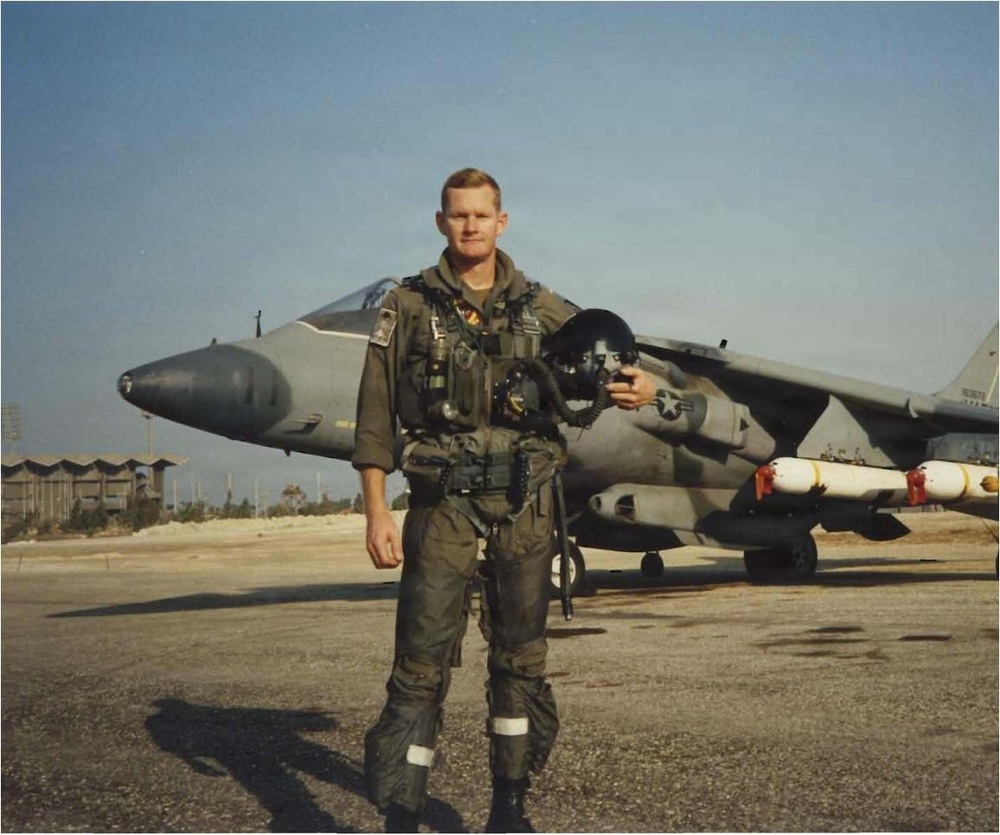
Photo By Tim Gantner | USMC Capt. Kevin Gross, who flew 44 combat missions during Desert Storm 1990-1991,...... read more read more
Kevin Gross has dedicated more than 40 years to serving his country in and out of uniform.
His career has taken him from the cockpit of a Harrier jet in combat to leading Osprey testing to a civilian leadership role where he continues to find new ways to keep American warfighters safe. “It's been a fabulous journey, and I don't know where the time went,” Gross said.
But he does know where it started.
“In seventh grade, I knew I wanted to fly and pursue a career in aviation,” Gross recalled. “It's all I ever wanted to do.”
The path was set early. His father worked for the airlines and his mother was a travel agent, exposing him to the world of aviation from a young age. On May 25, 1985, Gross’s dream materialized into a commission as a second lieutenant in the Marine Corps with a flight school contract. One week later, on June 1, he married Shari, his college sweetheart, starting his career with her by his side.
His journey began in earnest at China Lake in November 1988. There, the new lieutenant learned three critical survival skills: reading enemy radar warning indications; deploying chaff and flare countermeasures; and executing low-altitude runs. Two years later, those lessons would save his life over Kuwait.
Trial by fire: Desert Storm
Gross deployed to Saudi Arabia in August 1990. When the air war began, his first mission was on the second day. On the eve of the land war, he received orders to carry the CBU-72, a fuel-air explosive developed at China Lake. There was no manual, only flight clearances typed in all caps on a naval message.
“I was the first AV-8B Harrier pilot to drop fuel-air explosive in Desert Storm,” Gross explained. He flew 200 feet above the ground, accelerating to 580 knots before releasing the bombs. “Pickle pause, pickle pause, pickle pause to get all four bombs off,” he remembered. “The most scared I've ever been.” For 30 seconds, he flew straight and level, a sitting duck for any Iraqi soldier with a rocket-propelled grenade. The explosive cleared the trench line, opening the path for Marines to cross into Kuwait the next day.
The war also brought every squadron commander's nightmare. On Feb. 27, 1991, Capt. Craig Berryman, a wingman and friend, was shot down over enemy territory. Gross, as the squadron safety officer, had to release the mishap report.
Later, he was sent to Kuwait to find the aircraft.
On March 5, 1991, Gross gripped the CH-53's door frame, scanning the desert. Then something caught his eye: two Harrier hot nozzles sticking up from the sand.
They landed beside twisted metal and scorched sand. Everything behind the speed brake vanished. A missile tore the aircraft apart. He sketched each piece of twisted metal, documenting every detail that told the story of his friend’s final moments.
Gross returned to base having confirmed the wreckage was Berryman’s, and requested recovery of remains.
And then came news that changed everything: The Red Cross had announced Berryman was alive. A prisoner of war for 37 days.
"The emotions were so strong, I broke down and cried," Gross said.
Innovator and instructor
After Desert Storm, Gross stayed with VMA-311 to teach the next generation of aviators. He became a weapons tactics instructor and attended the prestigious Naval Test Pilot School, graduating in 1995. His next assignment was the V-22 Osprey Integrated Test Team at Patuxent River, Maryland. As the only fixed-wing pilot among helicopter test pilots, his fresh perspective proved invaluable. He reconfigured the flight path vector on the primary flight display, a critical innovation that made night and low-visibility landings safer and saved lives in Iraq and Afghanistan.
This innovation saved lives during night and low-visibility landings.
From 1995 to 1999, Gross pushed himself beyond normal limits. "I was flying helicopters with HX-21 ‘Blackjacks.’ I was flying the V-22. And I was flying Hornets with VX-23 ‘Salty Dogs.’” He flew Aircraft Three, the third V-22 ever built, and ferried Osprey 8 from the Bell Production Plant in Texas, both of which are now museum pieces preserving the history of the tilt-rotor platform Gross shepherded.
He returned to the V-22 in August 2002 as Government Flight Test Director. He led a team of 450 engineers and Marines and seven instrumented aircraft through white-knuckle developmental testing. His leadership earned him the Marine Corps Aviation Association James Maguire Award in 2003.
In June 2006, Gross returned to the same desert base where he'd learned to survive 18 years earlier, this time commanding the Marines at China Lake.
His final active-duty tour brought him to the Pentagon as senior military adviser to the Director, Operational Test and Evaluation. There, he helped prepare Leon Panetta for his Senate confirmation as secretary of defense, guiding him through 340 major defense acquisition programs.
Near the end of his Pentagon tour, Gross found himself standing outside a Pentagon office. Hanging there was a World War II poster. A soldier gripping a hand grenade ready to throw, thinking "I hope this works."
The thought terrified him. And motivated him.
"I don't ever want that thought to be in the mind of warfighters," Gross said. "Where they have to worry about a weapon system that doesn't work."
Civilian service: A new mission at an old post
In August 2011, Gross retired from active duty. While his peers stayed inside the Beltway, Gross chose to return to his true north: Naval Air Warfare Center Weapons Division. “I wanted to come back to this mission,” he said.
He returned as a civilian, first joining the Joint Electronic Advanced Technology team. In 2014, he moved to the Threat Target Systems Department, eventually taking his current role as TTSD’s director. In this role, Gross doesn't build weapons; he builds readiness.
Forging a new standard in safety
His team launches targets that train America's defenders: supersonic GQM-163A Coyote targets zoom by at Mach 2.5, at 15 feet above the waves. They also launch BQM-34S Firebee and BQM-177As, which mimic anti-ship cruise missiles. Additionally, high-speed boats are used to simulate enemy attack craft.
But launching targets was only half the mission. Making operations safer became his signature achievement.
In 2013, a BQM-74 target drone launched from Point Mugu lost control. It struck USS Chancellorsville (CG 62), punching a hole in the side of the ship.
Luckily, no one was seriously injured, but it highlighted a safety gap that needed closing – and fast.
Vice Admiral David Dunaway, then-commander of Naval Air Systems Command, made his expectations clear during the Safety Investigation Board briefing: "I want to see the NATOPS program for target operations."
Naval Air Training and Operating Procedures Standardization saved countless lives in manned aviation since 1961. But target operations had no equivalent standard. Different ranges. Different procedures. Different training.
Gross led the charge in correcting that gap.
“We identified and refined the best attributes of the NATOPS program, tailoring it to our target community,” he said. The result was Target Training Operating Procedure Standardization, or T-TOPS. “I'm very proud of the program.”
The foundation and the future
Throughout his career, Gross has carried three simple principles: Know your stuff, take care of people, and be a person of character. He credits his wife, Shari, as the anchor for their family through 13 moves and countless deployments.
“I wouldn't be here today if it weren't for my wife,” Gross acknowledged. “She allowed me to focus 100% on my job.”
On June 3, 2025, the final AV-8B Harrier flew at China Lake, the aircraft that Gross mastered and flew through combat. “When they flew their last mission, there was a lot of reflection on the entire span of the Harrier for me,” he said.
But nostalgia can't interrupt the mission. Gross's career has circled back to where it all began. He trained at China Lake as a lieutenant, commanded there as a colonel, and today, his work ensures the next generation is prepared for combat. After 40 years, he remains locked on target.
“This is where we support our fleet and Marine forces before they go into battle,” Gross explained. “I love this job.”
| Date Taken: | 06.10.2026 |
| Date Posted: | 06.10.2026 11:13 |
| Story ID: | 567326 |
| Location: | POINT MUGU NAWC, CALIFORNIA, US |
| Web Views: | 555 |
| Downloads: | 0 |

This work, From Harrier pilot to civilian leader, Gross marks 40 years of service, by Kimberly Brown, identified by DVIDS, must comply with the restrictions shown on https://www.dvidshub.net/about/copyright.


No keywords found.





