
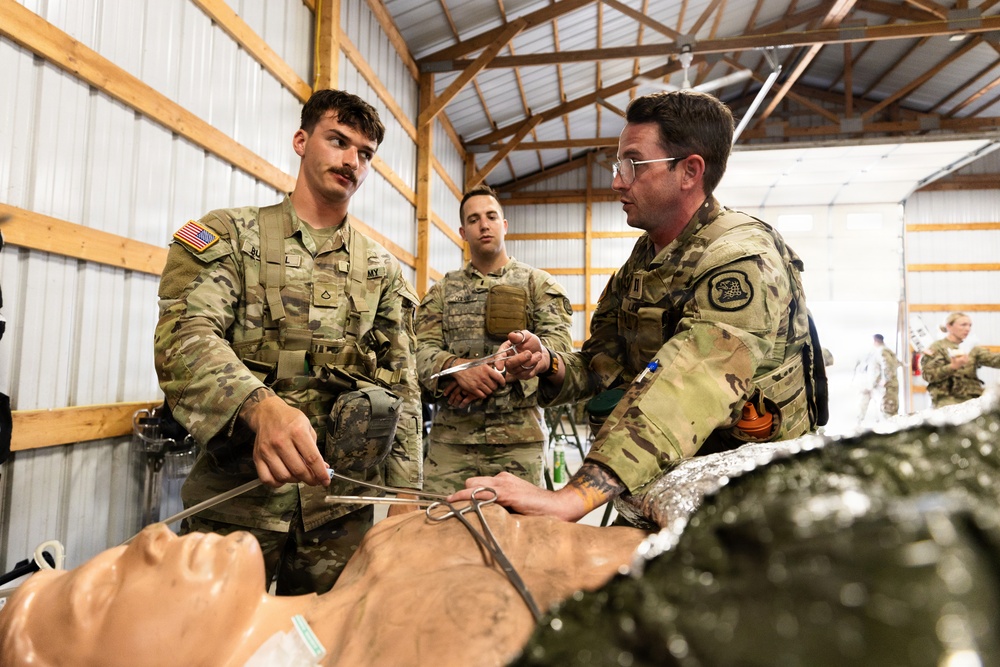
Photo By Staff Sgt. Rachel White | Iowa Army National Guard Capt. David Lane, medical provider, and Pfc. Nicholas...... read more read more
 Subscribe
With just two hours of sleep and in the sweltering heat of June in Iowa, Sgt. Griffin Vesley moved quickly toward an ambulance full of simulated casualties as fellow medics prepared the mobile treatment area. Patient one suffered a blast injury resulting in a leg fracture. The next suffered an abdominal evisceration, where organs were protruding from the midsection. The third carried shrapnel wounds on their rear end. The mass-casualty scenario was one of dozens played out during the Hawkeye River Run, a two-week long, statewide medical training exercise designed to prepare Iowa Army National Guard medics for large-scale combat operations. Soldiers assigned to 109th Multifunctional Medical Battalion, 67th Troop Command, Iowa National Guard conducted triage operations, stabilized and evacuated simulated casualties, and established mobile treatment areas while operating alongside local emergency medical and fire service partners from the Solon, Grundy Center, Marshalltown and Johnston areas. Soldiers serving as role players in the exercise were prepared with seemingly-realistic injuries to challenge the combat medics. Chemical, biological, radiological and nuclear teams as well as explosive ordnance disposal teams were dispatched to various locations to train medics on different scenarios they might face in a large-scale conflict. One of the challenges the 209th Medical Company Area Support faced during Hawkeye River Run was the turnover in leadership and experience after their mobilization to Poland in 2022. Since returning home, many senior leaders have rotated out of the unit or organization, leaving newer soldiers to learn those responsibilities. “It was awesome to see the growth in our junior soldiers that are learning and even in leadership roles that they don't necessarily know,” said Vesley. The exercise provided opportunities to learn and grow at every level. Junior soldiers gained hands-on experience operating with field medical equipment equipment on hundreds of patients. The unit’s new generation of leaders were able to manage the company’s medical capabilities and oversee personnel. “This training has been great to enhance readiness,” said 209th MCAS commander Maj. Jonathan Bluemke, “a lot of this unit is a younger fighting force and we were able to introduce them to the concept of our layout of our role two and introduce them to how we can be flexible as we continue to move across the battlefield.” Army medical units are organized into roles with increasing treatment capabilities, ranging from immediate battlefield care to hospital-level treatment. “Whenever we’re needed, we go out and we provide medical support to all the troops in whatever area that we’re designated to be used,” said Vesley. By integrating with local EMS agencies, fire departments and nursing students, Iowa Army National Guard medical personnel strengthened relationships, improved communication and gained a better understanding of each organization's capabilities. “Getting nursing students involved to see what the Army is,” said 1st Sgt. Amanda McCrary, noncommissioned officer in charge of the 209th MCAS, “telling our story and that we are real people, we have jobs in the civilian side and we’re just supporting our country overall.” As a federally overseen component of the U.S. Army, the Iowa Army National Guard is dedicated to serving not just the whole nation, but the whole of the state of Iowa and its citizens. Building relationships with civilian emergency services forges a stronger state. “When natural disaster strikes and we get called up to go and assist, it’s very important that we have those relationships so that way we know and they know what to expect when working together when that happens,” said Vesely. In a large-scale combat situation, Army medical professionals may be required to treat while operating in contaminated areas caused by chemical, biological, radiological, and nuclear attacks. “One of the things that we haven’t practiced a whole lot is our CBRN stuff,” said Vesely. “We talked about it, but we've been able to get really good training.” In midwestern fashion, role players were exposed to a simulated pesticide in a scenario where a crop duster released chemicals over civilians working in a cornfield. Medics with the 209th MCAS trained alongside firefighters in Grundy to treat the contaminated patients. “When we work together it is very good,” said Spc. Keider Gomez, a CBRN specialist, “sometimes civilians have better equipment than us.” Through realistic medical scenarios, community partnerships and specialized CBRN training, Hawkeye River Run challenged Soldiers to adapt, learn and lead. For many junior Soldiers and new leaders, the exercise served as their first opportunity to operate the unit's medical capabilities in a field environment which built confidence and experience needed for future missions at home and abroad. (U.S. Army National Guard story by Matthew F. Tudor)
| Date Taken: | 06.07.2026 |
| Date Posted: | 06.08.2026 15:25 |
| Story ID: | 567139 |
| Location: | JOHNSTON, IOWA, US |
| Web Views: | 270 |
| Downloads: | 1 |

This work, Iowa Army National Guard medical units participate in statewide training exercise, by SGT Matthew Tudor, identified by DVIDS, must comply with the restrictions shown on https://www.dvidshub.net/about/copyright.


No keywords found.




