
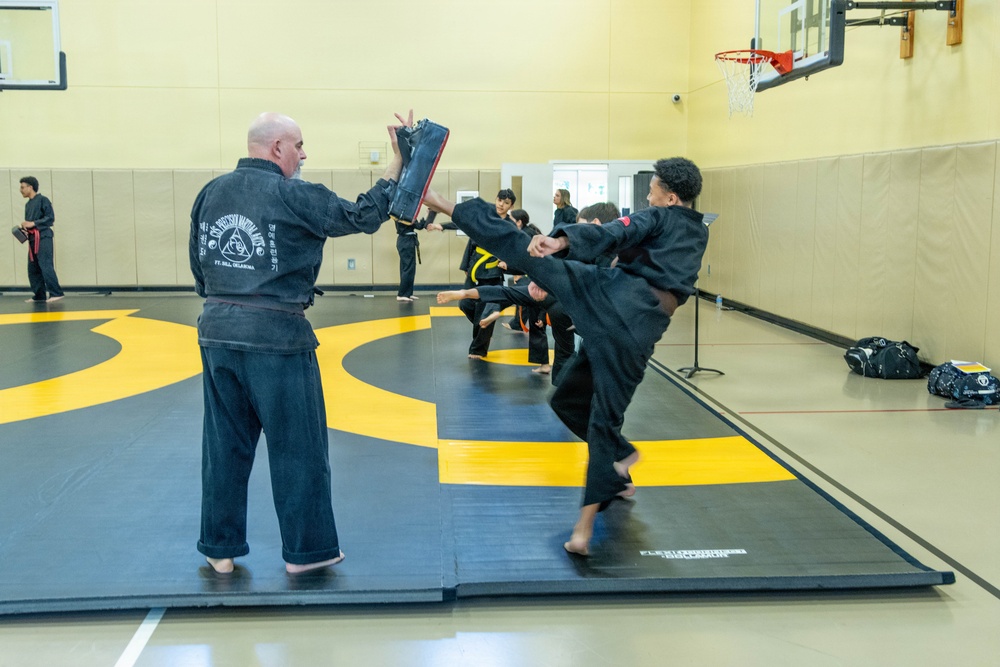
Photo By Chris Gardner | Sprague Taveau V, director of Logistics Readiness Center Sill and volunteer Taekwondo...... read more read more
 Subscribe
FORT SILL, Okla. — On a padded mat inside Flores Hall Youth Center, a student throws a kick into a striking pad while others stretch, spar and practice forms nearby. Before every drill, there is instruction. After every match, there is a bow.
For the children in Fort Sill’s Child and Youth Services Taekwondo program, the lessons are physical, but the purpose reaches far beyond the mat.
The twice-weekly class teaches children ages 8-18 how to kick, block, spar and defend themselves. It also teaches them how to listen, lead, show respect, recover from mistakes and keep going when something is hard.
The program recently reached a milestone when 14-year-old Cordelia Aitkins became the first student to earn a black belt through the Fort Sill CYS Taekwondo program. For her instructors, the achievement is proof that the program is doing what it was designed to do: help children grow.
Behind the class are three volunteers who bring decades of service, martial arts experience and a shared commitment to Fort Sill families.
The class is taught by H. Sprague Taveau V, director of Logistics Readiness Center Sill and a retired Army lieutenant colonel, with help from volunteer instructors Christin Major, a C-sUAS operator lifecycle program manager for the Fires Center of Excellence Transformation Integration Directorate, and Dr. Darrel Spencer, a dentist on post and Army Reserve major who has volunteered with the program for 3 1/2 years.
For Taveau, who has volunteered as a coach, scoutmaster and cubmaster for decades, teaching Taekwondo is another way to invest in the next generation.
“I volunteer in these capacities as I believe that we have a responsibility to pass what we know on to the next generation,” Taveau said. “This includes not only the skills we have, but also the values we hold.”
The program began after Taveau arrived at Fort Sill in August 2019. He asked then-acting Directorate of Family and Morale, Welfare and Recreation Director Lisa Jansen-Reese whether the installation had a martial arts program for children. When he learned it did not, he asked if she wanted one.
Jansen-Reese connected him with Kelsee Mullins, then the director of youth sports, who helped establish an initial one-week camp and later secured the space and equipment needed to make the class a year-round program.
Today, with the support of Family and MWR, led by Director Sarah Gersper, and the CYS team, the class gives Fort Sill children an affordable opportunity to stay active while learning the structure of martial arts.
The class meets twice a week for 90 minutes. Students begin with 15 to 30 minutes of stretching before rotating through warmups that may include an eight-minute run, plyometrics or station-based exercises. The remainder of class focuses on hand techniques, kicks, formal marching, sparring, forms, combat grappling and self-defense skills.
Taekwondo, a Korean martial art known for powerful kicks, hand techniques and formal patterns of movement, has grown into a sport practiced around the world. But inside Flores Hall Youth Center, Taveau said the focus is not only on physical technique.
“Taekwondo is as much a lifestyle and set of morals as it is a sport,” Taveau said.
Taveau holds a fourth-degree black belt in Moo Duk Kwan Taekwondo and took his master’s test in December 2023. He began studying Taekwondo in 1985 at age 19, but as an Army brat and Soldier, he said he was rarely in one place long enough to earn a black belt. He eventually earned his black belt after retiring from the Army in 2010.
Over the years, he has studied Karate, Jujitsu and Taekwondo under multiple instructors and incorporates techniques from those styles into the Fort Sill class.
“Martial arts has added discipline and a sense of instant belonging wherever I have gone,” Taveau said.
That sense of belonging is one reason he believes the program is especially valuable for military children. Students who move to another installation may find another martial arts class, another mat and another community where they understand the structure and expectations.
“Taekwondo, and martial arts in general, gives kids a ready pool of friends no matter where they go,” Taveau said. The program is built around gradual progression. Students begin with basic stances, blocks and punches before moving into more advanced kicks, forms, sparring, grappling and self-defense techniques. As they advance, they also begin helping teach newer students.
Taveau said that step-by-step approach is important because students need to master fundamentals before attempting more difficult movements. He uses the side kick as an example. A student may begin with a basic side kick before eventually progressing to a double side kick, reverse side kick, jump side kick, flying side kick and other advanced variations.
The structure allows students to build confidence while giving their bodies time to develop the strength, coordination and control needed for more complex techniques.
Major said that growth is one of the most rewarding parts of volunteering with the class.
“At first, many are shy or hesitant, but as they learn basic techniques and forms, you start to see their posture improve and their eyes light up, especially when they get it right after struggling,” Major said. “Belt advancements aren’t just about getting a new color of fabric, they’re visible milestones of internal growth.”
Major began training in Taekwondo at age 9 and earned her first-degree black belt after five years of consistent training. She competed at local, regional and state levels and said the sport became one of the most positive and transformative forces in her life.
“It taught me self-control, resilience, goal-setting and the importance of pushing through discomfort,” Major said.
After stepping away from competition, Major said Taekwondo remained part of who she was. When she mentioned to Taveau that she was thinking about getting back into Taekwondo or another martial art, he told her the Fort Sill program was looking for volunteers.
His commitment to giving back to military families inspired her to help.
“As a Department of the Army civilian who works with Soldiers every day, I’ve gained a clear understanding of the unique challenges military families face, like frequent moves, deployments and the everyday stresses that come with Army life,” Major said. “I wanted to support those children by offering them something consistent and positive.”
Major said the program helps children grow physically, mentally and socially.
Physically, students build strength, balance, coordination and endurance. Mentally, they learn focus, perseverance and how to work toward long-term goals. Socially, they learn respect, self-control, teamwork and good sportsmanship.
“Taekwondo is way more than just kicks and punches,” Major said. “It helps shape healthier, tougher, more respectful kids who carry those benefits into school, friendships and life.”
Those lessons are built into the expectations of the class. Students bow to instructors as a sign of respect for their knowledge and accomplishments. Instructors bow to stu,dents to show respect for their willingness to learn. Students also bow after sparring a reminder that competition and respect can exist in the same moment.
Taveau said students are taught that Taekwondo is for self-defense only, and he makes that clear from the beginning.
“You have already lost if you have to fight,” Taveau said.
He said two of the most important lessons students learn are awareness and treating others the way they want to be treated.
“With these two principles, you can solve 99.9% of life’s problems,” Taveau said. “Taekwondo is for that last .1%.”
Cordelia’s black belt shows what that progression can look like over time.
Cordelia, an eighth-grade student at Central Middle School, began Taekwondo when she was 11. She said earning her black belt felt meaningful because she stayed with something difficult and did not give up.
“It felt really great,” Cordelia said. “It felt great because I stuck to something and actually was able to get it and didn’t give up.”
Taveau said earning a black belt in the program takes three to five years, depending on a student’s natural ability, effort and time spent practicing both in class and at home.
“We promote to standard, not to time,” Taveau said.
For the program, Cordelia’s achievement shows other students that the goal is possible. For Cordelia, he said, it represents something even bigger.
“For the school, it is a milestone,” Taveau said. “For Cordelia, it is a beginning.”
When Cordelia started, Taveau said, she was timid. She struggled with exercises and lacked confidence. At first, she could barely complete the eight-minute run and could do fewer than 10 pushups.
Now, he said, she can do 50 pushups, leads the run and helps instruct students at every skill level.
“She has gone from not wanting to be in front of the class doing much of anything to being able to run the class on her own,” Taveau said.
Cordelia said the hardest part was practicing and sticking with the class, especially when she did not always feel like attending. She also had to learn patience, particularly as she began helping younger students.
“I had to learn to be patient and slow down with the younger kids as they learned, which has definitely helped a lot outside of the class,” Cordelia said.
For Cordelia, earning a black belt was about more than demonstrating techniques. It represented leadership, dedication, perseverance, respect, hard work and the confidence she built along the way. She said the class has changed how she looks at challenges and helped her overcome failure.
“With being able to overcome any failure I may have had and by helping me physically, my confidence has definitely grown since I started the class,” Cordelia said.
She said what helped her most was the support of her instructors and classmates.
“What I liked the best was the instructors and the students,” Cordelia said. “Having friends with me as I stayed in the class helped me continue actually wanting to come when I just really didn’t.”
For new students who may feel nervous, Cordelia’s advice is simple.
“Just breathe and you got this,” she said. “The class can be a lot and it can start out quick, but you’ll get the hang of it eventually. Just be patient and don’t give up.”
Taveau said the class is designed to be accessible for Fort Sill families. The cost is $85 for the first three months, which includes the class and required sparring gear, except a cup for boys. Each additional three-month period costs $35.
CYS pays for one tournament each year, generally in the spring, as well as belts and other required class materials, such as wood for breaking. There are no additional costs for parents unless they choose to have their child attend extra tournaments.
For Taveau and the other volunteer instructors, the program’s success is not measured only by belts. It is measured in students who stand taller, speak with more confidence, encourage their classmates and learn to keep trying after they fail.
Cordelia’s black belt may be the program’s first, but Taveau said it is not the finish line. It is a beginning — for her, for the students watching her and for a Fort Sill program built to help children grow one class, one belt and one lesson at a time.
For more Fort Sill Taekwondo photos follow the link, https://flic.kr/s/aHBqjCW4Qj
| Date Taken: | 06.08.2026 |
| Date Posted: | 06.08.2026 11:22 |
| Story ID: | 567126 |
| Location: | FORT SILL, OKLAHOMA, US |
| Hometown: | LAWTON, OKLAHOMA, US |
| Web Views: | 165 |
| Downloads: | 0 |

This work, Fort Sill youth Taekwondo class builds confidence, discipline and community, by Chris Gardner, identified by DVIDS, must comply with the restrictions shown on https://www.dvidshub.net/about/copyright.


No keywords found.




