
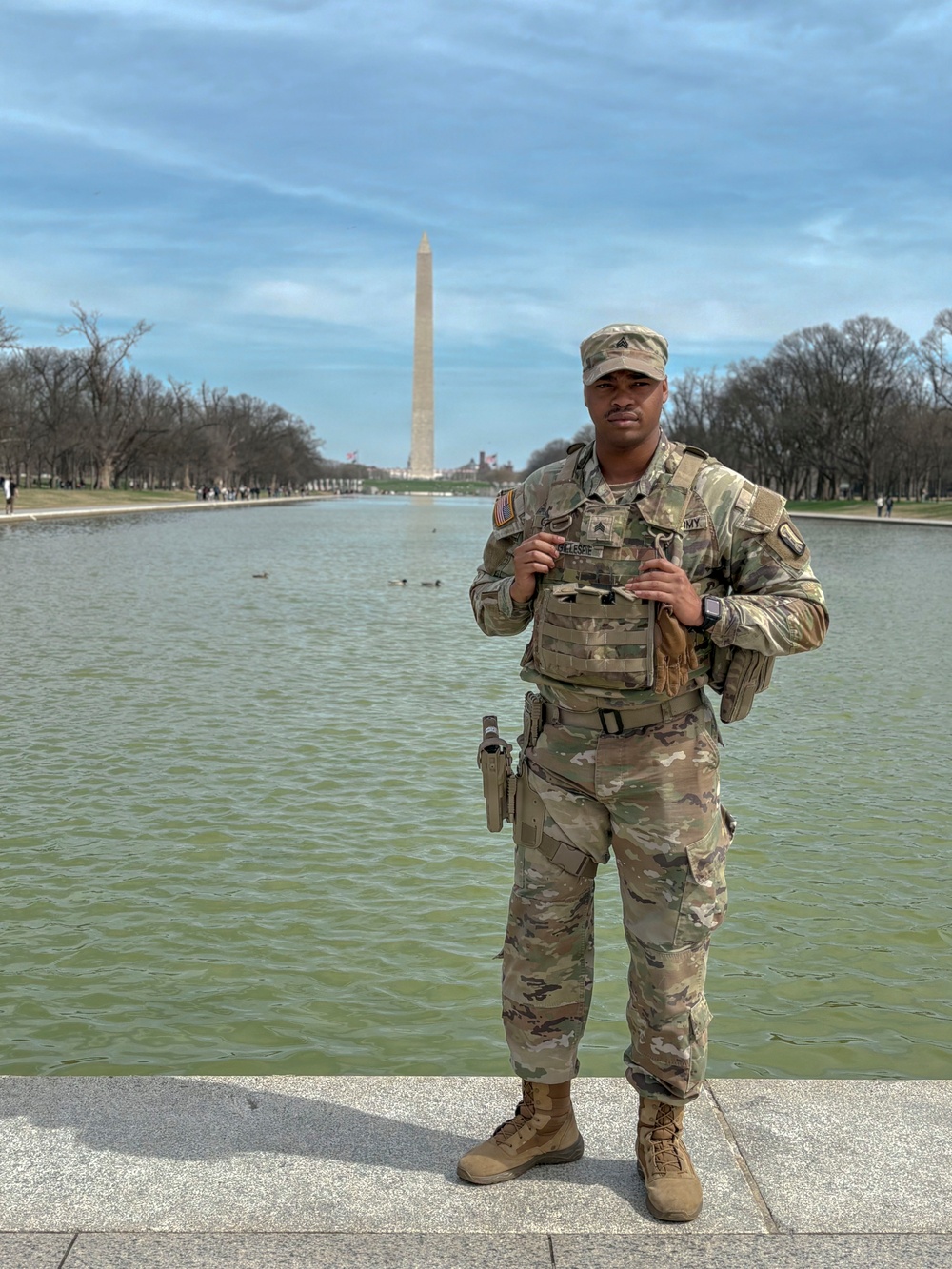
Photo By Sgt. Sherald McAulay | A man sat on the ledge of Arlington Memorial Bridge, his feet dangling over its edge...... read more read more
WASHINGTON – A man sat on the ledge of Arlington Memorial Bridge, his feet dangling over its edge when U.S. Army Sgt. Jordan Gillespie, a Crisis Intervention Training-certified personnel and Soldier with the Mississippi National Guard sat by him and began a conversation that ultimately helped bring him to safety on May 30, 2026.
This was one the first of two similar interventions Gillespie would make that day.
"The situation developed very quickly," said 1st Lt. William Fondren, platoon leader with the 223rd Engineering Company, Georgia National Guard. "A civilian approached us and alerted us to an individual on Arlington Memorial Bridge who appeared to be in distress. I immediately gathered two Soldiers, including Sgt. Gillespie, because I knew he served as a police officer in his civilian career….Sgt. Gillespie confirmed that he had received crisis intervention training, which gave me confidence that we had the right personnel to help de-escalate the situation.”
As Soldiers approached the bridge, they observed a man sitting on the ledge, visibly upset and crying.
“Do you mind if I approach?” Gillespie asked.
Moments into the conversation, Gillespie learned the man was a college student who felt overwhelmed after experiencing setbacks in school.
“People hear people, but they're not listening,” Gillespie said. “In situations like this, dealing with mental health, you want to be able to listen. They want somebody to listen to them… dealing with the situation, you have to be ready because it's a scary situation, but my training has allowed me to be prepared for situations like that.”
After talking with the individual, Gillespie helped convince him to step away from the ledge. U.S. Park Police and emergency medical personnel later arrived and assumed care.
Gillespie is a Cavalry Scout in the Mississippi National Guard and a squad leader. In his civilian life, he’s a police officer and is pursuing a degree in psychology at Mississippi State University, a father and family man.
Beyond his military and law enforcement service, Gillespie has spent seven years coaching youth football in his hometown.
"It's all about giving back to the kids," Gillespie said. "It's not just about football because we not only coach them football, but we also teach them how to become young men.”
Gillespie's motivation comes from helping others and setting an example for his family. Across all roles -- Soldier, police officer, coach, and student; empathy, listening, and community support are consistent as a major parts of his identity. Gillespie is a mental health advocate which stemmed from recognizing the struggles that his single mother went through when growing up. He and his sister were there to help her get through life.
“If you need somebody, ask for help, don't be afraid,” Gillespie said. “There's plenty of people out here that we'll listen to. There's plenty of people here that will help. It's okay to have a bad day. It's okay to be stressed sometimes because we all are going to be stressed. But don't hold it in. Tell somebody. Don't be afraid.”
He exemplified that willingness again later that day at the Frederick Douglas Memorial Bridge.
There, his squad encountered another man in crisis standing on the wrong side of the bridge railing. Visibly upset and crying, the man appeared overwhelmed by his circumstances. The immediate danger was the center of everyone's attention.
“Calmly, I took a deep breath," Gillespie said. "I started talking to him and shared past experiences from my life, showed him pictures of my children and talked about the reasons I fight so hard in life.”
Gillespie encouraged the man to think about the people who cared about him and the reasons he had to keep moving forward.
Eventually, the man agreed to step back to safety and was turned over to emergency responders for further care.
“As soldiers, we can play big roles in different communities,” Gillespie said. “That's our main objective, to help….That's what makes the military so beautiful. We're always willing to help because that's just how we are.”
Fondren said the incidents highlight the unique strengths National Guard Soldiers bring to their communities.
"More than anything, I believe situations like this demonstrate the unique value of the National Guard," Fondren said. "Our Soldiers bring not only their military training but also the skills and experiences they gain in their civilian professions. Incidents like this show the public that we genuinely care about the communities we serve."
When Gillespie was asked what he was most proud of after helping both men he said, "They came back over safely. They're alive."
| Date Taken: | 06.08.2026 |
| Date Posted: | 06.09.2026 16:10 |
| Story ID: | 567107 |
| Location: | WASHINGTON, DISTRICT OF COLUMBIA, US |
| Web Views: | 4,705 |
| Downloads: | 0 |

This work, How a Soldier's Humanity Helped Two Lives, by SGT Sherald McAulay, identified by DVIDS, must comply with the restrictions shown on https://www.dvidshub.net/about/copyright.


No keywords found.





