
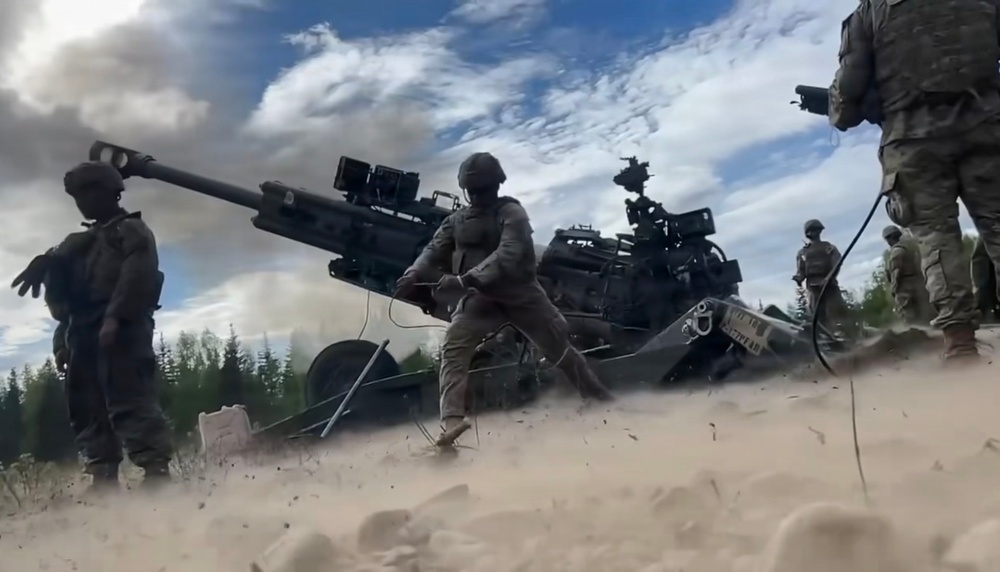
Photo By Maj. Ian Roth | Soldiers assigned to 2nd Battalion, 377th Parachute Field Artillery Regiment, 2nd...... read more read more
 Subscribe
For the first time since 1991, 105mm artillery rounds—and for the first time ever, 155mm rounds—were fired in the spring at Richardson Training Area (RTA) on Joint Base Elmendorf-Richardson, marking a historic milestone for Army artillery training in Alaska.
On June 1-2, 2026, Soldiers from 2nd Battalion, 377th Parachute Field Artillery Regiment (2-377 PFAR) conducted four successful Artillery Table VI live fire qualifications, firing a total of 36 rounds each of 105mm and 155mm ammunition. The event was made possible by the recently approved Proposed Mortar and Artillery Training (PMART) Record of Decision, which now allows year-round indirect fire training in the RTA—lifting decades-old restrictions that previously limited such training to the winter months to protect the Cook Inlet beluga whale habitat.
“Being able to train with live artillery outside the winter months gives our howitzer crews and our fellow infantry battalion mortar crews the ability to maintain live fire proficiency at home station, while limiting wear and tear on vehicles conducting multiple trips throughout the year into the Alaskan interior to maintain crew qualifications,” said Lt. Col. Ian Grundhauser, commander of 2-377 PFAR.
All rounds were observed safe within the Eagle River Flats Impact Area and the designated safety boxes, which were developed in close coordination with RTA Range Control. The safety boxes, while restrictive, enabled the unit to focus on point targets and required strict adherence to the Five Requirements for Accurate Predicted Fire.
"Our team took special care to ensure the accuracy of each round we fired," Grundhauser explained. “With the smaller safety boxes in the Eagle River Flats Impact Area, there's no room for error. We emphasized strict adherence to meeting the Five Requirements for Accurate Predicted Fire, using multiple redundant checks for every datapoint."
Environmental protection was integral to the operation. “We had dedicated teams on the ground at multiple observation posts to ensure our training didn't impact the wildlife in the Cook Inlet," said Grundhauser.
The battalion’s after-action review highlighted several best practices, including early coordination with Range Control, redundant meteorological data checks, and proactive wildfire mitigation planning. Grundhauser noted, "We recommend other units start their planning early and work closely with Range Control to ensure all environmental safeguards are in place to enable a safe and effective training event.”
Looking ahead, 2-377 PFAR is eager to share lessons learned and support other units in leveraging the new year-round training capability. “This is about building readiness across the division," Grundhauser said. "We're grateful to the 11th Airborne Division G3, TSA-AK, and the JBER team for making this possible. The ability to conduct year-round mortar and artillery live fire in the RTA will pay dividends for years to come."
| Date Taken: | 06.03.2026 |
| Date Posted: | 06.04.2026 16:07 |
| Story ID: | 566797 |
| Location: | ALASKA, US |
| Web Views: | 11 |
| Downloads: | 0 |

This work, Historic Artillery Live Fire Marks New Era at Richardson Training Area, by MAJ Ian Roth, identified by DVIDS, must comply with the restrictions shown on https://www.dvidshub.net/about/copyright.


No keywords found.




