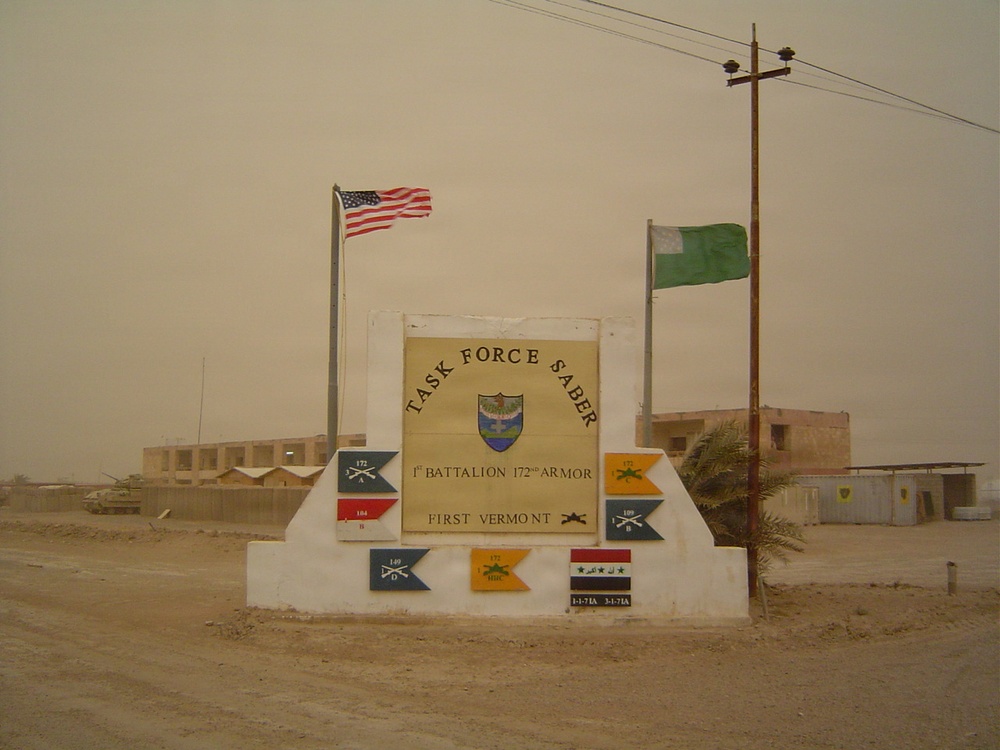
Photo By Sgt. Denis Nunez | Camp Ramadi, home to Task Force Saber, in Ramadi, Iraq, September 21, 2005. Vermont National Guard Soldiers, veterans and families continue to honor the legacy of Task Force Saber and remember the men who never returned home. (U.S. Army National Guard photo by SFC James Greene.) see less
| View Image Page
Remembering Ramadi: Vermont National Guard Honors the Legacy of Task Force Saber
Twenty years later, the memories remain vivid about Saber Land.
The dust-choked streets of Ramadi. The relentless heat. The sound of radio traffic crackling through armored vehicles. The uncertainty that accompanied every patrol beyond the wire.
For the Soldiers of Vermont National Guard's Task Force Saber, operating in the Tameem District of Iraq, that deployment to Ramadi from 2005 to 2006 was more than a combat mission. It was a defining chapter in Vermont military history, marked by extraordinary courage, sacrifice and an unbreakable bond forged under fire.
Retired Major General Gregory Knight, served as a battle captain at the time and became the Adjutant General for the Vermont National Guard. He recalls the bravery of the Soldiers he served with.
“Every day they put on their gear and they went out. No hesitation. Not that they would display. Those are just phenomenal people.” said (Ret.) Maj. Gen. Gregory Knight, “Where do we find people like that? That, to me, is probably the most humbling aspect of this.”
Today, Vermont National Guard Soldiers, veterans and families continue to honor the legacy of Task Force Saber and remember the men who never returned home.
Task Force Saber deployed during one of the most violent periods of the Iraq War. Operating in Al Anbar Province, the unit was assigned to Ramadi, a city that had become one of the most dangerous battlegrounds in Iraq. Coalition forces faced a determined insurgency, frequent improvised explosive device attacks and near-daily engagements with enemy forces.
“Everyone Googles, you know, what’s Ramadi like? And I think George W. Bush had just recently said that it was the deadliest city in the world. So that added at least some pucker factor.” said 1st. Sergeant Max Rooney, U.S. Army Mountain Warfare School.
In Ramadi, Rooney was an infantry team leader having been attached to B. Company, 109th Infantry Regiment out of the Pennsylvania National Guard, later also serving with A. Company, Black Platoon. Now he is the 1st. Sergeant at the prestigious U.S. Army Mountain Warfare School in Jericho, Vermont.
Despite the dangers, Vermont's Soldiers carried out their mission with professionalism and resolve. They conducted combat patrols, convoy security operations, force protection missions and partnered with Iraqi security forces while helping establish stability in a region consumed by violence.
“I’m telling you, you’re going to get blown up. One way or another, you’re going to get blown up.” said Lt. Col. Scott Mathewson, Commander of the 15th Civil Support Team.
Mathewson recalls a variety of tenuous events, the op tempo, and the demand being so high. During the deployment he was a Staff Sergeant who served as a platoon leader for A. Company, 3-172nd Infantry Regiment (Mountain), attached to the 1-172nd Armored Regiment.
“We had to substitute all that training and then go back and train at night on stuff that was actually going to make a difference and keep you alive,” said Lt. Col. Mathewson.
Their efforts came at a tremendous cost. Six Vermonters never came back from that war. Two months into theater the Vermont National Guard lost Master Sgt. Chris Chapin, from a sniper round. Chapin had requested to go train local national forces as an embed and felt great about his work.
“If you go through my pictures, you’ll see a number of pictures of him… and all this sort of stuff that I've taken,” said (Ret.) Sgt. 1st. Class Jim Greene, at the time a battle captain in the operations center. “He got permission to do the training for the Iraqi Army and police force. He was proud of his work and he was good at it.”
Among those who made the ultimate sacrifice were 1st. Lt. Mark Dooley, Sgt. Scott McLaughlin, 2nd Lt. Mark Procopio, Sgt. Joshua Johnson and Spc. Christopher Merchant.
Soldiers of the Vermont Army National Guard who served proudly with Task Force Saber during the deployment. Their deaths were felt not only within the ranks of the unit but across the entire state of Vermont.
For many Soldiers who served alongside them, the passage of time has not diminished their memory.
Their names are permanently woven into the story of Task Force Saber. Their sacrifice represents the reality of a generation of Guardsmen who answered the nation's call following the attacks of Sept. 11, 2001, and willingly placed themselves in harm's way far from home.
The deployment also marked a significant moment in the history of the Vermont National Guard. For many Soldiers, Ramadi represented their first experience in sustained combat operations. The lessons learned during that year would shape careers, leadership styles and the Guard's operational readiness for years to come.
The environment in Ramadi demanded adaptability and resilience. Soldiers routinely faced roadside bombs, indirect fire attacks and complex urban combat conditions. Yet amid the danger, they built lasting relationships with one another and demonstrated the values that have defined Vermont Soldiers for generations: duty, selfless service and personal courage.
“We went from Humvees to 113s to Bradleys.” said 1st. Sgt. Max Rooney
Col. Robert Beaudry, was a Battalion Maintenance Officer at the time. He has often reflected on the profound impact Ramadi had on those who served there. He noted that many Vermont Soldiers deployed alongside various units during the mission including Marines, fighting together in one of the war's most challenging operational environments.
“That also started a lot of team building because you’re bringing very different branches together to work together,” said Col. Robert Beaudry, Vermont National Guard USPFO “NTC was good for that — just getting us to start thinking about task organization.”
The bonds formed during the deployment remain strong today.
Task Force Saber reunions, remembrance ceremonies and informal gatherings continue to bring veterans together. For many, these events are opportunities to reconnect with fellow Soldiers who shared the experience and to ensure the stories of their fallen comrades are never forgotten.
As the years pass, remembrance takes on additional meaning. The ‘Ramadi Cross’ painted with the names of those fallen sat atop LZ Gold at the Ethan Allen Firing Range for years. This year it was taken down as it has since been replaced by an iron cross. The original has been refurbished and sealed so that it may find a new home for people to more readily see and remember at Camp Johnson, Vermont.
New generations of Vermont National Guard Soldiers have entered the ranks without firsthand knowledge of Ramadi or the sacrifices made there. Veterans of Task Force Saber recognize the importance of preserving those memories and passing them on to those who follow.
Their stories serve as a reminder that behind every deployment are families, communities and Soldiers willing to endure hardship in service to their nation.
The legacy of Task Force Saber extends beyond battlefield accomplishments. It lives on in the leaders who emerged from the deployment, the families who supported them, and the communities that welcomed them home. It lives on in the Soldiers who continue to serve and in the memories of those who made the ultimate sacrifice.
For Vermont, Ramadi remains more than a place on a map.
It is a chapter written in courage and sacrifice.
It is the story of Citizen-Soldiers who answered their nation's call during a time of war to one of the most violent cities in the world. A story of honoring those who never made it back and every member of Task Force Saber whose service ensured that freedom endured and that it may never be forgotten.

 Subscribe






