
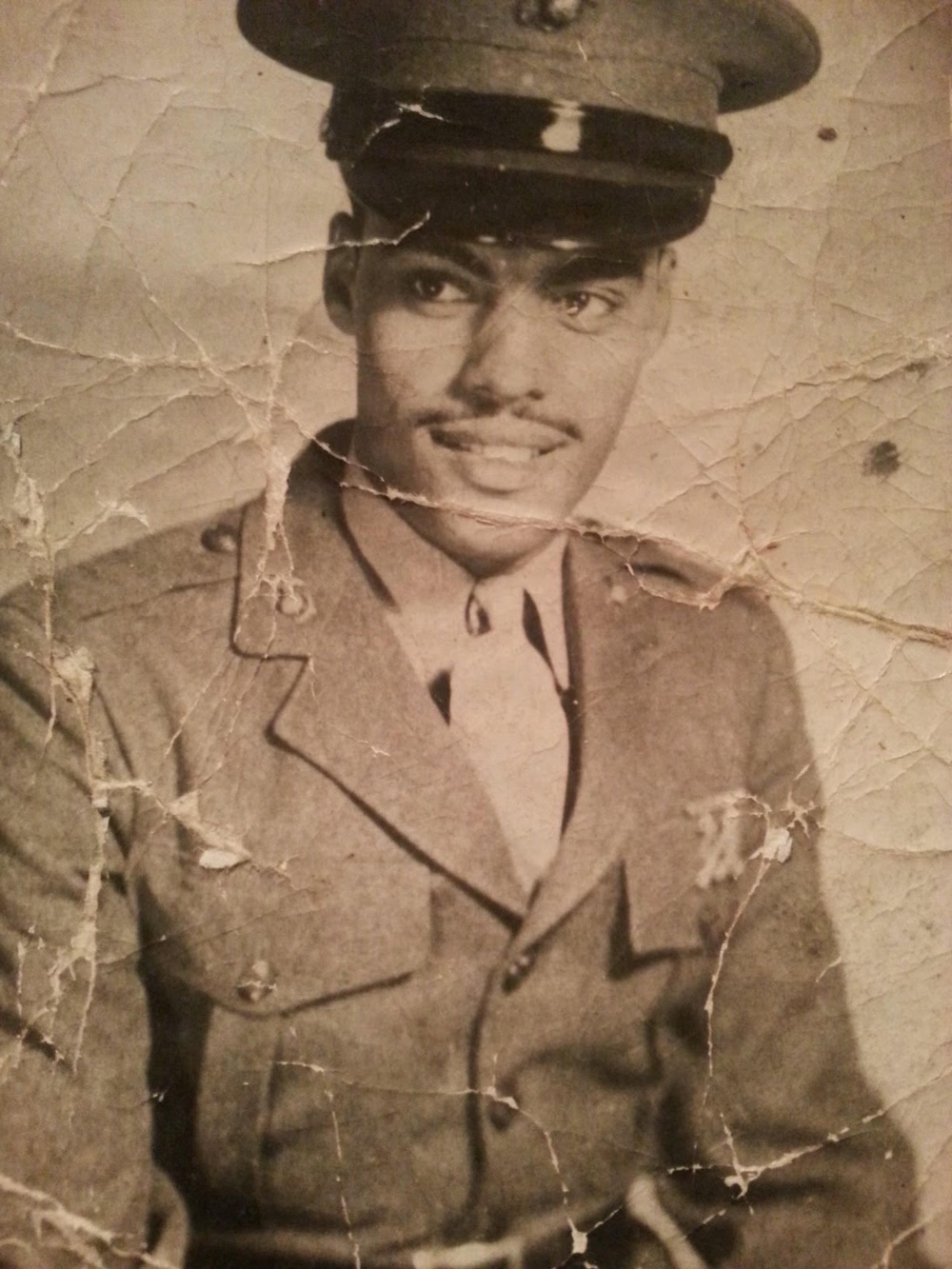
Photo By Staff Sgt. Ryanne Williams | U.S. Marine Corps Sgt. Francis Leroy Hopkins enlisted in the era of the Montford Point...... read more read more
SAN DIEGO, Calif. - Legacy is often thought of as something grand—monuments, medals, names etched into history. But more often, legacy lives in quieter places: in old photographs tucked away in boxes, in lessons passed across generations, in the unshakable belief that one person’s sacrifices can shape lives they may never meet.
For Staff Sgt. Ryan Hill, legacy began long before he ever wore the uniform.
It began with Sgt. Francis Leroy Hopkins.
Born in 1919, Hopkins was among the first African Americans to break barriers as a Montford Point Marine, training at a segregated camp during a time when even the opportunity to serve in the Marine Corps was denied to many who looked like him. A drummer by trade and a Marine by identity, Hopkins carried himself with unmistakable pride. His clothes were always crisp, sharply pressed. A Marine Corps lapel pin never left his jacket. Even years after his service, the Corps remained stitched into his identity.
But Hopkins’ true legacy was not in appearances or accolades. It was in how he treated others. His family remembers a man who always thought of his fellow man before himself—a quiet kind of leadership rooted in service, humility, and compassion.
In January 2022, decades after his passing in 1982, Hopkins was posthumously awarded the Congressional Gold Medal alongside fellow Montford Point Marines, formal recognition of a legacy his family had understood all along.
For Hill, that legacy first took shape in fragments.
At 10 years old, he watched his Uncle Kenny move through the world in uniform. Kenneth Leon Hopkins was a Gunnery Sergeant in the Marine Corps Reserve at the time but had previously served on active duty and ultimately retired as a Master Sergeant. Hill saw him in his desert camouflage utility uniform, and there was something magnetic about it. Something larger than the man himself.
“Marine blood runs deep in our family,” his uncle told him.
Later, while digging through forgotten boxes in the family garage, Hill uncovered two small Eagle, Globe, and Anchor insignias. They had belonged to his grandfather. That discovery changed everything.
Soon after, his mother showed him a photograph he had never seen before—Hopkins in his boot camp portrait, young, sharp, and unmistakably Marine. What had once been abstract suddenly became personal.
Hill joined the Young Marines, drawn toward the institution that had helped define his family. By the time he arrived at recruit training, the challenges were real, but the sense of belonging came naturally. Marine Corps values were not foreign concepts—they were already woven into the household that raised him. Whenever training tested him, Hill leaned on a simple truth:
If they can do it, I can do it.
Upon graduating boot camp, those same EGA insignias he had discovered years earlier were presented to Hill and his cousin, then Corporal Kenneth Leon Hopkins Jr. What had once been history became inheritance. But the deepest connection came later.
While attending Military Occupational Specialty school at Camp Johnson, Hill saw the sign:
Home of the Montford Point Marines.
Suddenly, every step across that base carried weight. He couldn’t help but wonder whether his grandfather had once walked that same ground more than 80 years earlier. Whether those same roads had carried the same uncertainty, ambition, and determination.
For Hill, the connection transformed something in him. The question was no longer whether he belonged. It became: How far can I go?
How could he keep beating the odds? What else was possible?
Hopkins may never have understood the full impact of his own service. To him, becoming a Marine may simply have been the path in front of him—a job, a duty, an opportunity.
But history rarely reveals its significance in the moment. What Hopkins built became a blueprint, not just for the Marine Corps, but for his son and grandsons.
Now serving as a Senior Drill Instructor at Marine Corps Recruit Depot San Diego, Staff Sgt. Hill understands the legacy from the other side.
Every cycle of recruits that steps onto the yellow footprints represents possibility. Some arrive with confidence. Others arrive with very little at all. But Hill sees potential in every one of them.
“A lot of the recruits come from nothing,” Hill said. “And I know I have the power to help them become something more. And maybe everything I teach them can be passed on to their children and through the next generations as it was to me.”
That is how legacy survives. Not in medals alone. Not in photographs. Not even in names remembered by history. It survives in what we pass forward.
A grandfather breaks barriers at Montford Point.
A grandson walks the same ground decades later.
And now, through the Marines he shapes, Staff Sgt. Ryan Hill ensures those echoes will continue long after his own footsteps fade.
| Date Taken: | 06.01.2026 |
| Date Posted: | 06.01.2026 15:19 |
| Story ID: | 566601 |
| Location: | SAN DIEGO, CALIFORNIA, US |
| Hometown: | RALEIGH, NORTH CAROLINA, US |
| Web Views: | 365 |
| Downloads: | 2 |

This work, Echoes of Montford Point, by SSgt Ryanne Williams, identified by DVIDS, must comply with the restrictions shown on https://www.dvidshub.net/about/copyright.


No keywords found.





