Beating the clock: FRCE rapid repair team keeps C-130 on schedule
Photo By Samantha Morse |
An aircraft mechanic on Fleet Readiness Center East’s (FRCE) In-Service Repair Team......read moreread more
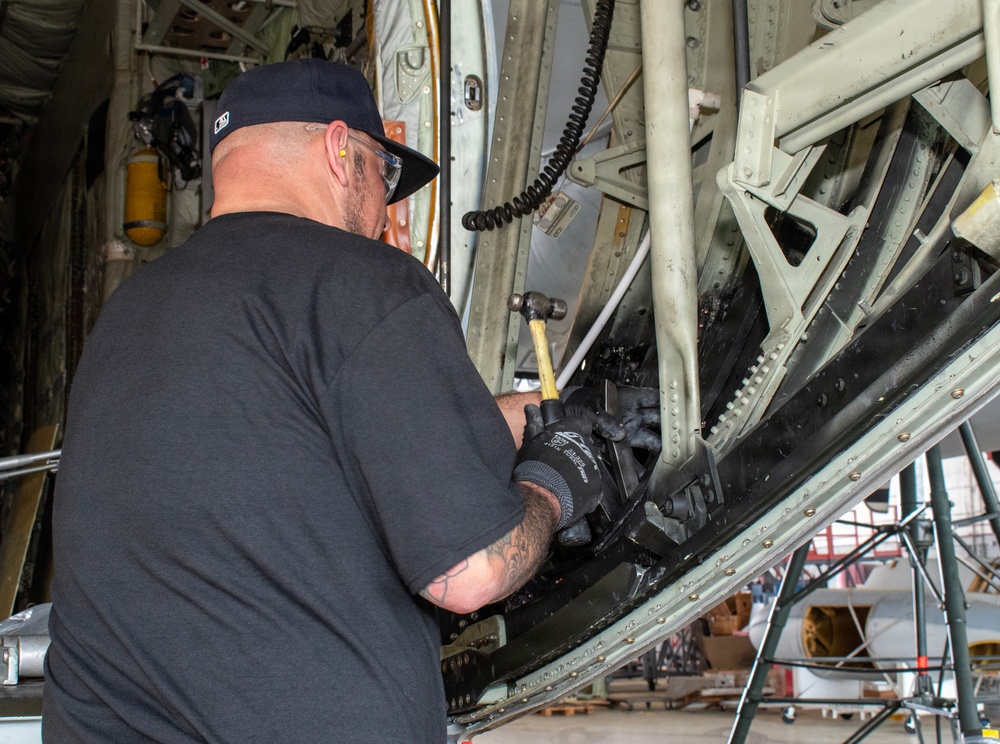
Photo By Samantha Morse | An aircraft mechanic on Fleet Readiness Center East’s (FRCE) In-Service Repair Team repairs a heavy duty fitting on a KC-130J Hercules. This repair was the first of its kind completed by FRCE, which allowed the depot to develop tooling, processes and proficiency in preparation for future repairs of its kind. see less
| View Image Page
Beating the clock: FRCE rapid repair team keeps C-130 on schedule
MARINE CORPS AIR STATION CHERRY POINT, N.C. – What started as a routine inspection on a KC-130J Hercules at Fleet Readiness Center East (FRCE) quickly turned into a coordinated, cross-functional team effort to repair and return the aircraft to the fleet on time.
While performing a scheduled maintenance inspection, called a minor depot inspection, on a KC-130J Hercules, the depot’s Minor Depot Inspection Team identified a corroded component in need of replacement. While discovering corrosion and hidden damage is common during these inspections, FRCE had to act fast as the aircraft was on a tight schedule and due back to the squadron for a modification.
Minor depot inspections are 30-day, depot-level maintenance evolutions focused on diagnosing and repairing discrepancies that fall beyond the scope of maintenance that can be done at the squadron or intermediate level. The goal of these inspections is to maintain the quality, safety and reliability of the aircraft between scheduled, depot-level maintenance events.
With the shortened timeline, FRCE called upon its In-Service Repair Team to complete the repair. Often referred to as the ISR Team, this specialized group of maintenance professionals, engineers and quality assurance specialists is equipped to rapidly tackle emergent, depot-level aircraft repairs for the fleet, worldwide. If the fleet is unable to bring the aircraft to the depot, the ISR Team brings the depot to the aircraft.
“The beauty of the In-Service Repair Team is we’re able to identify an issue and provide depot-level repairs on site, that way it’s a permanent fix,” said a planner on the In-Service Repair Team. “It’s not a temporary repair just to get them back in the air; it’s a repair that will last. Our team goes anywhere we need to go to get the job done. We’ve gone to places like Japan, Hawaii, San Diego, California, and Fort Worth, Texas. For this C-130, it was here on Marine Corps Air Station Cherry Point, and it was for a major structural component that often sees corrosion due to its location.”
The corrosion was found on a heavy-duty structural fitting that serves as a connection point between the aircraft’s main body and tail. Because this was the depot’s first time replacing this fitting, the ISR Team had to start from scratch, working alongside various teams within the facility to develop the tooling and techniques to accomplish the task, said the depot’s In-Service Repair Branch head.
“This was a comprehensive repair – not an easy job to do,” said the branch head. “Many man hours went into this across the different disciplines of everyone involved here at FRC East. We had help from our planners, engineers, quality assurance professionals, non-destructive inspectors, paint strippers, machinists in the machine shop, and sheet metal folk. It couldn’t have been done just anywhere; FRC East has all those disciplines here in house and because of that, we were able to staff and support this evolution.”
This cross-functional team effort is helping pave the way for future C-130 repairs at FRCE. Now that the depot has developed the required support equipment for this repair, it is ready to take on more of these repairs in the future.
“This major structural fitting is a zero-tolerance part, meaning it can’t have any bit of corrosion,” said a planner on In-Service Repair Team. “We got a replacement part from the squadron and developed the tooling and jigs to properly drill the holes in the fitting. Now, if we have to do another one of these repairs, we already have everything ready to go. They could drill one up in a matter of days.”
While this specific repair was a first for the team, it bridged the gap between the depot’s current and future support of the C-130 platform. The hands-on experience with a component that is typically addressed during in-depth maintenance evolutions, like those that will take place at the depot’s new aviation maintenance complex set to house FRCE’s incoming C-130 workload at the North Carolina Global TransPark in Kinston, will ensure a more seamless transition when the new facility opens its doors later this year.
“This was a great learning experience for our team,” said the Field Team Shop supervisor, who oversees the In-Service Repair Team. “For most of our experienced mechanics out on the floor, these kinds of jobs are the ones they strive for because it’s a challenge that tests their abilities. And once they’ve completed the job and overcome that challenge, it puts them in an advantageous position. They now have that specific experience under their belt that nobody else has, which will be helpful for when we transition to Kinston.”
The facility in Kinston will provide more than 700,000 square feet of space to support FRCE’s work on the Navy and Marine Corps C/KC-130J Super Hercules and C/KC-130T Hercules and Air Force HH-60W Jolly Green II.
Meeting this tight delivery window eliminated the risk of a missed modification and kept a vital military asset exactly where the fleet needed it: on schedule. This commitment to the fleet is the driving force behind FRCE’s work; by tackling complex repairs with urgency and precision, the depot ensures the warfighter remains ready to respond to any mission.
FRCE is North Carolina's largest maintenance, repair,overhauland technical services provider, withmore than3,600civilian,militaryand contract workers. Its annual revenue exceeds $886 million. The depot provides service to the fleet while functioning as an integral part of the greater U.S. Navy; Naval Air Systems Command; and Commander, Fleet Readiness Centers.