
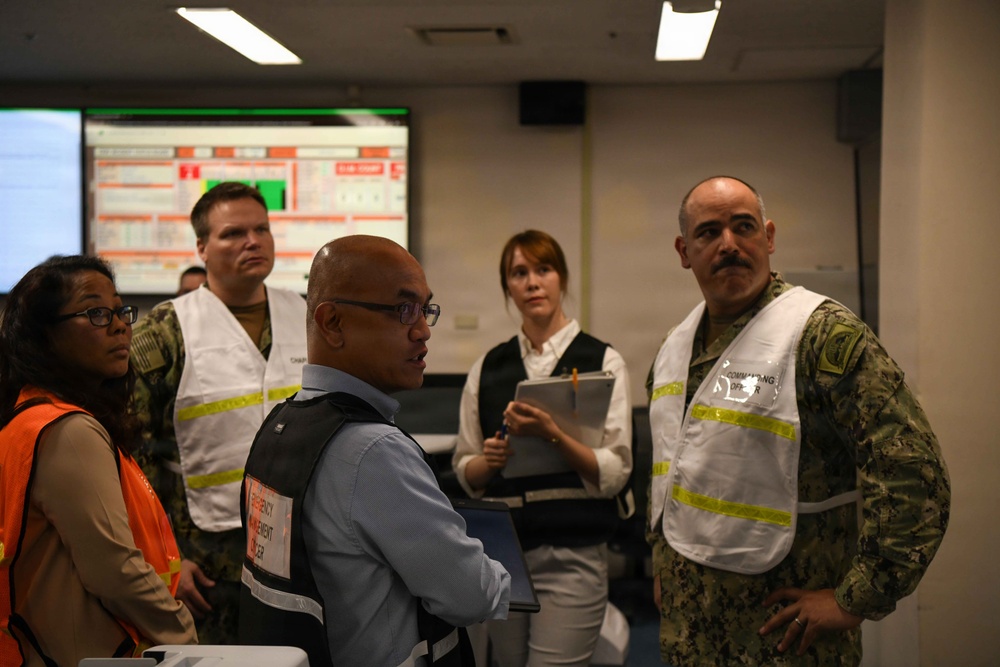
Photo By Petty Officer 2nd Class Caleb Strong | YOKOSUKA, Japan (April 21, 2026) – Capt. Jon Hopkins, Commander, Fleet Activities...... read more read more
 Subscribe
YOKOSUKA, Japan — Commander, Fleet Activities Yokosuka stands ready as the Tropical Cyclone Conditions of Readiness (TCCOR) season kicks into gear June 1. Within the installation’s Emergency Operations Center (EOC), personnel do not wait for a storm to arrive before they begin preparing.
Throughout the year, the EOC actively trains and runs practice drills, building the shared experience and teamwork needed to respond quickly, work together smoothly and keep the community safe.
Pre-Storm: Purposeful Preparation
When forecasters confirm a storm is heading toward Yokosuka, the EOC shifts from routine operations into a deliberate, disciplined rhythm.
"Everyone has a well-rehearsed role, and the entire team focuses on one unified mission, protecting the community," said Emily L. Von Vasold, EOC manager.
The team executes three critical first actions:
To advise the installation commander on changing TCCOR levels, the EOC relies on hard facts rather than guesswork. It pairs the forecasts NOAC provides with the time the base needs to secure itself. “We take NOAC’s weather picture and weigh it against the physical time required to protect people, ships and equipment,” Von Vasold added. “The commander makes the final call on the TCCOR level, and the EOC pushes it out across the installation.”
During the Storm: The Brain of the Installation
As destructive winds arrive and the base locks down, the work inside the EOC changes character. The preparation gives way to focused, deliberate monitoring — the calm at the center of the storm. “Inside the operations center, we keep the noise to a deliberate minimum, so the information that matters reaches the whole team and gets acted on without anyone talking over each other,” Von Vasold explained. “We shift from preparing the base to tracking exactly what the storm is doing.”
While the community shelters safely, the EOC acts as the installation's brain. Personnel track vital systems in real time, from power and water to roads and facilities. This ensures leadership has a complete picture of base safety and knows exactly what teams must fix first when the winds subside.
"Managing a crisis from inside the EOC requires staying calm amid chaos," said Von Vasold. "We take in a flood of information — like weather updates and power alerts — and use our training to turn a powerful storm into a series of organized, solvable problems."
Post-Storm Recovery
Immediately after the storm passes, the installation enters the TCCOR Recovery phase. During this critical window, the community must remain sheltered while response teams go to work. The weather might look perfectly fine from a living room window, but appearances can be deceiving.
Before leadership issues the "All Clear," CFAY Public Works and Security crews sweep the entire base for hazards, with the EOC tracking their progress. Staying inside keeps residents safe and out of the way while those crews clear roads and address hidden hazards such as downed power lines, fallen trees and flooding.
"When we finally issue the 'All Clear,' our goal is for the community to step outside without a single worry regarding their safety," Von Vasold said.
A Community Partnership
The EOC coordinates the installation’s response and tracks every hazard-clearing effort, giving the commander the information needed to call the “All Clear.” In return, personal preparation plays a crucial role in that success.
"When residents follow safety instructions and maintain emergency kits, our emergency teams can focus entirely on fixing major damage and returning the base to normal operations," Von Vasold explained.
| Date Taken: | 05.27.2026 |
| Date Posted: | 06.02.2026 07:43 |
| Story ID: | 566383 |
| Location: | YOKOSUKA NAVAL BASE, KANAGAWA, JP |
| Web Views: | 486 |
| Downloads: | 0 |

This work, Inside the Emergency Operations Center: Weathering the Storm Together, by Jenna Cotherman, identified by DVIDS, must comply with the restrictions shown on https://www.dvidshub.net/about/copyright.

No keywords found.




