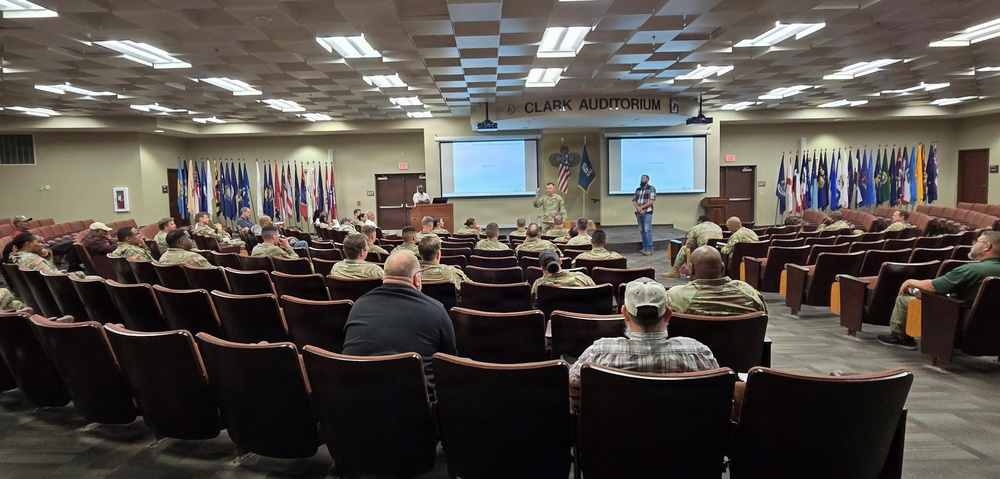
The Fort Bragg Department of Public Health briefed Soldiers living in the barracks on mold prevention during the May barracks stakeholder meeting recently held in Clark Auditorium of the NCO Academy.
“Mold is an indicator of a moisture problem,” said Lt. Col. Owen Price, the Chief of Environmental Health in the Fort Bragg Department of Public Health.
“If you have mold,” Price told the Soldiers in attendance, “the biggest issue is to find out where the moisture is coming from.”
Mold can become a problem when leaks continue, such as when a Soldier is out of the barracks for field duty or extended training, or when there is a lack of adequate ventilation. Even untreated condensation around pipes can lead to mold growth in buildings. Mold is commonly found in bathrooms, kitchens or around HVAC systems.
Mold is a common problem in North Carolina, but it doesn’t happen overnight, said Timothy Heflin, Housing Division Maintenance Mechanic Leader.
“Of the 536 mold DMOs received between December 2025 and May 2026, most were in bathrooms,” Heflin said.
While mold spores are present in the natural environment, they can become a potential health concern to individuals when found indoors.
Molds produce allergens, Price said. When a Soldier touches mold or inhales mold spores, it can cause allergic reactions in some. The most common symptoms are runny nose, scratchy throat, itchy eyes or sneezing. Less common symptoms are wheezing, coughing or dizziness.
Price said each individual’s sensitivity to mold is highly variable. He reminded the audience that the color of mold is not an indicator of its potential to cause negative health effects but recommended that if a Soldier has a mold health concern, they should see their primary care manager.
The facilities management team offered several preventive maintenance steps to take such as checking for HVAC drips, changing filters regularly, and reporting drips immediately. Soldiers were also reminded that regular and thorough cleaning is important, especially in bathrooms where mildew on caulking is often mistaken for mold.
When mold is discovered, the facilities team said after addressing the source of moisture, small areas (up to 10 square feet) can be cleaned off with water and dish detergent (not bleach). For larger areas, occupants can reach out to DPW for assistance.
At the meeting, Housing Division representatives also presented briefs on preventive maintenance, work orders, furnishings and certificates of non-availability. Soldiers were given time to ask questions and speak with briefers one-on-one after the meeting.
The next quarterly Barracks Stakeholder Meeting is scheduled for 10 a.m. on Aug. 12 in the NCOA’s Clark Auditorium. All Soldiers living in the barracks are invited to attend.
| Date Taken: |
05.15.2026 |
| Date Posted: |
05.28.2026 17:01 |
| Story ID: |
566362 |
| Location: |
FORT BRAGG, NORTH CAROLINA, US |
| Hometown: |
EAST FAYETTEVILLE, NORTH CAROLINA, US |
| Web Views: |
59 |
| Downloads: |
0 |
PUBLIC DOMAIN

This work, Public Health briefs Soldiers on mold prevention at Barracks Stakeholder Meeting, by April Olsen, identified by DVIDS, must comply with the restrictions shown on https://www.dvidshub.net/about/copyright.

 Subscribe






