New Exoskeleton Designed to Facilitate the Self-Evacuation of Wounded Soldiers
Photo By Anna Applegate |
The Intrepid Battlefield EXoskeleton (IBEX) system stabilizes lower-leg injuries such......read moreread more
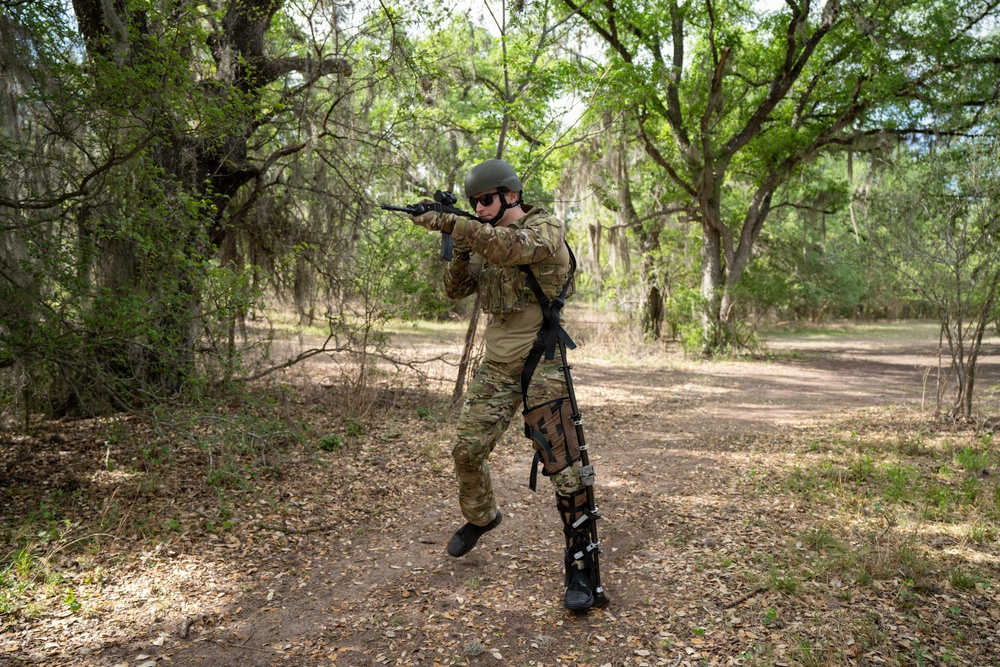
Photo By Anna Applegate | The Intrepid Battlefield EXoskeleton (IBEX) system stabilizes lower-leg injuries such as shin fractures while bearing a person’s body weight so the injured service member can stand and walk on their own when evacuation is unavailable. (photo credit: Extremity Trauma and Amputation Center of Excellence (EACE) Military Performance Lab) see less
| View Image Page
New Exoskeleton Designed to Facilitate the Self-Evacuation of Wounded Soldiers
An invention led by the U.S. Army Medical Research and Development Command could change how service members with lower leg injuries are treated and evacuated on the battlefield – enabling self-evacuation, reducing risk to fellow soldiers, and helping units remain engaged in the fight.
The Intrepid Battlefield EXoskeleton (IBEX) system stabilizes lower-leg injuries such as tibia fractures while bearing a service member’s body weight, allowing the injured individual to stand and walk independently when evacuation is delayed or unavailable.
Weighing just seven pounds, the collapsible IBEX, is easy to carry and quick to put on. It offers an alternative to traditional litter evacuation, which requires two to four service members and a supporting security team, temporarily removing several service members from the fight and increasing exposure to enemy fire. By allowing injured soldiers to move themselves to safety, IBEX helps keep more troops focused on the mission while improving survivability.
Since it is more portable than a litter, the IBEX can be utilized in difficult terrain such as dense woods and rocky mountainsides. The IBEX has also survived a 400-foot drop by a cargo drone to an awaiting service member on the ground.
By bearing a warfighter’s body weight and having the injured limb movement isolated from the frame, the IBEX relieves pressure on soft tissue, nerves, and blood vessels to mitigate pain and prevent further damage. It is designed so the injured service member can also execute military actions such as dropping to, and raising from, a prone firing position.
The IBEX addresses a decades-old dilemma faced by warfighters, according to Dr. Lee Childers, senior scientist at the Extremity Trauma and Amputation Center of Excellence (EACE) Military Performance Lab, Center for the Intrepid, Brooke Army Medical Center, in San Antonio, Texas.
“In combat, troops suffer tibia fractures, torn knee ligaments, high-grade ankle sprains, and foot fractures; these are the most common but survivable battlefield injuries,” Childers said. “The IBEX enables more walking wounded, which means more warfighters putting bullets downrange while providing a smaller target for enemy drones to attack.”
The IBEX system includes a telescoping lateral frame, harness to hold the hip, thigh corset, knee joint, fracture splint around the lower leg, and walking boot with a rocker bottom sole. The entire system collapses and is wrapped up in the thigh corset for a package comparable in size to a 1‑liter water bottle—roughly 6 inches wide, 7 inches deep, and 15 inches long.
The U.S. Army, Navy, and Marines have successfully tested the IBEX system in field trials. The project started in 2020, is now on its third round of funding, and has developed a 5th-generation prototype, each smaller, lighter, and better functioning than the one before. IBEX was licensed by a commercial partner and work is ongoing to bring the device to a final prototype suitable for manufacturing and then commercial production.
The IBEX was developed to address prolonged field-care scenarios in austere conditions, where evacuation can be delayed or unavailable. These lower-leg trauma injuries typically result from gunshot wounds and bomb blasts, such as from improvised explosive devices, but also occur when traversing rugged, unstable, and remote terrain strewn with hazards and during adverse weather. An IBEX can be transported to the site of these injuries by unit medics, fellow warfighters, or drones.
U.S. warfighters in recent years suffered numerous lower-leg injuries during battles in Iraq and Afghanistan and in lesser-known conflicts around the world. These injuries left wounded service members and their units unnecessarily vulnerable.
Between 2001-2018, service members deployed to combat zones suffered just over 22,000 non-amputated lower-leg injuries, including over 3,500 to the knee, nearly 9,000 to the lower leg and ankle, and close to 3,000 to the foot and toes, according to “A Focus on Non-Amputation Combat Extremity Injury: 2001-2018,” published by the National Library of Medicine. Approximately 68 percent of all extremity injuries were open wounds or fractures.
The next round of IBEX testing will be undertaken by the EACE research team at the Center for the Intrepid, early next year, on the outdoor training grounds near the Brooke Army Medical Center.
NEWS INFO
Date Taken:
05.27.2026
Date Posted:
05.28.2026 16:57
Story ID:
566361
Location:
FORT DETRICK, MARYLAND, US
Web Views:
304
Downloads:
1
PUBLIC DOMAIN
This work, New Exoskeleton Designed to Facilitate the Self-Evacuation of Wounded Soldiers, must comply with the restrictions shown on https://www.dvidshub.net/about/copyright.