
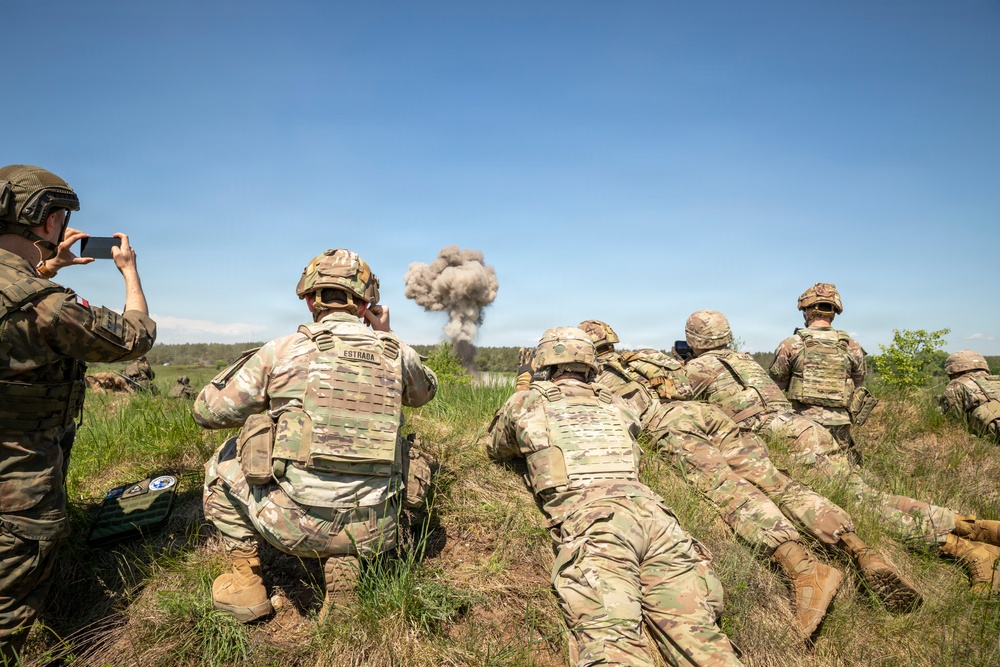
Photo By Staff Sgt. Emilie Lenglain | U.S. Soldiers, assigned to the 8th Brigade Engineer Battalion, 2nd Armored Brigade...... read more read more
 Subscribe
BEMOWO PISKIE TRAINING AREA, Poland — For the last two weeks of May 2026, Alpha Company, 8th Brigade Engineer Battalion (BEB), conducted demolition training with the Polish combat engineers.
Combat engineers play a critical role on the battlefield by enabling maneuver forces to not only move effectively, but also to survive and fight.
“Our job is to provide mobility, countermobility, and survivability for tankers and infantry,” Capt. Zachary McBride, commander of Alpha Company, 8th BEB, explained.
These three core engineering functions are essential to ensuring armored and infantry units can maneuver effectively on the battlefield while remaining protected from enemy threats.
Mobility operations include breaching obstacles and clearing minefields to allow armored forces to advance. Countermobility focuses on slowing or stopping enemy movement through obstacles, minefields, and defensive positions. Survivability operations involve improving defensive positions and protection for friendly forces.
“Breaching minefields is the essence of what we do for tankers,” McBride said. “Then behind us, we can reseed minefields to stop the enemy from following.”
The cohesion on the battlefield between combat engineers and tankers is what brought the 8th BEB to Poland in support of the 1st Battalion, 8th Cavalry Regiment during their overseas rotational deployment.
While in Poland, the U.S. Army combat engineers are strengthening interoperability with Polish forces through a series of spontaneous yet highly effective joint training events focused on demolition operations, mine warfare, and battlefield mobility.
What began as an unplanned visit to a Polish engineer building quickly evolved into a growing partnership between American and Polish combat engineers stationed in Eastern Europe.
McBride says, “The first sergeant and I saw a building that had EOD Sapersky on it, walked in, and started talking to people.”
After obtaining contact information for the Polish Explosive Ordnance Disposal commander, unit leadership returned the next day with a linguist and formally coordinated training with the Polish engineers. Since then, the partnership has expanded into multiple demolition ranges, classroom instruction, and future training opportunities.
The Polish engineers invited the Soldiers to participate in a demolition demonstration range last week and extended invitations for additional ranges and classes.
McBride said. “They’re going to teach us some of their demolition techniques, and we’re going to teach them ours using interpreters.”
For the Soldiers involved, the training represents more than simply learning new demolition methods. It reinforces interoperability between allied forces.
“As a NATO force, we’re expected to work together,” McBride said. “We’re not just the U.S. or the Brits or the Croatians or the Romanians or the Polish, we are the NATO battle group as a whole.”
The Soldiers emphasized that understanding how allied nations operate is critical if multinational forces ever deploy together in a real-world conflict.
“Training alongside the Polish sappers sharpens our combat effectiveness by exposing our soldiers to different demolition techniques and battlefield problem-solving methods,” 1st Sgt. Justin Morgan, Alpha Company, 8th BEB, first sergeant, said.
Morgan continued, “Building interoperability with our NATO allies ensures that when we fight together, we can integrate quickly and bring overwhelming firepower.”
Cross-training also provides junior soldiers with valuable international exposure. Many of the troops participating had never previously left the United States.
“It’s good for them to interact with different cultures and different NATO partners because they may never get this opportunity again,” McBride explained.
2nd Lt. Benjamin Thomas, an Engineering Support Platoon Leader with Alpha Company, said the training centered on understanding Polish mine capabilities and comparing them to U.S. procedures.
“The purpose of the training was for us as U.S. Army Soldiers to learn the Polish anti-tank mine capabilities, understand how they lay their mines, and how they clear them,” Thomas said.
One major difference involved how each military deploys mines. U.S. Army engineers often use vehicle-mounted systems, such as the M136 Volcano Vehicle-launched Scatterable Mine System, while Polish engineers rely more on dismounted placement techniques.
“Understanding how our capabilities differ and how they lay the mines was definitely something I took away,” Thomas said.
Soldiers also observed several technical differences in demolition methods. Polish engineers frequently train with TNT explosives, while U.S. Army combat engineers more commonly use C4 and Claymore charges.
“We primarily use C4 back home,” Sgt. Marcquis Knox, 8th BEB gunner, explained. “So getting hands-on exposure to TNT and seeing their methods is a huge win for us.”
The Polish engineers also demonstrated mine-detection dogs during training, something many of the U.S. Army Soldiers had never seen used operationally.
“My favorite thing that I learned was seeing the dogs detect the mines,” Thomas said. “It removes the soldier from the fight and provides another effective way to detect explosives.”
Leaders from both nations viewed the training as a success, especially considering the partnership began with a simple conversation and an unplanned visit.
“Even if we get one person to train with the Polish, we count that as a huge success,” McBride said.
The professionalism displayed by both forces during the demolition ranges helped build trust and opened the door for future training opportunities.
“We had no accidents, everyone was professional, and they invited us back,” McBride said. “That tells us the training was successful.”
As NATO continues emphasizing multinational readiness and deterrence, small-unit partnerships like the one between U.S. and Polish engineers remain critical to building stronger allied capabilities and improving combat effectiveness across the alliance.
The recent Polish-led training incorporated both mobility and countermobility concepts, giving U.S. Army Soldiers firsthand exposure to how allied engineers conduct similar missions.
| Date Taken: | 05.27.2026 |
| Date Posted: | 05.28.2026 15:13 |
| Story ID: | 566334 |
| Location: | PL |
| Web Views: | 392 |
| Downloads: | 0 |

This work, U.S. Army engineers strengthen NATO partnership through cross-training in Poland, by SGT Ronald Bell, identified by DVIDS, must comply with the restrictions shown on https://www.dvidshub.net/about/copyright.


No keywords found.




