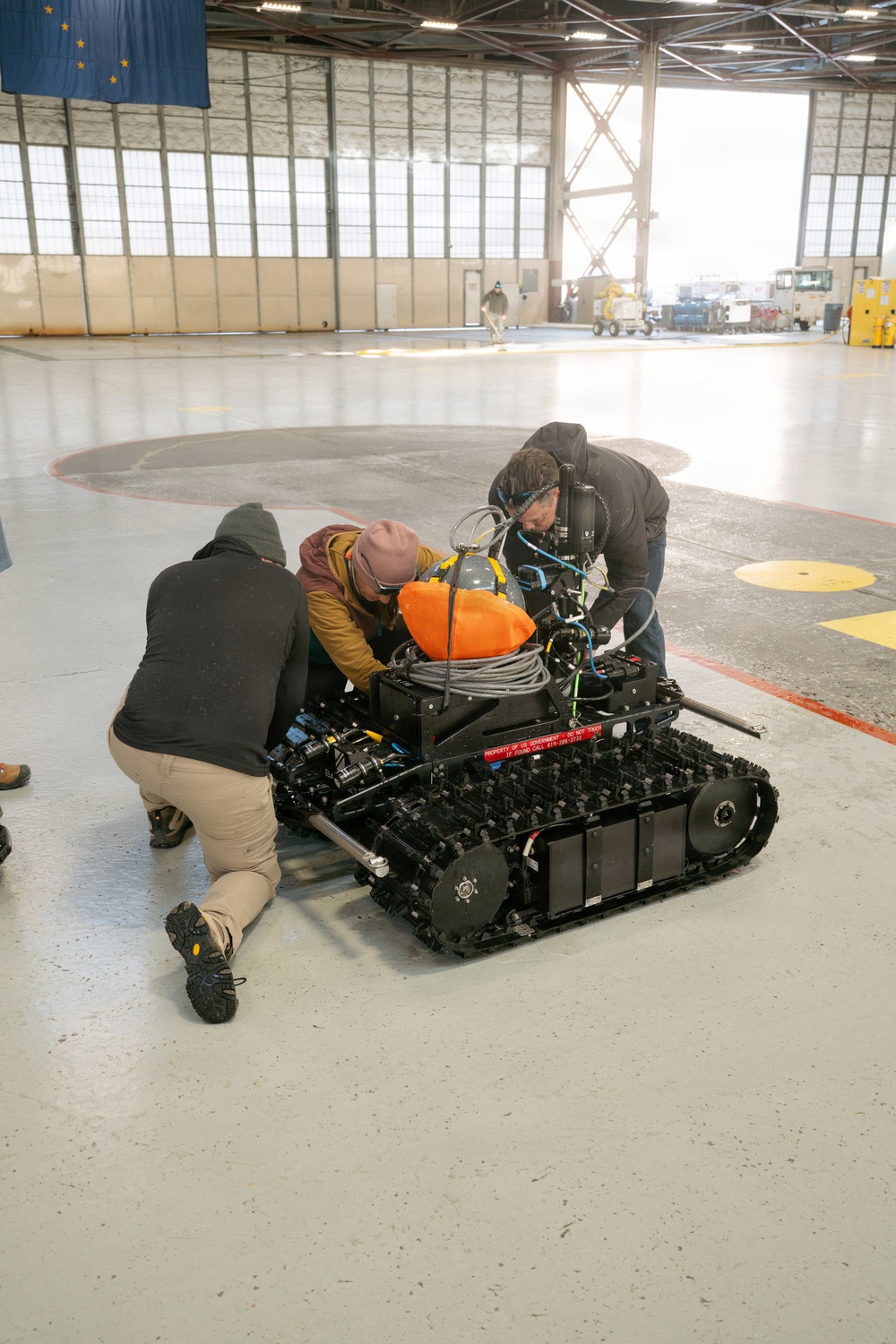
Photo By Joel Riveracamacho | PAE Marine Corps is testing a new autonomous system for Explosive Ordnance Disposal capabilities in Kodiak, AK, Feb. 27, 2026. The system will greatly expand littoral explosive ordnance neutralization (LEON) efforts across the Marine Corps. (PAE Marine Corps photo by Joel Rivera-Camacho) see less
| View Image Page
AUGV expands Marine Corps EOD capability in Arctic Edge 26 exercise
KODIAK, Alaska -- U.S. Marines with 7th Engineer Support Battalion, 1st Marine Logistics Group, conducted underwater cold weather dive operations during Arctic Edge 26 at Coast Guard Base Kodiak, integrating unmanned systems that expand the Marine Corps’ littoral explosive ordnance neutralization capability in the surf and very shallow water zones.
Arctic Edge is a biennial exercise designed to strengthen joint readiness and the Department of War’s ability to operate in Arctic conditions. For Marine Corps explosive ordnance disposal technicians, the exercise provided an opportunity to validate maritime capabilities while employing emerging systems such as unmanned underwater vehicles and the Autonomous Underwater Ground Vehicle, or AUGV.
Chief Warrant Officer Jonathan Veenhuizen, officer in charge of Fox Section, one of two Littoral Explosive Ordnance Neutralization, or LEON, capable sections in the Marine Corps, said the capability combines traditional dive expertise with advanced sensing and robotic systems.
“That’s kind of EOD’s support to maritime operations where we blend a lot of the diver capability with some of the underwater systems, sensing systems and things like that,” Veenhuizen said.
As the Marine Corps continues to focus on expeditionary and maritime operations, the ability to detect and neutralize underwater explosive threats in coastal waters, island chains, piers, and harbors has become increasingly important.
“The real critical importance of the maritime capability from an EOD standpoint in the Marine Corps is always kind of the ready to fight first in scenario,” Veenhuizen said. “As we look towards the future and expand our maritime capability and missions in island chains or coastal waters, it really pushed the Marine Corps to modernize and focus on a gap that we could fill. And that was the LEON capability.”
At the center of that modernization effort is the AUGV, a Marine Corps program of record designed to operate in the complex surf and very shallow water environment where traditional systems often struggle.
“You’ve got a capability in the AUGV that’s nowhere else. The rest of the department doesn’t have something like this,” Veenhuizen said. “Right now we have it and we’re ready to start employing it.”
Unlike many unmanned underwater vehicles designed for deeper waters, the AUGV fills a critical gap between offshore sensing and the surf zone, where waves, currents and sediment make traditional sonar systems less effective.
“The gap that it’s filling is an area that we can’t necessarily rely on those tried and true UUVs that the Navy’s had for years,” Veenhuizen said. “You’ve got a capability that can actually look in that tidal zone or in that wave breaking area in the surf.”
Operating in those environments provides commanders with improved situational awareness in areas that have historically been difficult to assess.
“When you’re looking in that turbulent environment in the surf zone, it’s very difficult,” Veenhuizen said. “So you’ve got something with the AUGV that has the ability to give us better insight and some key decision points for commanders.”
Matt Jackson, an engineer with Naval Information Warfare Center Pacific supporting intelligence, surveillance and reconnaissance expeditionary unmanned systems, said his team deployed to Kodiak to support the integration and upcoming fielding of the system to the Marine Corps.
According to Jackson, the AUGV is designed to gather intelligence and environmental data in areas that are both difficult and dangerous for humans to access.
“It’s to collect intelligence and bathymetry in areas that are very difficult to collect, specifically the surf zone and very shallow water,” Jackson said. “It can accurately map and capture sonar imagery and video imagery of objects within that environment.”
The surf zone presents significant hazards due to strong currents, shifting terrain and limited visibility. Deploying a robotic system first reduces the risk to personnel while improving understanding of the operating environment.
“This drastically reduces the risk because within the very shallow water area and the surf zone area, it is a very dangerous environment,” Jackson said. “To put a robot in there first is highly advantageous.”
For explosive ordnance disposal operations, the system supports the long-standing principle of increasing distance between personnel and potential threats.
“Much like a ground robot, you put time, shielding and distance between you and the threat during explosive ordnance operations,” Jackson said. “For that purpose, it keeps the man out of the minefield.”
In Kodiak, the AUGV was used to survey subsurface areas and identify environmental hazards before divers entered the water.
“So AUGV specifically here in Kodiak, at Coast Guard Base, we’re looking for it to survey subsurface environments and get to locations that we can mitigate,” Veenhuizen said. “Mitigate risk to divers, keep them out of the cold and preserve combat power.”
Data collected by the system is integrated into the Tactical Awareness Kit, a common operational picture used across the joint force to visualize and share information across the battlespace.
“We take the data from our unmanned systems and visualize it and network that common tactical picture so we can share it across the battle space,” Jackson said.
Leaders emphasized that the AUGV is part of a broader LEON family of systems that includes unmanned surface vessels, remotely operated vehicles, unmanned underwater vehicles and divers working together to build a layered capability.
“It’s a system of systems,” Jackson said. “Even though the AUGV focuses on the very shallow water and surf zone areas, it communicates and functions with other systems that are coming to the Marine Corps.”
By validating the AUGV in Arctic conditions and the challenging surf environment off Kodiak, Marines demonstrated how unmanned systems can expand access to the littoral battlespace while reducing risk to personnel.
“If we can preserve the human combat power and task some of these robotic platforms to do the sensing and understanding of the environment,” Veenhuizen said, “then allow Marines to focus on the decision making that matters, that really will make us a more efficient force.”