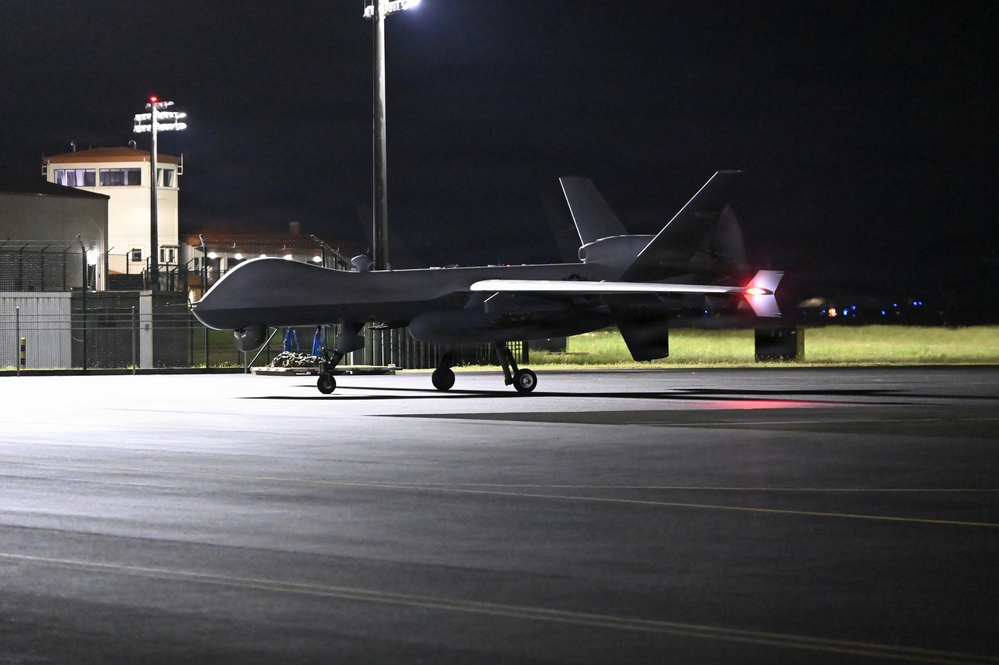
Photo By Tech. Sgt. Alexander Rector | A New York Air National Guard MQ-9 Reaper from the 174th Attack Wing taxis across the tarmac at Lajes Field, Portugal, Apr. 2, 2026. The Reaper, which took more than 10 hours to reach the Portuguese base, was serviced and refueled before embarking for its next destination. (U.S. Air Force photo by Ricky Baptista) see less
| View Image Page
174th Attack Wing Conducts Historic First, by Landing a MQ-9 Reaper at Lajes field, Portugal
New York Air National Guardsman assigned to the 174th Attack Wing, conducted a historic first on Apr. 1st, 2026, by successfully landing an MQ-9 Reaper at Lajes Field, Portugal. The flight, the first of several, demonstrated the Wing’s ability to self-transport the MQ-9 Reaper remotely piloted aircraft from their home station in Syracuse, NY, to operational locations overseas.
The MQ-9, which has been operated by the Wing since 2009, is normally disassembled and transported as cargo in the C-17 Globemaster when transported intercontinentally. By self-transporting, the unit eliminated the burdensome requirement of disassembling the aircraft, coordinating with an airlift wing to transport the aircraft, reassembling the aircraft at the destination, and performing time-consuming post-reassembly maintenance before the MQ-9 is ready to conduct missions.
“Flying the aircraft directly drastically reduces our reliance on heavy strategic airlift,” said U.S. Air Force Master Sgt. Jacob Wolfe, an aircraft maintenance supervisor for the 174th Aircraft Maintenance Squadron, 174th Attack Wing. “Crating an MQ-9 requires tearing it down, waiting for airlift from aircraft that are already busy supporting missions, and then spending days rebuilding and ops checking it at the destination. Flying the MQ-9 proves we can project power much faster, leaner, and with a significantly smaller footprint.”
Wolfe, along with a small contingent of maintenance personnel, headed to Lajes Field in advance of the flight to receive and refuel the MQ-9s and perform any maintenance required before conducting subsequent flights.
“This is Agile Combat Employment in action,” Wolfe said. “By utilizing Lajes as a strategic steppingstone, we demonstrated that we can rapidly deploy, recover, and sustain operations with a minimal, highly adaptable maintenance team.”
“Trans-oceanic flights push the limits of our standard operational envelope. We had to ensure seamless handovers over open water and closely manage fuel burn rates,” Wolfe said. “From a maintenance standpoint, it required ensuring the aircraft was in pristine condition to handle the long duration and addressing any potential issues to ensure smooth transit.”
The Wing, which has continuously operated the MQ-9 overseas in numerous combatant commands since 2009, demonstrated a first by working with Portuguese Air Force and U.S. Air Force personnel stationed at Lajes Field to demonstrate the safety and reliability of the MQ-9 platform in Portuguese airspace.
“Operating unmanned aircraft in sovereign airspace introduced a new dynamic that required trust, transparency, and close coordination with our host nation partners,” said U.S. Air Force Lt. Col. Nathan Erickson, the 174th Attack Wing’s chief of plans. “Working hand-in-hand with the Portuguese Air Force and the U.S. Air Force’s 65th Air Base Group, our team focused on ensuring operations were conducted with the same predictability, professionalism, and safety standards as any manned aircraft mission.”
Though the MQ-9 is remotely piloted, we needed our operations to look and feel routine to everyone involved, Erikson elaborated.
“After the first successful recovery and launch of an MQ-9, the lead Portuguese Air Traffic Controller noted that the MQ-9 behaved like all manned aircraft that flow through Lajes.” Erickson said. “Each launch and recovery reinforced the notion that remotely piloted aircraft can seamlessly integrate into established airspace systems without disrupting existing operations.”
The Wing, which hosts a training unit at its headquarters in Syracuse, NY, is no stranger to operating the MQ-9 alongside manned aviation operations. The unit, which shares a flightline with Syracuse Hancock International Airport, routinely launches and recovers the Reaper on runways and airspace shared with commercial aircraft.
“There is no substitute for real-world execution,” Wolfe said. “For maintenance personnel, it tests our ability to recover and turn/troubleshoot and launch aircraft quickly in an unfamiliar transit environment under tight timelines. It forces our maintainers to think outside the box and operate efficiently away from home station.”
For one of the mission's pilots, the flight to Lajes held special significance. Lt. Col. Jon Kinsey, the director of the 174th Test Detachment, recalled a memory from childhood as the son of an Army officer. In 1989, Kinsey flew with his parents on a trans-Atlantic flight in their family-owned Piper Cherokee airplane. The flight which took the family from Maine to Germany via Canada, Greenland, Iceland, and the Shetland Islands, took 14 days and more than 30 hours of flight time.
Kinsey, now a MQ-9 Reaper pilot, found himself in familiar territory in the skies over the Atlantic. “For me, flying over the Atlantic was a 37-year callback to when Dad flew our family across that same ocean in a little single-engine Piper Cherokee,” Kinsey said. “This time, in the MQ-9 Reaper, my trip took just 9 hours. The sea was just as rough though, and the sunset was just as beautiful. When I called Dad to tell him, he celebrated with me and we laughed about how much had changed—two generations of pilots flying single-engine aircraft, decades apart but connected by the same water.”
“Dad's love of flying led me to where I am today, and as I broke out of the clouds to land at Lajes, it felt like it had finally come full circle,” Kinsey continued.
The 174th Attack Wing is one of five wings that comprise the New York Air National Guard. Headquartered in Syracuse, NY, the Wing’s primary mission is to operate the MQ-9 Reaper remotely piloted aircraft.