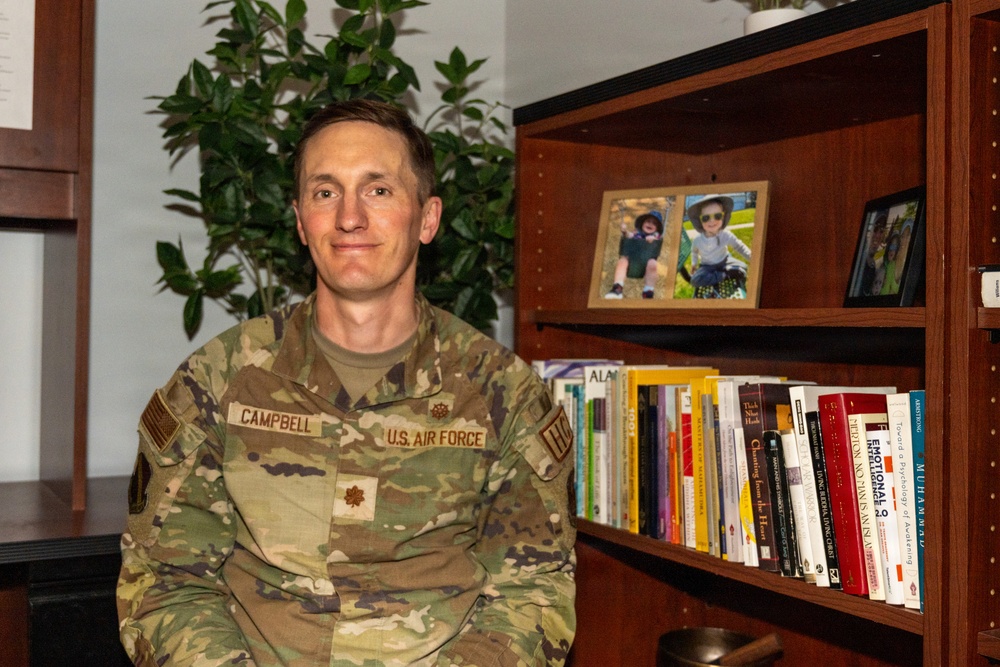
Photo By Airman 1st Class Eliana Raspet | U.S. Air Force Maj. Brett Campbell, chaplain, 140th Wing, Colorado Air National Guard stands ready to support Airmen at Buckley Space Force Base, Colorado, April 23, 2026. Campbell commissioned as the first Buddhist chaplain in the U.S. Air Force Chaplain Corps in 2016. (U.S. National Guard photo by Senior Airman Eliana Raspet) see less
| View Image Page
Air Force chaplain brings unique faith perspective to 140th Wing
Spiritual readiness is a key component of mission effectiveness, and, for U.S. Air Force Maj. Brett Campbell, that mission begins with meeting Airmen where they are—regardless of faith background.
“The role of a chaplain is to care for people and their spiritual health and their spiritual needs, " Campbell said. “Our role is to make sure that the people who actually do the mission are spiritually, mentally and emotionally ready to go out there and do it.”
In 2016, Campbell became the first Buddhist chaplain in the Air Force.
He remains the only Buddhist chaplain in the Air Force. Campbell now fosters and maintains the spiritual readiness of the men and women of the Colorado Air National Guard. That support plays a critical role in Comprehensive Airman Fitness, particularly in helping individuals build resilience in high-stress environments.
Campbell described spiritual readiness as having a set of tools, practices or belief systems that lead to inner stability.
“It’s that inner peace that calms the mind so that you can manage when difficult things happen,” Campbell said.
While religion is often a part of the chaplaincy, Campbell reiterates that, at the core, chaplains are spiritual caregivers whose mission is to care not only for people of their own religion, but of any religion or no religion at all.
“When I teach about spirituality, I always like to start by defining it,” Campbell said. “I think spirituality often gets confused with religion, but religion exists within spirituality. You don't have to be religious to be spiritual or to know that there is a part of you that you need to take care of. The goal of spiritual practice is really to develop a sense of feeling of inner peace, a quiet mind, and a quiet heart.”
Campbell’s path to service was shaped by years of personal exploration. He grew up Catholic, but when he got to college he started to pull away from it.
“I stopped going to church,” Campbell said. “I was studying philosophy and became really curious about religion as a topic.”
That curiosity led to studying multiple traditions, including Buddhism, Hinduism and Taoism, and eventually developing a personal connection to Buddhist practice.
“It wasn’t just like I went to a temple, and I knew it there,” Campbell said. “It was a slow process of research and questioning…and, eventually, I kind of just found my way there.”
After earning a Master of Divinity degree, Campbell pursued military service, encountering challenges along the way.
“I told a U.S. Air Force chaplain recruiter that I wanted to be a Buddhist chaplain, and he said: ‘the Air Force doesn't need any Buddhists,’” Campbell said.
Following time in a U.S. Navy chaplain candidacy program and a period of reassessment, Campbell reapplied and was later accepted into the Air Force Reserve. Now, grounded in Buddhist principles, Campbell emphasizes compassion as a central part of both personal practice and professional care.
Campbell discussed the concept of the Bodhisattva, which he described as somebody who is fully dedicated to practicing a certain path for the sole purpose of benefiting others.
“The only thing that matters is the heart-to-heart connection that I have with that person in that moment,” he said.
During a recent deployment, Campbell helped expand spiritual support by leading the first Buddhist service in a deployed Air Force setting. The service was also offered virtually, allowing members across multiple locations to participate.
“It was a really powerful experience,” Campbell said. “There were some pretty heavy things that happened…and I think it gave people a different way to frame their experience.”
The group drew strong participation and provided a space for reflection during a high-tempo, high-stress deployment. Campbell also leads discussion-based Buddhist groups during drill weekends, designed to be accessible to all Airmen, regardless of religious affiliation.
“It’s not a service, and it’s very non-threatening,” Campbell said. “It’s just a discussion group… whether they’re religious or not religious, it doesn’t really matter.”
Chaplains remain available to provide confidential support through multiple avenues, including in-person visits, phone calls, and unit engagement.
“Any way they need to reach out, we will be available for them,” Campbell said.
Campbell encourages Airmen to reconsider common misconceptions about chaplain services. While most people first think of religion when it comes to chaplain services, Campbell pushes back explaining that they provide for everyone.
“We meet people on a human level first,” Campbell said. “We’re going to support you in whatever way you need.”
By fostering spiritual resilience and connection, chaplains help ensure Airmen are ready—not only for the mission, but for the challenges that come with it.
“My personal mission is to highlight for people the importance of spiritual health,” Campbell said. “It’s a very human thing.”
For those seeking support, the chaplain’s office remains a starting point.
“The chaplain’s office is a good place to start for any support that you might need,” Campbell said. “Know that everybody in the chaplain’s office are kind and caring people that really just want to support the wing in any way we can.”

 Subscribe






