
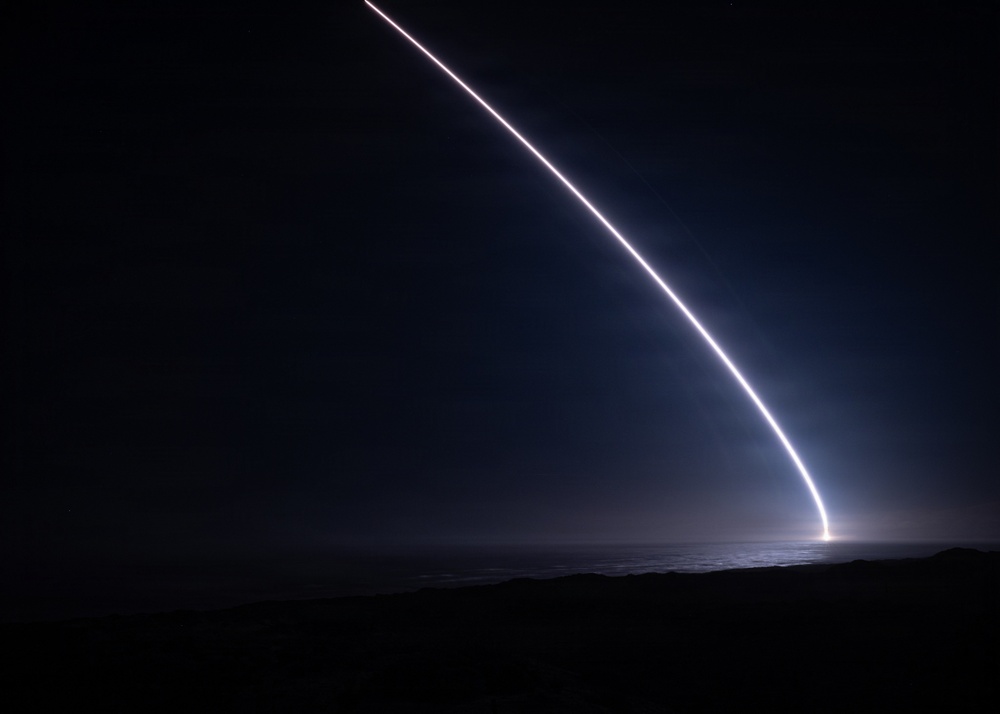
Photo By Command Chief Master Sgt. silvia s maria | An unarmed Minuteman III Intercontinental Ballistic Missile launches during an...... read more read more
 Subscribe
REDSTONE ARSENAL, Ala. – A U.S. Army Space and Missile Defense Command team played an important role in supporting the Air Force’s latest Glory Trip.
An unarmed Minuteman III Intercontinental Ballistic Missile landed at USASMDC’s Ronald Reagan Space and Missile Test Range, or RTR, on Kwajalein Atoll in the Republic of the Marshall Islands during an Air Force Global Strike Command’s Glory Trip-256 operational test on May 20.
The RTR Operation Center – Huntsville, or ROC-H, provides command and control for test missions and space operations despite being more than 6,500 miles from Kwajalein, which is located halfway between Hawaii and Australia.
All the radars at RTR are controlled and operated from ROC-H. The optics and telemetry sites on Kwajalein Atoll are managed by the controllers in ROC-H. The data upon mission completion is sent to ROC-H for analysis and distribution to the customer.
“RTR supported the Glory Trip Mission by providing Mission Operations, Safety, and Instrumentation,” said Lt. Col. Kevin R. Smith, RTR Range Operations branch chief. “These services collect data for our customer, Air Force Global Strike Command, and assist the Minuteman III program office in demonstrating to the world that they are ready to respond when called upon.
“RTR has a very strategic importance to our national security, especially when it comes to supporting testing of one leg of the nuclear triad,” he added.
Smith said his role is to ensure the range is ready to support all missions on the island. This includes the operations and maintenance of the range instrumentation, communication network, and the weather station.
As a Department of Defense Major Range and Test Facility Base, RTR radars, imaging systems, data collection capabilities, and personnel have supported hundreds of missile tests ranging from validation of concepts and designs for more than 50 years.
“These tests are very exciting,” Smith said. “It’s an opportunity to see the hard work that goes on behind the scenes from all our teammates to ensure a successful mission. The on-island team here on Kwajalein performed outstanding. It makes me proud to know I am serving alongside this team of competent professionals.”
Danny Bryant, RTR director, said RTR and Kwaj have never been more important as a Major Range and Test Facility Base, or MRTFB. He added The Department of War ensures that test capability and capacity are available to meet the nation’s needs, especially with the proliferation of hypersonics, the exponential growth of space launches, and the need to defend the freedom of space.
“The Reagan Test Range team is amazing,” Bryant said. “Test professionals across this nation are often unsung. Heroic feats are accomplished during each test to make sure execution occurs. The Reagan team is no different. Being the director of RTR is easily the best test job at Redstone Arsenal.
“RTR is a quiet pillar of American security and technological superiority,” he added. “In fact, most Americans have never heard of it. Kwajalein’s strategic location in the Pacific is more important now than it has ever been. We’re not just about missiles anymore – our work to defend the freedom of space is critical.”
Bryant said Kwaj gives the U.S. something geography itself cannot easily replicate - enormous uninterrupted ocean ranges, isolation, equatorial positioning, and unmatched tracking capabilities.
He added you cannot simply build another Kwajalein somewhere else, and we should not think of RTR as a faraway outpost, but ratheras a critical national asset.
“Reagan Test Range and the MRTFB system is a great benefit and use of taxpayer dollars,” Bryant said. The Department of War creates a collaborative network of test ranges and capabilities to test for every service. The capabilities are communicated, monitored and managed such that duplication is only allowed when necessary for range and test capacity. MRTFBs are national assets; there’s not another range in the world that can provide the services that Reagan Test Range provides.”
Bryan M. Wheelock, RTR Mission Operations and lead mission manager, said ROC-H is our primary command and control facility for mission execution on the range and RTR is one of four Major Range and Test Facility bases supporting Glory Trip missions.
He added that Vandenberg Space Force Base and Naval Air Warfare Center, Point Mugu, Calif., provide support early in flight. The Pacific Missile Range Facility in Kauai, Hawaii, provides mid-range support, and those at RTR provide support during the terminal phase of flight.
“RTR is vitally important to the Glory Trip missions,” Wheelock said. “We are the only impact range that can collect and record the critical terminal area radar, optics, and telemetry data our Air Force customer needs to evaluate the performance of their weapon system. RTR is a vital national asset, possessing unique radar, optics, telemetry, and safety capabilities that should be preserved and maintained, ensuring the nation’s ICBM forces can continue to test, evaluate and refine their weapon systems for generations to come.
“One couldn’t ask for a better team,” he added. “The RTR execution team is a tight-knit, hard-working team of professionals dedicated to ensuring mission success on behalf of our customers.”
| Date Taken: | 05.22.2026 |
| Date Posted: | 05.22.2026 14:38 |
| Story ID: | 566016 |
| Location: | REDSTONE ARSENAL, ALABAMA, US |
| Web Views: | 292 |
| Downloads: | 0 |

This work, RTR supports Air Force Glory Trip-256, by Jason Cutshaw, identified by DVIDS, must comply with the restrictions shown on https://www.dvidshub.net/about/copyright.

No keywords found.




