
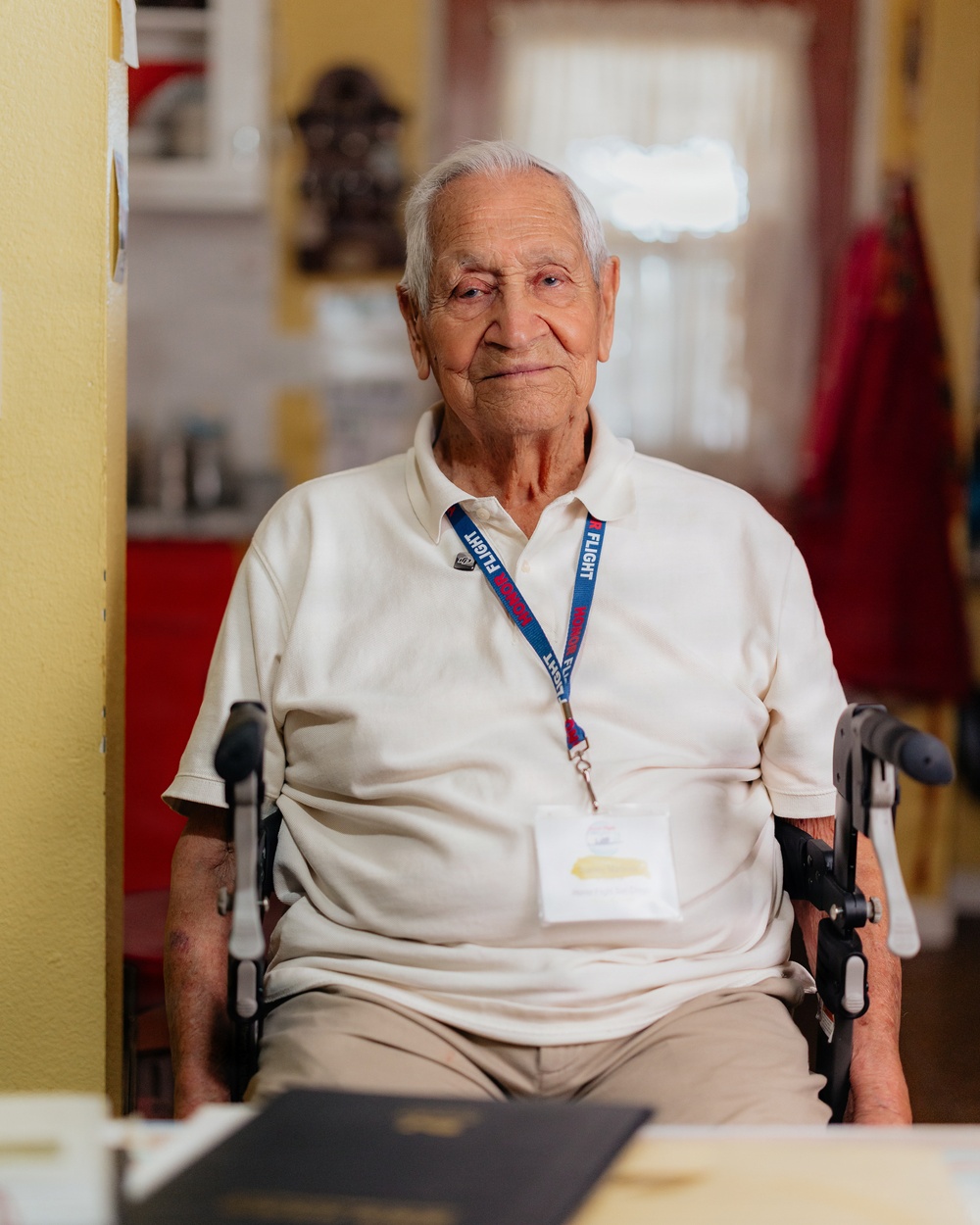
Photo By Staff Sgt. Cayce Watson | Stanley Martinez, a 96-year-old Korean War veteran, poses for a photo during an...... read more read more
 Subscribe
EL CENTRO, Calif. Staff Sgt. Stanley Martinez was the last man to step off the truck. It was autumn of 1951, somewhere north of Pusan, the deuce-and-a-half he had ridden up from Korea’s southern tip had been dropping replacements all day: a Soldier here, two there, each stepping into a slot another had just vacated. Martinez waited for his turn, listening to artillery thump in the dark.
“You couldn’t see anything, but you could hear it going off,” Martinez said.
Now, decades later, at 96, he is one of two surviving members of his local Korean War Veterans Association chapter. He served as a tank driver with the 7th Infantry Division, whose hourglass patch remains worn by Soldiers at Joint Base Lewis-McChord today.
Martinez grew up the son of a New Mexico coal miner, one of 10 children: six brothers and four sisters. His mother died when he was six. His father never remarried and raised all 10 by himself. He moved to El Centro in 1947 to live with his sister. At that time, gas cost 17 cents a gallon, and Hank Williams was just starting to climb the country charts. He almost enlisted before being drafted.
He and his childhood friend, Guillermo, walked to the post office, where young men would sign their enlistment papers at that time.
“We called him William,” Martinez said.
A car pulled up alongside them, with a couple of guys inside and cold beer in the back seat.
“I let William go [in] by himself, and I jumped in the car,” Martinez said. William was shipped to Korea, and soon after was reported missing in action.
“To this day, they still haven’t heard anything from him,” Martinez said. “No bones. Nothing.”
Martinez’s draft notice arrived months later, signed by President Truman. By then, one of his brothers had died in the English Channel in December 1941, seven months after high school, when a German U-boat sank his ship. Remembering the loss, Martinez said he was proud to be called up, especially since he had been ready to volunteer.
“I was kind of proud,” he said. “I didn’t mind it at all.”
Within a week of receiving the notice, he was on a Greyhound to San Diego for a physical. Soon after, he went to Camp Roberts, California, a World War II installation the Army was hastily reactivating.
“They wouldn’t let us in the base at Fort Ord,” he said. “It was full.”
Sixteen weeks of infantry training followed. After training, he took a 13-day voyage to Yokohama, Japan, then traveled by train to Sasebo, took a ferry to Pusan, Korea, and then endured a long, slow truck ride north. Martinez began as an infantryman but did not stay one for long. A few weeks after arriving, an officer asked if anyone could drive a truck. Martinez had hauled carrots and watermelons in the Imperial Valley, so he volunteered.
“They put me in a tank,” he said. “All they did was show me the gears and the clutch.”
He drove for a four-man crew supporting infantry patrols for about a year. His world narrowed to a 10-inch periscope slit. The crew slept inside the tank while the infantry slept in foxholes. Hot food was served twice a month; the rest was C-rations. Whenever the Air Force struck the hills, Martinez watched napalm explode from a distance.
“That was some dangerous stuff,” he said. “All you could see was the fire. It was white.”
Martinez eventually rotated home, ferrying back to the Presidio of San Francisco. Then went to Fort Hood, Texas, to finish his enlistment. On the return voyage, his first sight was the Golden Gate Bridge’s silhouette.
“You knew you were getting close,” he said.
He had married his wife, Alice, before deploying. Soon they will mark their 75th anniversary. Asked for the secret of their long marriage, Martinez did not hesitate.
“Give her at least 90% of your time,” he said.
He raised a family in El Centro, quit smoking and drinking, cold turkey around 40, and stayed on his feet until arthritis forced him to use a walker. Only he and his friend Benny Benavides remain in his Korean War Veterans Association chapter.
Several years ago, he returned to South Korea, on a trip sponsored by the Korean government. The villages he remembered as rubble had become a metropolis.
“It’s something like San Francisco now,” he said.
When asked what he would advise young Soldiers wearing his old patch, Martinez paused.
“I think everybody should spend a couple of years in the service,” he said. “Learn some discipline. It makes a difference.”
| Date Taken: | 05.21.2026 |
| Date Posted: | 05.21.2026 22:17 |
| Story ID: | 565969 |
| Location: | CALIFORNIA, US |
| Web Views: | 86 |
| Downloads: | 0 |

This work, At 96, former 7th ID tank driver reflects on the Korean War, by SSG Cayce Watson, identified by DVIDS, must comply with the restrictions shown on https://www.dvidshub.net/about/copyright.


No keywords found.




