
Photo By Aliyah Harrison | The Acquisition Transformation Initiative: Rebuilding the Arsenal of Freedom at a...... read more read more
 Subscribe
The Naval Postgraduate School (NPS) hosted its 23rd annual Acquisition Research Symposium and Innovation Summit on May 6–7, 2026, as a fully virtual event centered on the theme Accelerating Warfighting Capabilities, which brought together leaders and experts to explore innovations in logistics, program management, space systems and test and evaluation—all aimed at delivering capabilities to the warfighter faster and more effectively. Among the key topics discussed was “Empowering the Professional: Shaping the Future of Acquisition Talent,” an executive panel led by Lt. Gen. Bob Marion (Ret.), professor of the practice at NPS and former military deputy assistant secretary of the Army for acquisition, logistics and technology.
“The success of any acquisition reform is fundamentally tied to the caliber and readiness of the professionals executing it,” Marion said in his opening remarks. “This executive panel brings together the service directors of acquisition career and talent management to discuss the strategic development of the Department’s most critical asset: its people.”
By highlighting cross-service initiatives in education, credentialing and certification, panelists explored how to better synchronize efforts to build a modern acquisition workforce capable of accelerating warfighting capabilities in a complex global environment.
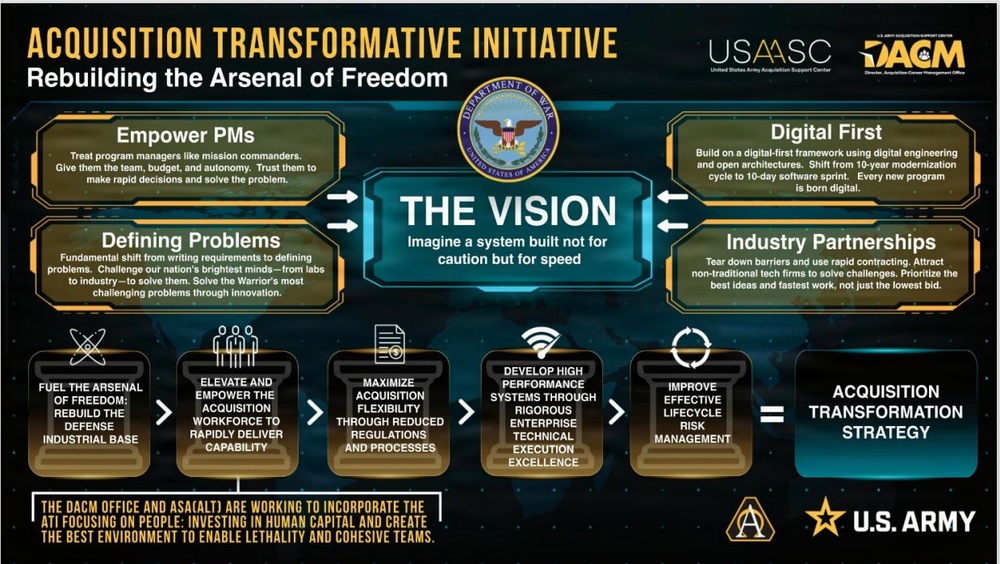
“We look a little different than the other services when you look at the new structures going forward as a result of the acquisition transformation initiative,” said Ronald R. Richardson, Jr., director of acquisition career management at the U.S. Army Acquisition Support Center, who spoke on the panel. This reflects the Army’s transition from the traditional program executive office (PEO) model to a more agile program acquisition executive (PAE) structure that reduces manpower and better aligns requirements, funding and acquisition tools under a single authority. Under the new structure, the former PEOs transition into capability program executives (CPEs), aligned within the PAE framework alongside key enablers. The change is intended to streamline decisions and accelerate capability delivery.
Richardson outlined how the Army Acquisition Workforce is navigating significant transformation and reshaping how it develops and empowers acquisition professionals. He described substantial changes over the past year, including workforce reductions that have resulted in both the loss of senior expertise and a diminished junior pipeline. Despite these challenges, he emphasized that the Army is focusing on recruitment, retention incentives and workforce modernization to close emerging gaps. Central to the effort is a shift toward agility, prudent risk-taking and stronger partnerships with industry.
“We’re fundamentally changing from the ground up how we’re going to build that ethos into our workforce to really be focused on rapid delivery of capability,” Richardson said.
He also highlighted new Army-specific training initiatives, including updates to curriculum at The Army Acquisition School in Huntsville, Alabama. These efforts focus on cybersecurity, artificial intelligence, commercial contracting approaches and integrating risk management into daily workflows—all designed to better prepare professionals to deliver capabilities more quickly.
Lauren Engle, director of acquisition talent management for the Department of the Navy, framed workforce transformation as a strategic imperative tied directly to national security. “This isn’t just a workforce management story, it’s a national security story,” Engle explained to panel members. “The acquisition professionals who manage our programs, negotiate our contracts and steward our resources are mission-critical partners.”
Engle described how the Navy is responding to workforce reductions by rethinking how acquisition talent is recruited, developed and sustained. Similar to the Army’s four pillars of Army Acquisition Workforce Reform, the Navy’s approach centers on four lines of effort—recruit, develop, manage and assess—which Engle described as “pillars of a transformation ecosystem, each reinforcing the others.”
Speed of hiring is a key readiness factor, supported by programs such as the Naval Acquisition Development Program and expanded hiring authorities.
“We are shifting from compliance-based management to outcome-driven talent development,” Engle said. “The question now isn’t ‘did this person complete their training requirement?’ It’s ‘is this person ready to deliver for the warfighter?’ ”
She also emphasized aligning performance management with mission outcomes. “You want to incentivize the behaviors that actually matter—speed, innovation and calculated risk-taking,” Engle said.
While each service maintains its own parallel institutions—like the Army War College and Naval Education and Training Command—that develop and train personnel within their respective branches, the Warfighting Acquisition University represents a Fourth Estate function supporting the department-wide acquisition force. Panelist Michelle Trigg, director of acquisition career management for the Fourth Estate, highlighted the complexity of supporting acquisition professionals across more than 30 defense agencies and field activities with varied missions and workforce needs.
Despite recent reductions, Trigg noted that nearly 80% of the Fourth Estate workforce is already certified in their functional areas. She emphasized the importance of continuous learning, tailored development and cross-functional expertise to maintain readiness.
“We’re focusing on paying attention to shaping ourselves for that future acquisition,” Trigg said. “Whether they be foundational professionals, experts from the field or the workforce we have today, shaping ourselves to shape the future is very important.”
Trigg underscored the growing role of individualized development plans, credentials and flexible learning tools, including resources from the Warfighting Acquisition University, to help professionals stay current and adapt to evolving mission demands.
By highlighting cross-service initiatives in education, credentialing, workforce development and performance management, the panel reinforced the importance of synchronizing talent management efforts across the Department of War.
These efforts are helping shape a modern acquisition workforce—one prepared to accept prudent risk, leverage industry innovation and accelerate the delivery of capabilities to the warfighter in an increasingly complex global environment.
For more information about the Naval Postgraduate School, go to https://nps.edu/. For more information about the Warfighting Acquisition University, go to https://www.waru.edu/.
CHERYL MARINO is a writer-editor at the U.S. Army Acquisition Support Center at Fort Belvoir, Virginia, providing contract support for Behind the Frontlines and TMGL, LLC. Prior to USAASC, she served as a technical report editor at the Combat Capabilities Development Command Center at Picatinny Arsenal. She holds a B.A. in communications from Seton Hall University and has more than 25 years of writing and editing experience in both the government and private sectors.
| Date Taken: | 05.21.2026 |
| Date Posted: | 05.26.2026 09:45 |
| Story ID: | 565904 |
| Location: | US |
| Web Views: | 78 |
| Downloads: | 0 |

This work, Acquisition Leaders Highlight Workforce Transformation at NPS Symposium, by Cheryl Marino, identified by DVIDS, must comply with the restrictions shown on https://www.dvidshub.net/about/copyright.


No keywords found.




