
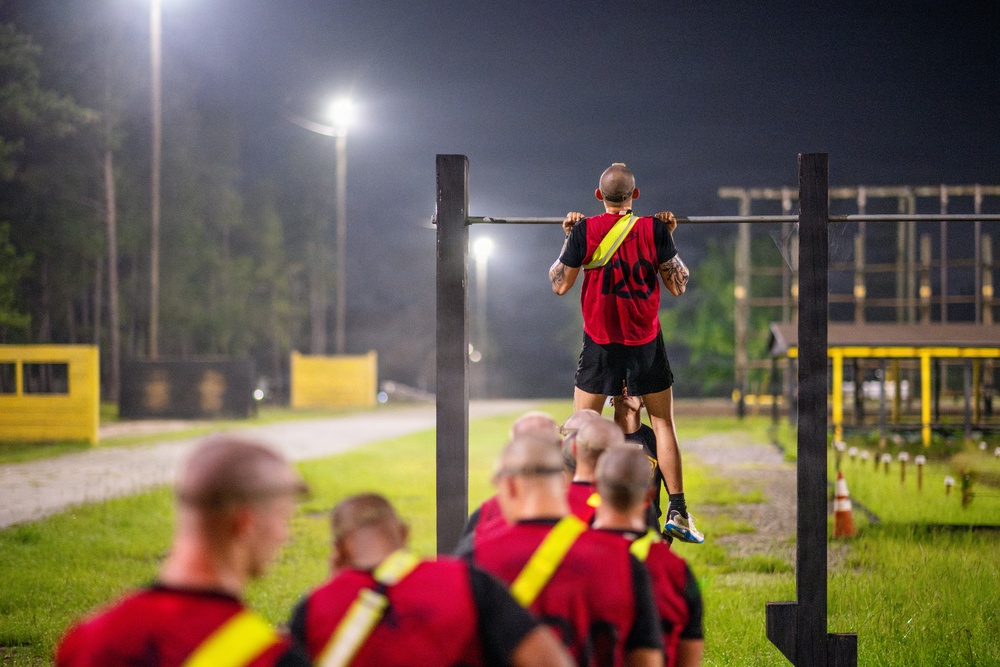
Photo By Capt. Stephanie Snyder | A U.S. Army Ranger student performs chin-ups during the Ranger Combat Fitness...... read more read more
 Subscribe
FORT BENNING, Ga. — In June 2025, the Airborne and Ranger Training Brigade refined its entry requirements for the Ranger Course, implementing the Ranger Combat Fitness Assessment to evaluate the physical durability and functional readiness of students. The assessment replaces the legacy Ranger Physical Assessment, shifting from traditional gym-based exercises to a tactical circuit designed to evaluate a student’s capacity to perform under the metabolic and physical demands of a high-intensity environment.
“The RCFA gives our cadre the ability to assess a student’s capacity to endure the cumulative strain of the program,” said Brig. Gen. Phillip J. Kiniery III, commandant of the U.S. Army Infantry School, which ultimately oversees the Ranger Course. “A primary concern for the command is ensuring students can not only meet the standard on day one but also sustain that level of performance throughout the course without compromising safety.”
The core of the RCFA is a continuous, high-intensity circuit that must be completed within a 12-minute and 30-second window. The clock begins with an initial 800-meter run, which reflects the physical strain of a movement to contact from an insertion point to a target area. Upon completing the run, students immediately transition to scaling a 6-foot wall without the use of side beams. This task mirrors the explosive upper-body strength required to crest compound walls or enter elevated breach points during urban operations. Failure to clear this obstacle within the first eight minutes of the circuit results in an immediate course failure.
Following the wall, students execute individual movement techniques by performing 3-to-5 second rushes between designated sandbag fighting positions and going prone at each station. This requirement evaluates the coordination needed to move under fire while transitioning between prone and standing positions. To assess the capacity for sustained labor, students move two five-gallon water cans — each weighing approximately 40 pounds — to a platform and back, reflecting the tactical necessity of manually resupplying a forward patrol base.
This is followed by a sandbag lift, requiring the placement of 16 40-pound sandbags onto a platform. This event simulates the physical tax of hardening a defensive position or establishing a support-by-fire position. Any bag that falls must be replaced before the student proceeds to the weighted sled drag, which evaluates the anaerobic strain of moving a 160-pound simulated downed teammate to a collection point. The 12-minute and 30-second clock concludes with a second 800-meter sprint, representing the requirement to break contact and move to an extraction point.
Upon successful completion of the tactical circuit, students transition to final endurance gates. The primary requirement is a 4-mile run, which must be completed in 32 minutes or less, at an average 8-minute per mile pace. Before the 4-mile run, students are given a 25-minute break to change into the appropriate seasonal APFT uniform, resulting in a 1:2 work-to-rest ratio prior to the 4-mile run. To ensure proper conditioning, students must reach the two-mile turnaround point in no more than 17 minutes. This standard ensures the student can maintain the high operational tempo required throughout the Ranger Course. The assessment concludes with the chin-up event, testing upper-body pulling strength.
Students must execute six correct repetitions from a dead hang with palms facing toward the body. While a failure on the first attempt is significant, the standard allows for one retest following a mandatory 10-minute rest period. A second failure on the chin-up retest results in a final failure for the assessment. This event relates to the vertical mobility required for tasks such as rope climbs, cliff-side navigation, and negotiating urban obstacles while under load.
The assessment uses two uniform configurations. The tactical circuit is conducted in Army Combat Uniform trousers and boots to simulate operational movement, with headlamps and reflective belts required for safety. For the 4-mile run and chin-ups, students transition to the Army Physical Fitness Uniform.
“The RCFA is about refining how we measure the standard,” said Col. Stewart Lindsay, Airborne and Ranger Training Brigade commander. “By moving toward functional tactical tasks like the weighted sled drag and wall climb, cadre can better assess a student’s true physical durability. This allows us to identify potential safety concerns early and ensure that every Soldier who moves into the mountains has the structural strength to reach the finish line.”
| Date Taken: | 05.21.2026 |
| Date Posted: | 05.21.2026 10:26 |
| Story ID: | 565884 |
| Location: | FORT BENNING, GEORGIA, US |
| Web Views: | 113 |
| Downloads: | 0 |

This work, RCFA prioritizes student assessment and safety, by CPT Stephanie Snyder, identified by DVIDS, must comply with the restrictions shown on https://www.dvidshub.net/about/copyright.


No keywords found.




