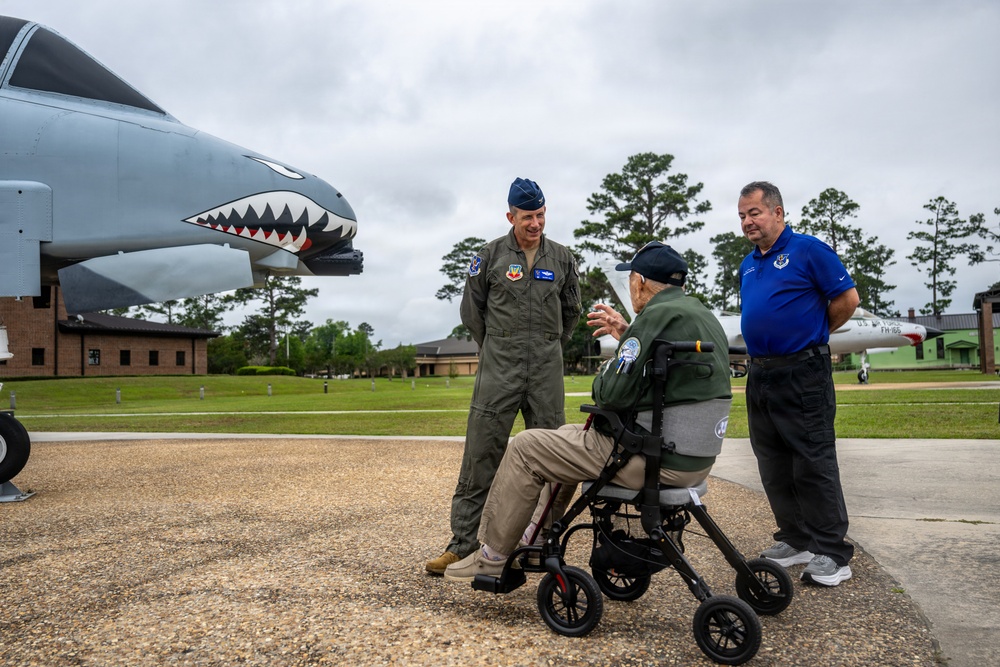
Photo By Airman 1st Class Savannah Carpenter | U.S. Air Force retired Col. Joe Peterburs, World War II veteran, discusses aircraft in President George W. Bush Heritage Park with Col. Sean Hall, 23d Wing commander, and Mark Godwin, 23d Wing historian, at Moody Air Force Base, Georgia, May 9, 2026. The discussion highlighted Peterburs’ experiences as a fighter pilot and the evolution of Air Force airpower across generations. (U.S. Air Force photo by SrA Savannah Carpenter) see less
| View Image Page
WWII fighter pilot reflects on Air Force heritage at Moody Air Force Base
MOODY AIR FORCE BASE, GA. – History stood quietly among the weathered aircraft of Moody Air Force Base’s President George W. Bush Heritage Park as retired Col. Joe Peterburs reflected on a lifetime shaped by war, sacrifice and unwavering service. Surrounded by the very aircraft that symbolize generations of American airpower, the World War II P-51 Mustang pilot, former prisoner of war and veteran of three wars shared stories forged through combat and resilience, offering a living connection to the Air Force’s past.
Surrounded by aircraft symbolizing generations of Airmen, Peterburs offered a living connection between the Air Force’s past and present, a reminder that while the aircraft have changed, the mission and the people have not.
“It’s been deeply humbling to walk these bases again and see how the Air Force continues to honor its history,” Peterburs said. “Many of the places we’ve visited brought back memories of young men who served beside me, some who made it home and some who did not. At 101 years old, I never imagined I’d have the opportunity to revisit these places and share these stories with younger generations. It reminds me that our service and sacrifices have not been forgotten.”
Throughout the tour, which included multiple historic stops tied to his decades of service, Peterburs reflected on the moments that stood out most during his time visiting Moody Air Force Base and other locations connected to his military career.
“Returning to places connected to my training and wartime service has been emotional,” Peterburs said. “Seeing the aircraft, the old airfields and meeting today’s Airmen has reminded me of how quickly time passes, yet how strong the bond of military service remains. One of the most meaningful moments has simply been seeing young people genuinely interested in learning about our generation and what we experienced. Although the technology has changed tremendously over the years, the commitment, dedication and sense of duty among Airmen have stayed the same.”
As the tour continued through Heritage Hall and Moody AFB, Peterburs paused to reflect on the places, sights and conversations that had carried him back through decades of service.
“Seeing the aircraft up close again immediately takes me back to my flying days,” Peterburs said. “The smell of aviation fuel, the sound of engines, even the sight of a flight line. It all comes back very quickly. Looking at those airplanes reminded me of the men I flew with and the missions we carried out together. Aviation was more than a job to us; it was our duty and our way of life.”
Those memories reach back to the earliest turning point in his life.
In 1941, while attending seminary in Wisconsin and studying for the priesthood, Peterburs learned of the attack on Pearl Harbor—a moment that ultimately shaped his decision to leave that path and enlist in the U.S. Army Air Forces in 1942.
That decision placed him on a path that would carry him into some of the most pivotal moments of World War II.
On his 49th combat mission in 1945, then-Lt. Peterburs was escorting B-17 bombers over Germany when his formation came under heavy attack by German fighters. Breaking off alone, he pursued a Me-262 jet fighter—Germany’s first operational jet and one of the most advanced aircraft of the war—after witnessing it strike multiple bombers, following it through chaotic skies and over a German airfield during the engagement.
His aircraft was hit during the fight, forcing him to bail out and descend alone into enemy-controlled farmland. In the immediate aftermath, he focused on survival, aware of how quickly everything had unfolded and relying on his training to stay composed under pressure while recognizing he was deep behind enemy lines and thinking of the certainty that news of his situation would soon reach his family.
“Everything happened very quickly,” Peterburs said. “One moment you’re focused on the mission, and the next you’re trying to get out alive. After parachuting down, I knew I was in enemy territory and that every decision mattered. There was fear, certainly, but also determination. Training teaches you to stay calm and keep moving forward, even under the worst circumstances. At that moment, I thought my mom was going to get a telegram.”
Upon landing, he was quickly surrounded in a rural field where German civilians were working before a Luftwaffe sergeant arrived by motorcycle, fired warning shots and took him into custody as a prisoner of war.
He was transported through German-controlled territory and endured interrogation by German forces while being moved between holding locations. During this time, he also experienced the instability of the war's final months, including periods spent sharing air raid shelters with German airmen during Allied bombing raids.
He eventually escaped during the evacuation of his prison camp and made his way east through collapsing German defenses, where he encountered a Soviet tank column and traveled with advancing Russian forces toward the Elbe River. From there, he was recovered by a U.S. Army patrol and returned to American control after months behind enemy lines.
Decades later, researchers concluded the Me-262 pilot he engaged was likely Walter Schuck, a highly decorated German ace credited with 206 aerial victories. The Me-262 itself was Germany’s first operational jet fighter and among the most advanced aircraft of World War II, making the encounter one of the war’s most significant air-to-air engagements. In 2005, Peterburs and Schuck would finally meet and form an unlikely friendship, with Schuck later explaining that his aircraft had been critically damaged in the encounter and that he likely would not have survived the final months of the war.
“Being shot down over Germany changed my life forever,” Peterburs said. “In those moments, you realize how fragile life truly is and how much depends on the people beside you. Surviving that experience taught me resilience, humility and the importance of leadership under pressure. It shaped the way I approached every responsibility afterward, both in combat and in life.”
That experience in the skies over Germany would define the rest of his life in uniform, shaping a career that continued through Korea and Vietnam.
In Korea, Peterburs flew 76 combat missions in the F-51D Mustang and survived multiple combat injuries, including gunfire to the face. During Vietnam, he served as a command and control officer and endured a Viet
Cong rocket attack during the Tet Offensive. He later commanded tactical air control units in Europe and earned numerous military honors, including the Legion of Merit, Distinguished Flying Cross, Bronze Star, Purple Heart, Air Medal and POW Medal.
When asked to reflect on his service across World War II, Korea and Vietnam, Peterburs said the memories that remain with him are not defined by any single mission, but by the people who served beside him.
“The memory that has stayed with me most is the loss of fellow pilots and friends,” Peterburs said. “Combat missions were dangerous every single day, and there were many young men who never got the chance to grow old. You carry those memories with you forever. At the same time, I also remember the incredible courage and teamwork that existed among our crews and squadrons.”
As his visit to Moody Air Force Base came to a close, Peterburs reflected on the values that he believes have remained unchanged across generations of Airmen.
“Duty, integrity, teamwork and sacrifice,” he said. “Those values never change. Every generation faces different challenges, but the commitment to serving something greater than yourself is what connects Airmen across the decades.”
He added that the importance of preserving Air Force history lies in ensuring that connection is never lost.
“It means everything,” Peterburs explained. “History matters because it teaches future generations what was sacrificed to preserve freedom. When veterans are remembered and their stories are shared, it keeps that history alive. I’m grateful the Air Force continues to value and preserve those connections.”
From a lifetime of combat, loss and service, he offered a final message to today’s Airmen rooted in responsibility.
“Never take freedom for granted,” Peterburs said. “Service requires sacrifice, discipline and courage, but it is one of the greatest privileges a person can have. Remember those who came before you, honor those beside you and always do your duty with integrity.”
At Moody’s Heritage Hall and air park, those reflections were echoed by the base historian, who said Peterburs carried a quiet humility throughout the visit while sharing stories that bridged generations of Airmen.
“Col. Peterburs talked about Air Force personnel praising him for being from the Greatest Generation,” said Mark Godwin, 23d Wing historian. “He told me, ‘That’s hogwash. I just served my country and tried to do the best I could. Now it’s time for today’s Airmen to make their generation great.’”
Godwin added that visits like Peterburs’ reinforce the Air Force’s culture, heritage and warrior ethos by connecting today’s Airmen directly with those who lived its history.
“Col. Peterburs’ visit gives us a glimpse into the past,” Godwin said. “As we stopped at each aircraft in the air park, he had a story to tell.”

 Subscribe






