
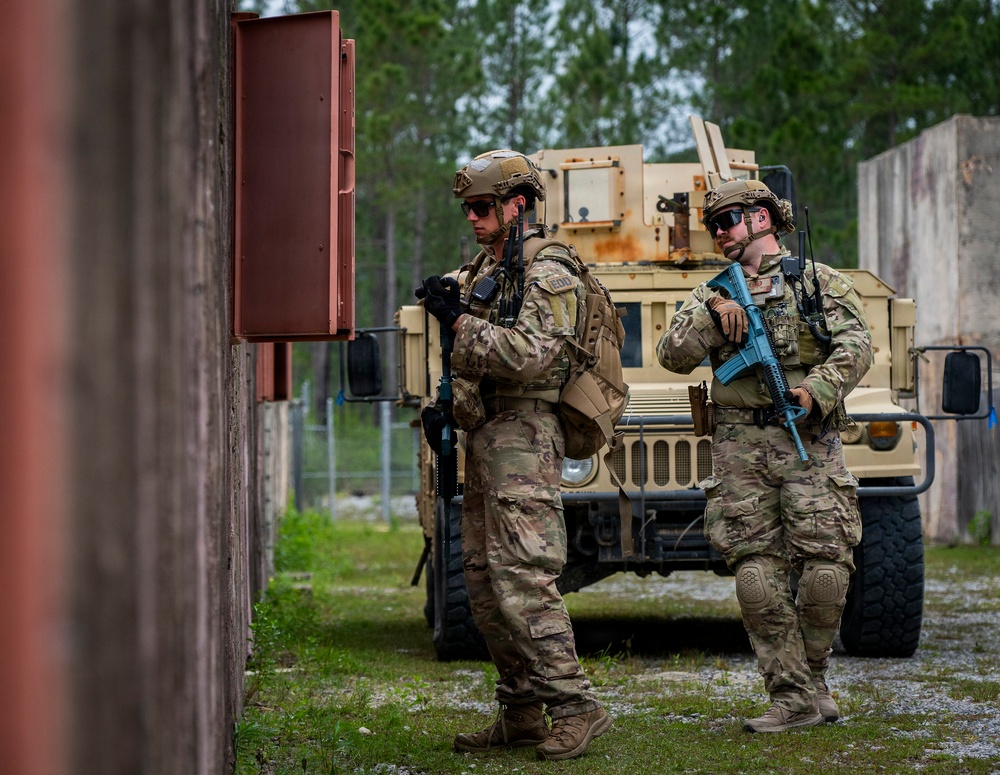
Photo By Samuel King Jr. | Staff Sgt. Justin Thomas, 354th Civil Engineer Squadron, checks inside a building for...... read more read more
 Subscribe
A flashlight beam breaks through the darkness of a culvert. TheExplosiveOrdnanceDisposal Airman’s light lands on a hidden-away cache of grenades and rocket launchers.
The Airman enters the culvert using his arms and legs to grip the concrete walls to hover over the weapons. After carefully assessing the situation, he secures a rope to the cache as sweat drips off his nose. He slowly eases himself and the rope back out, so he and his team can create a pulley system to remove the armament from the culvert.
Airmen repeatedly faced scenarios like this during the EODwarfighter training event held the first two weeks in May. The 96th Test Wing-hosted annual event brought together 95EOD Airmen from five different major commands for skills development and some hands-on training.
Each year, thewarfighter event uses real-world data gleaned from operational areas of responsibility to focus the training on the most current scenarios occurring down range.This year’s focus areas wereUSSOUTHCOM,EOD quality assurance processes, aircraft arming and de-arming familiarization,and combat medical training.
In the Air Force EOD community, knowing and enforcing standards across the career field is a critical piecedue to its inherent danger.
A unit evaluator performs inspections toensure Airmenfollow standard EOD processes and procedures. During thewarfighter event, new Airmen become evaluators and then apply that skill in evaluating the exercise scenarios throughout the week.
Many times, an Air Force EOD team will beisolatedduring a response,ensuring an area is safe from explosive hazards in support of a larger joint or coalition force, to provide freedom of maneuver. A higher level of medical knowledge and expertise benefits that Airman, so if an accident or injury occurs, the technician can provide some care and brief medical personnel they may escort into a hot zone.
“Every second counts when it comes to injuries and if something happens, it's nice to know I can provide immediate aid to help my brothers and sisters downrange,” said Staff Sgt. Braden Farlow, 788th Civil Engineer Squadron from Wright Patterson AFB, Ohio.
Thewarfighter focuses on bothAirmen and aircraft safety. A part of the Air Force EOD mission is working with aircraft maintenance teams if an aircraft has a weapon malfunction or hazard,like damaged gun rounds or punctured munitions.
Eglin’s various flying missions provided the EOD Airmen hands-on familiarization and experience with three different fighter aircraft and the arming and disarming procedures required for each of them.
“Many Airmen can go most of their career and not work with the fighters we have here,” said Staff Sgt. Joseph Trumble, 96th Civil Engineer Squadron. “This familiarization allows the Airmen to see the aircraft and examine its weapon components up close. This removes some of the mystery that may surround it, so they’re more comfortable if they must respond to an aircraft explosive hazard.”
The culmination of these events was the warfighter challenge where three-person teams performed day and nighttime tactical EOD field procedures like detonations, bomb, drone and weapons removal and disposal and more.
The teams found a hazard and worked on the problem while communicating with each other, the teams around them,and up the leadership chain. Instructors also injected new and different variables into the scenario forcing the teams toevolvetheir approach and tactics. The recently trained QA evaluators watched and provided real-time feedback as these sequences played out.
“Working with explosives in such a constrained real-life environment isn’t something available to a lot of smaller EOD units,” said Master Sgt. Daniel Metts, 96th CES. “The Eglin range complex provides us with areas to conduct this training.”
For those three-person teams of mostly new NCOs and senior airmen, the combat realistic training was invaluable.
“I’m learning so much just gaining reps as a team leader-in-training from all of the small unit tactics we apply and constant communication through the coordination chain,” said Staff Sgt. Jonathan Conradt, 366th Civil Engineer Squadron from Mountain Home AFB, Idaho. “At home, we can train on devices all day long, but this large-scale experience is the biggest value for me.”
Plans have already begun for next year’s warfighter exercise, which takes place in conjunction with the annual EOD Memorial ceremony each year. The exercise’s events will continue to evolve as the Air Force EOD career field adapts to constantly changing threats.
“These annual training events give EOD techs the realistic field repetitions they need to handle complex hazards,” said Capt. Jacob Murray, 96th CES. “It takes a lot of effort from our Eglin EOD Team to put on these events, but this exercise and training guarantee our technicians maintain the operational lethality and strict safety standards required to enable the Joint Force maneuver anywhere in the world.”
| Date Taken: | 05.19.2026 |
| Date Posted: | 05.20.2026 10:30 |
| Story ID: | 565758 |
| Location: | FLORIDA, US |
| Web Views: | 37 |
| Downloads: | 1 |

This work, Toward danger: warfighter exercise ensures EOD readiness, by Samuel King Jr., identified by DVIDS, must comply with the restrictions shown on https://www.dvidshub.net/about/copyright.


No keywords found.




