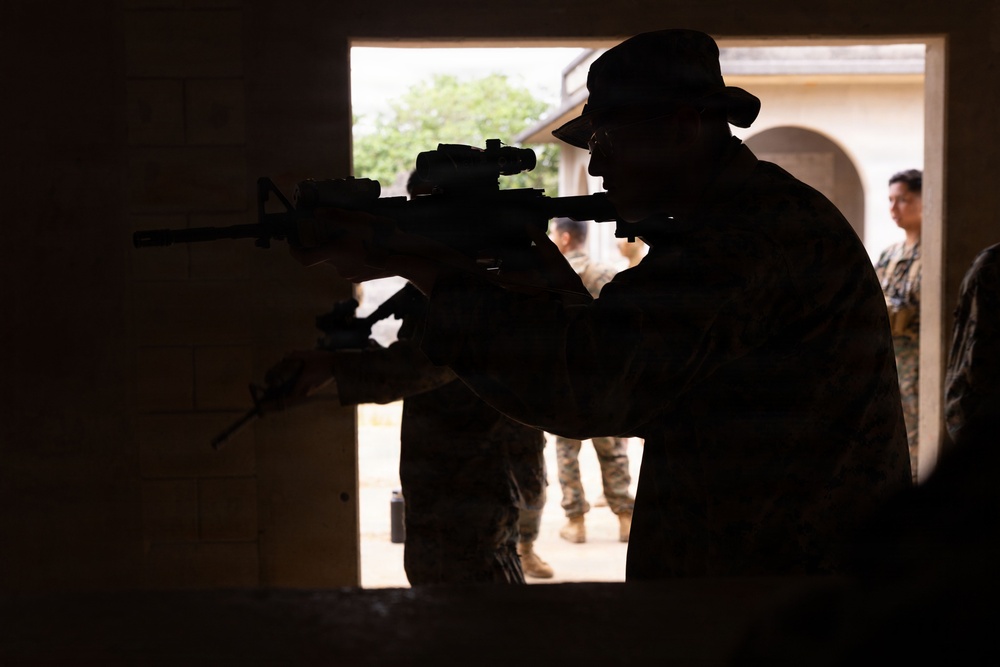
Photo By Cpl. Ella Cadby | U.S. Marine Corps Lance Cpl. Tyler Bassett, a combat graphics specialist with Headquarters and Headquarters Squadron (HHS), Marine Corps Air Station Iwakuni, and a native of Tampa, Florida, practices clearing a room during a Communication Strategy and Operations field training exercise on Camp Hansen, Okinawa, Japan, April 9, 2026. The COMMSTRAT FTX is a five-day event focused on increasing quick decision-making skills and tactical proficiency through high pressure environments to provide commanders with more capable COMMSTRAT forces. (U.S. Marine Corps photo by Cpl. Ella Cadby) see less
| View Image Page
MARINE CORPS AIR STATION IWAKUNI, YAMAGUCHI, JAPAN
MARINE CORPS AIR STATION IWAKUNI, Japan – What would drive someone to wake up before the sunrise; to carry packs tightly stuffed with more gear than thought possible; and what would motivate them to rush into danger?
Beneath the reputation of intensity and aggression, the Marine Corps’ culture is built on loyalty, accountability and the sacrifice of those who served before us. Marines are seen as disciplined, stubborn and brave young men and women, shaped by difficulty and defined by their ability to never give up. Marines are driven by a mindset that embraces challenge rather than avoids it; a mindset forged through tough military training, shared struggle and commitment.
Often recognized for their efforts behind a camera, Marines with Communication Strategy and Operations are expected to embody the same resilience and warfighting mindset as every Marine. COMMSTRAT Marines with III Marine Expeditionary Force and Marine Corps Installations Pacific, faced a five-day field training exercise consisting of an obstacle course, a live-fire range, a 13-kilometer hike, Marine Corps martial arts, and site exploitation while sleeping outdoors under harsh weather. This training was meant to test their mental tenacity as well as their tactical skills.
“We should all maintain some level of tactical proficiency,” said U.S. Marine Corps Cpl. Isaiah Mejias, an infantryman with 2nd battalion, 8th Marines, 2nd Marine division. “This way we can maintain high unit readiness and become better warfighters.”
The uncertainty of war can never fully be predicted, but continuous training builds the resilience, initiative, and adaptability necessary to operate effectively in dynamic environments. The first of many challenges Marines faced during this field training exercise was an obstacle course beginning with a high metal bar, to test both upper and lower body strength, as Marines must spring up, grab the bar and pull themselves up and over. Overcoming the cold steel bar, Marines must then jump over logs, testing their endurance and coordination. They climb, jump, and sprint over and under various obstacles, only to be stopped short by a tall red wall. Many attempt the climb, but few pass without assistance. Last, but not least, the rope climb. One hand over the other, a simple task made more difficult when adrenaline runs dry.
“I gassed myself in the beginning, only for my arms to give out on the rope climb,” said Cpl. Moses Ortiz-Miller, a combat videographer participating in the field training exercise.
No matter the obstacles, there are many common sayings in the Marine Corps meant to keep a Marine moving forward.
One, “Embrace the suck." This encourages Marines to accept hardship rather than resist it. Challenges are welcomed as opportunities to grow stronger while weeding out deficiencies.
Two, “Be comfortable with the uncomfortable.” Marines are taught to adapt to conditions many people avoid; to grow accustomed to harsh conditions and bodily cries, the aches and pains that scream for attention.
Three, “This is what you asked for." This is a reminder of the commitment every Marine willingly accepted: to uphold the integrity of the uniform and all it symbolizes. A Marine’s mentality runs on the promise of a challenge and protects the country’s reputation by representing its strength and core values.
“There is not one person in the Marine Corps that is not going to face hardship at some point,” said 1st Lt. Tyler Thomas, the production officer in charge of III Marine Expeditionary Force. “Hardship just makes us that much better and more prepared.”
The challenges Marines face are meant to strengthen their endurance and test their mental agility. The training undergone by Marines is mostly thought to be physical; however, the true challenge often lies in the mental resilience required to endure hardship and persevere when the body wants to quit.
Motivation is an unreliable feeling; one must have determination to commit to maintaining the high standards of the Marine Corps. A 7.8-mile ruck carrying over 45 pounds of gear, walking up and downhill can make anyone question their decision to enlist. Muscles start cramping a few miles in, foreheads are slick with sweat, and blisters burn against wet socks and miles still to conquer ahead. Nevertheless, every Marine participating must finish the hike.
What does it mean to be a Marine?
It isn’t about wearing the uniform. It’s about who you become once you have earned the right to wear it. Every Marine learns to embody every trait the Marine Corps holds dear.
“Not only can I do it, but I can exceed their expectations,” said Pfc. Angel R. Avalos, a combat graphics specialist participating in the field training exercise.
No matter the insurmountable odds a Marine faces, it is expected for them to overcome it. Marines need to be tactically proficient and prepared for war at any given moment. That includes having the mentality to never stay down and to welcome challenges with open arms.

 Subscribe






