
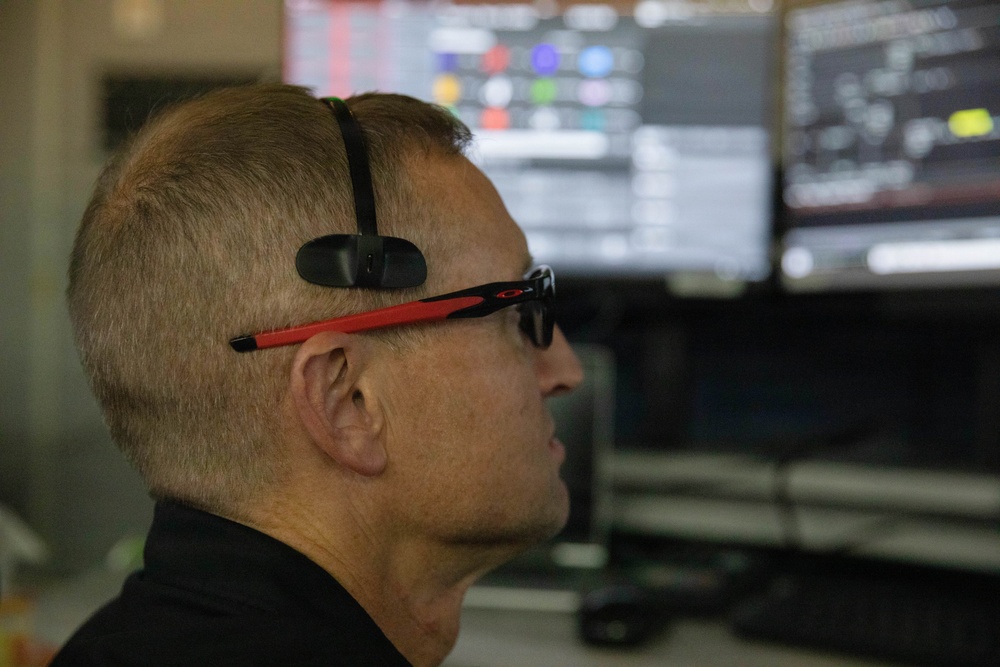
Photo By Lance Cpl. Gage Collins | Jeremiah Johnson, an emergency services dispatcher with Headquarters and Headquarters...... read more read more
 Subscribe
MARINE CORPS AIR STATION IWAKUNI, Japan – Tucked away aboard Marine Corps Air Station (MCAS) Iwakuni deep inside an unobtrusive building, lies a compact, barely lit room, just big enough for five or six people. Computers, phones and radios line the desks, while monitors brighten the dim room. Initially, one might see this as just another office.However, this room, and the people who work inside are a crucial component in keeping service members, civilians, their dependents, and all other personnel working at MCAS Iwakuni safe. “We’re a communication center, so our job is to make sure everyone is in the loop,” said Ricardo Reyes, an emergency dispatch telecommunicator (EDT) with Headquarters and Headquarters Squadron (H&HS). The H&HS Dispatch team answers all emergency calls from service members, their dependents, or SOFA personnel both on and off base. Twenty-four hours a day, seven days a week, two teams stay on high alert, working for 12 hours and switching between day and night rotations. “No two days are the same in dispatch, that’s for sure,” said Kori Kleinjans, an EDT with H&HS Being an emergency dispatch telecommunicator takes someone who is skilled and knowledgeable in the systems that they use. There are many moving parts to their job: each member of the team needs to be able to pick up the phone, rapidly coordinate, inform, and send the proper authorities to the scene. Along with needing an immense amount of technical knowledge, they also need to be able to work well under pressure. Calls will come that require a steady head, and EDTs may need to dispatch to a location at a moment’s notice. “A lot of people don’t know what goes on in a dispatch center, they think you’re just answering phones,” said Kleinjans, “but we’re doing mass notifications, answering the phones, dispatching police, fire, EMS (Emergency Medical Services). We’re helping people in their darkest day.” Their 12-hour workdays can sometimes be uneventful, receiving only a few calls over the course of their shift. This gives the crew the opportunity to decompress, spending this time with their fellow co-workers, or working on other things. Christjan Ruby, a U.S. Marine Corps veteran and public safety telecommunicator, uses his downtime to pursue a degree in criminal justice. With young children at home, he is left with little free time outside of work, so the gaps between phone calls allow him to further his education. During their busy days, however, they may receive over a hundred calls in a day. Their entire shift is spent on the phone with the callers and dispatching authorities or coordinating with the local population. Being on standby for hours makes long days feel even longer. Still, though, they need to be ready to answer the call at the drop of a hat. While one may see this as a relaxed setting to a very critical job, the MCAS Iwakuni emergency dispatch center has proven to be very effective. In April 2026, the team was awarded the MCICOM Emergency Dispatch Services award for Public Safety Communications Center of the Year. This is the second year in a row that the unit has been recognized for being outstanding in their field. “Not every phone call is an emergency, but we have to be ready for emergency situations. Sometimes, waiting makes us a little tired. But since I have been here for 18 years, I have a switch. I relax, but then once my phone rings, my switch turns on, and my professionalism is on,” said Saki Suemoto, the emergency dispatch telecommunicator supervisor. The Marine Corps Installations Command (MCICOM) Emergency Dispatcher Awards seeks to recognize emergency dispatchers from around the Marine Corps. While members of emergency dispatch centers from Marine Corps Bases Quantico, and Camp Pendleton, and Marine Corps Recruit Depot Parris Island all won awards, dispatchers from MCAS Iwakuni consistently won the most. They won four total awards in each available category, demonstrating their abilities, and devotion to keeping the people of MCAS Iwakuni safe. Tucked away, deep inside an unassuming building lies a dimly lit room, just big enough for five or six people. The people inside are on high alert 24/7, ready to pick up the phone at a moment’s notice. Day in, day out each member of their team ensures the safety of everyone aboard MCAS Iwakuni, on and off base. They are the first voices one will hear when in need.
-30-
| Date Taken: | 05.06.2026 |
| Date Posted: | 05.19.2026 21:06 |
| Story ID: | 565731 |
| Location: | IWAKUNI, YAMAGUCHI, JP |
| Web Views: | 138 |
| Downloads: | 0 |

This work, Inside the Public Safety Communications Center of the Year, by LCpl Gage Collins, identified by DVIDS, must comply with the restrictions shown on https://www.dvidshub.net/about/copyright.


No keywords found.




