Watershed management biologists and specialists with the Colorado State University’s Center for Environmental Management of Military Lands who work in partnership with Fort McCoy’s Directorate of Public Works Environmental Division Natural Resources Branch (NRB) once again completed fish surveys in 2026 at Fort McCoy’s waterways during March and April.
Watershed Management Biologist Derek Maki said the fisheries team conducted many surveys at a variety of lakes, and those surveys will help future fisheries planning.
“The importance of these surveys is so we can monitor populations — that’s the big thing, and body condition of the fish,” Maki said in a past news article. “And then we can see with our stocking rate and make sure we’re not stocking too many at one time with the rainbows. And then continuing these surveys year after year, then we can see how the lake changes over time and if we need to put in different management strategies based off what we’re finding.”
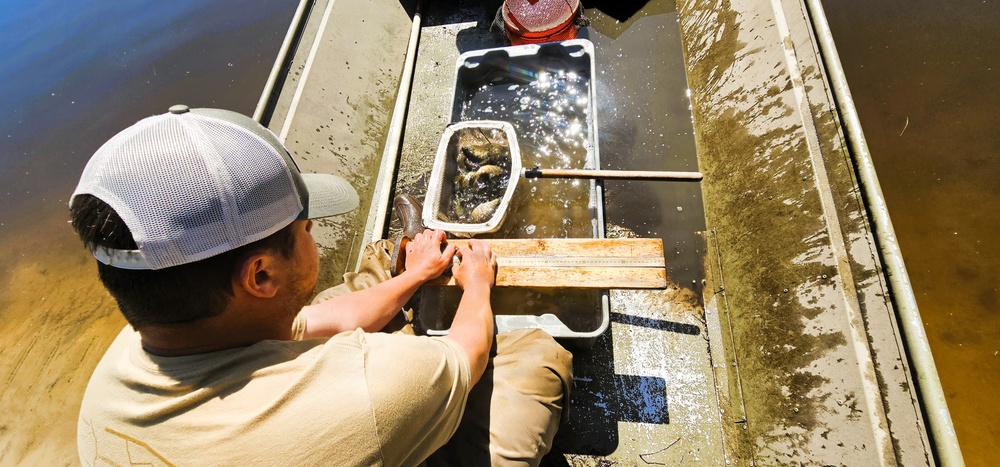
While doing survey work April 22 in Suukjak Sep Lake in Pine View Recreation Area, Maki described what work is done during the survey.
“We’ll get a population estimate on all the fish in the lake by doing marked recapture with a hole punch on the tail,” Maki said. “We’re also taking lengths and weights, and we also take a subsample of scales on each species so we can age the fish with the scales. Then we can look at the length and age and compare that to the historical surveys. We can also compare our findings to the rest of the state of Wisconsin to see where our lakes line up.”
Maki said they normally survey five lakes every year. That’s not every waterway on post as he said they do different sets of lakes during each year’s surveys.
“We typically do five a year, and they’re on a rotational basis,” Maki said. “So, for the most part, each lake is every other year, and North Flowage we sample every year.”
These surveys also help determine the health of lakes and how well that lake’s habitat is supporting fish populations.
“And depending on how our panfish and bass are doing, we can also look at our stocking rates and if we need to change those as well,” Maki said.
A fish survey on each lake is typically a week long, Maki said. But for North Flowage at Fort McCoy, which has a lot of fish, he said it can take three to four weeks. He noted most of the fish surveys at North Flowage are completed with hook-and-line surveys.
“That’s how we get our bass estimate (at North Flowage) and look at body condition,” Maki said.
Fort McCoy Fisheries Biologist Steve Rood, who works with NRB, said in a past news article that this work is critical to understanding the health of each of McCoy’s lakes.
“Each spring we conduct surveys of the fish populations in the lakes on Fort McCoy,” Rood said. “To sample the fish, we place fyke nets around the edge of a lake to capture them. We also will use a boom shocker, which is a boat outfitted with electrodes that puts an electrical current into the water. When the boat goes over a fish, it temporarily stuns them so they can be collected with a net. Using both methods allows us to effectively collect all the fish species in the lake. Each fish that is caught is measured and weighed so we can determine its body condition.”
Rood also said previously that another goal of fish surveys is conducting a population estimate for each species within the lake. Using mathematical equations, a fish population estimate can be derived from marked and recaptured fish during a survey. Age and growth of these populations are also determined from lab assessment of fish structures, such as scales or otoliths.
“Knowing how many fish there are, what the age structure is, and their body condition can tell us a lot about the lake,” Rood said. “For example, if most of the fish are heavier than the set standard, we know there is plenty of food available. Conversely, if the majority of the fish are lighter, it could be due to lack of available food.”
Rood also said that throughout the year, creel surveys monitor fishing pressure on each lake.
“Creel surveys give us an idea about anglers catch and the harvest rate, which can play a big role in fish abundance,” Rood said. “Additionally, surveys including monitoring aquatic vegetation, water temperatures, dissolved oxygen, and nutrients, will paint the entire picture of what is going on under the water.”
Through all of the survey work, much care is taken to ensure the fish caught are not harmed, Rood said. He knows because he has done the work himself for many years. The fish caught include rainbow, brook, and brown trout; bluegills; bass; pumpkinseed; crappies; and other warm-water species.
Rood said he encourages Fort McCoy anglers to report any tagged fish information, too. They can report the date of catch, lake or stream location, the tag number, and fish length information to the Permit Sales Office.
Anglers must have the appropriate Fort McCoy permits and Wisconsin licenses to fish on post. This includes a general Wisconsin fishing license, trout stamp fishing for trout, and a Fort McCoy fishing permit.
The cost of a Fort McCoy annual fishing permit is $13 for people aged 16 and older. Permits for youth under 16, seniors, and disabled anglers and four-day fishing permits are $8. All are available for purchase through the iSportsman website, https://ftmccoy.isportsman.net.
Fort McCoy’s motto beginning in 2026 is “Training the Total Force and Shaping the Future since 1909.”
The installation’s mission: “Fort McCoy strengthens Total Force Readiness by serving as a training center, Mobilization Force Generation Installation, and Strategic Support Area enabling warfighter lethality to deploy, fight, and win our nation’s wars.”
And Fort McCoy’s vision is, “To be the premier training center supporting the most capable, combat-ready, and lethal armed forces.”
Located in the heart of the upper Midwest, Fort McCoy is the only U.S. Army installation in Wisconsin. The installation has provided support and facilities for the field and classroom training of more than 100,000 military personnel from all services nearly every year since 1984.
Learn more about Fort McCoy online at https://home.army.mil/mccoy, on Facebook by searching “ftmccoy,” on Flickr at https://www.flickr.com/photos/fortmccoywi, and on X (formerly Twitter) by searching “usagmccoy.” Also try downloading the My Army Post app to your smartphone and set “Fort McCoy” or another installation as your preferred base. Fort McCoy is also part of Army’s Installation Management Command where “We Are The Army’s Home.”
| Date Taken: |
05.19.2026 |
| Date Posted: |
05.19.2026 17:26 |
| Story ID: |
565716 |
| Location: |
FORT MCCOY, WISCONSIN, US |
| Web Views: |
620 |
| Downloads: |
0 |
PUBLIC DOMAIN

This work, Fort McCoy natural resources fisheries team conducts spring lake surveys; study health of waterways, fish, by Scott Sturkol, identified by DVIDS, must comply with the restrictions shown on https://www.dvidshub.net/about/copyright.

 Subscribe






