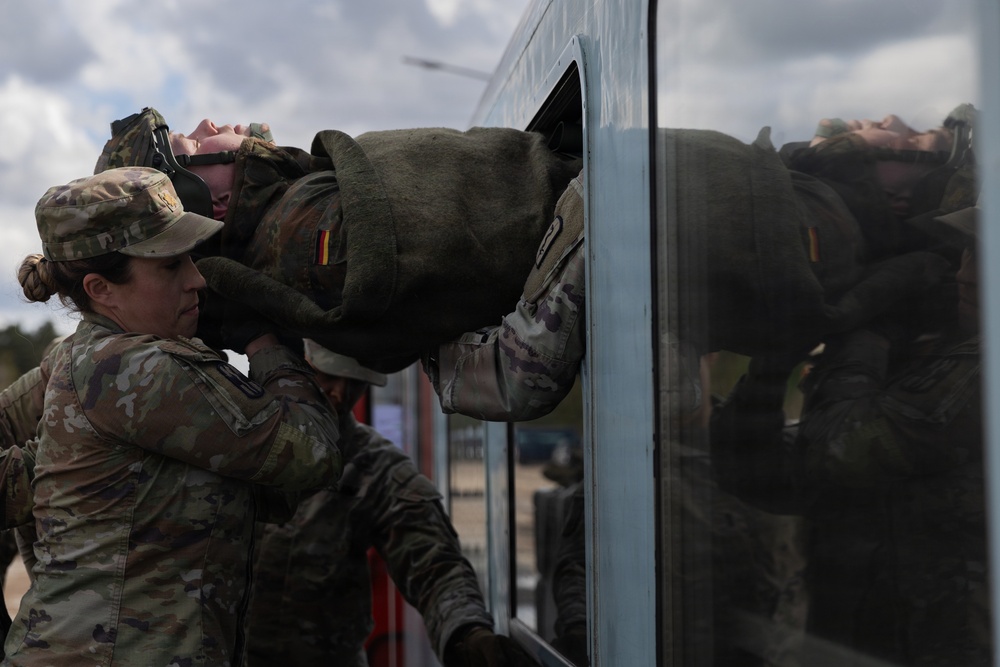
Photo By Pfc. Kadence Connors | U.S. Army Soldiers assigned to the 30th Medical Brigade carry a simulated casualty aboard a train during casualty evacuation training at Drawsko Combat Training Center, Poland, May 14, 2026. The training helps Soldiers practice casualty movement, medical response and coordination in a realistic transportation environment. During Sword 26, the 30th Medical Brigade uses this training to capture lessons learned and strengthen interoperability with NATO medical allies. (U.S. Army photo by Pfc. Kadence Connors) see less
| View Image Page
Army Medicine Expands Casualty Evacuation Training with Rail Operations During SWORD 26
DRAWSKO, Poland — Soldiers with the 30th Medical Brigade conducted a rail casualty evacuation exercise during SWORD 26, May 11-15, to prepare Army medicine for the realities of large-scale combat operations across Europe.
The training, conducted under the 21st Theater Sustainment Command, tested the use of rail transportation as a casualty evacuation platform while integrating multinational medical personnel, host-nation rail systems and NATO interoperability standards.
“We need to make sure that we’re looking at multimodal transportation for casualty evacuation during large-scale combat operations,” said Col. Crystal Belew, commander of the 519th Hospital Center. “We had overwhelming success in what we called the golden hour. We had air superiority. We were able to use rotary-wing evacuation. Moving into large-scale combat operations, we need to use all forms of evacuation methods.”
The exercise reflected a shift in Army medicine’s focus from counterinsurgency operations to preparing for high-intensity conflict against near-peer adversaries, where contested airspace may limit the use of helicopters for medical evacuation.
According to Belew, Europe’s extensive rail network provides an opportunity for NATO allies to train together while testing the challenges of moving casualties across multiple countries and transportation systems.
“Training with rail assets improves NATO interoperability with our host-nation partners,” said Belew. “Europe has one of the most extensive rail networks in the world, and we get to use NATO standards, standardized agreements and transload node agreements when we’re crossing different country borders.”
The rail exercise incorporated multinational cooperation at every level, from medical treatment to transportation logistics.
“The true interoperability would be a Mexican Soldier being treated by a Polish medical provider going to a German facility,” said Belew. “Using a rail asset and training through those different means and methods really brings the interoperability piece to full success.”
In addition to the rail platform, the exercise also tested a casualty staging unit concept, an innovation modeled after systems used by NATO partners. The casualty staging unit is designed to stabilize patients before they are moved onward for additional treatment, helping reduce strain on emergency medical facilities during mass casualty events.
“This is a concept we’re experimenting with that, by doctrine, does not exist in Army medicine,” Belew said. “This is where we are stabilizing stable patients for onward evacuation.”
The training scenario focused on preparing Soldiers and medical personnel for the scale and complexity expected in future conflicts.
“Large-scale combat operations have an expectation of mass casualties and complexity that has not been seen in our generation,” said Belew. “Exercises such as SWORD 26, where we’re focused on larger scales, mass casualties and stressing the system, are training Soldiers for those real-world expectations.”
The exercise also supported the broader sustainment mission of the 21st TSC by ensuring medical forces remain prepared to care for wounded personnel during future operations.
“Army medicine sustains the warfighter,” said Belew. “This training will sustain the warfighter by preparing for large-scale combat operations and preparing our medical professionals to take care of Soldiers.”
By integrating multinational partners, testing emerging medical concepts and expanding casualty evacuation capabilities beyond traditional air evacuation, SWORD 26 demonstrated NATO’s continued commitment to readiness and interoperability across the European theater.

 Subscribe






