
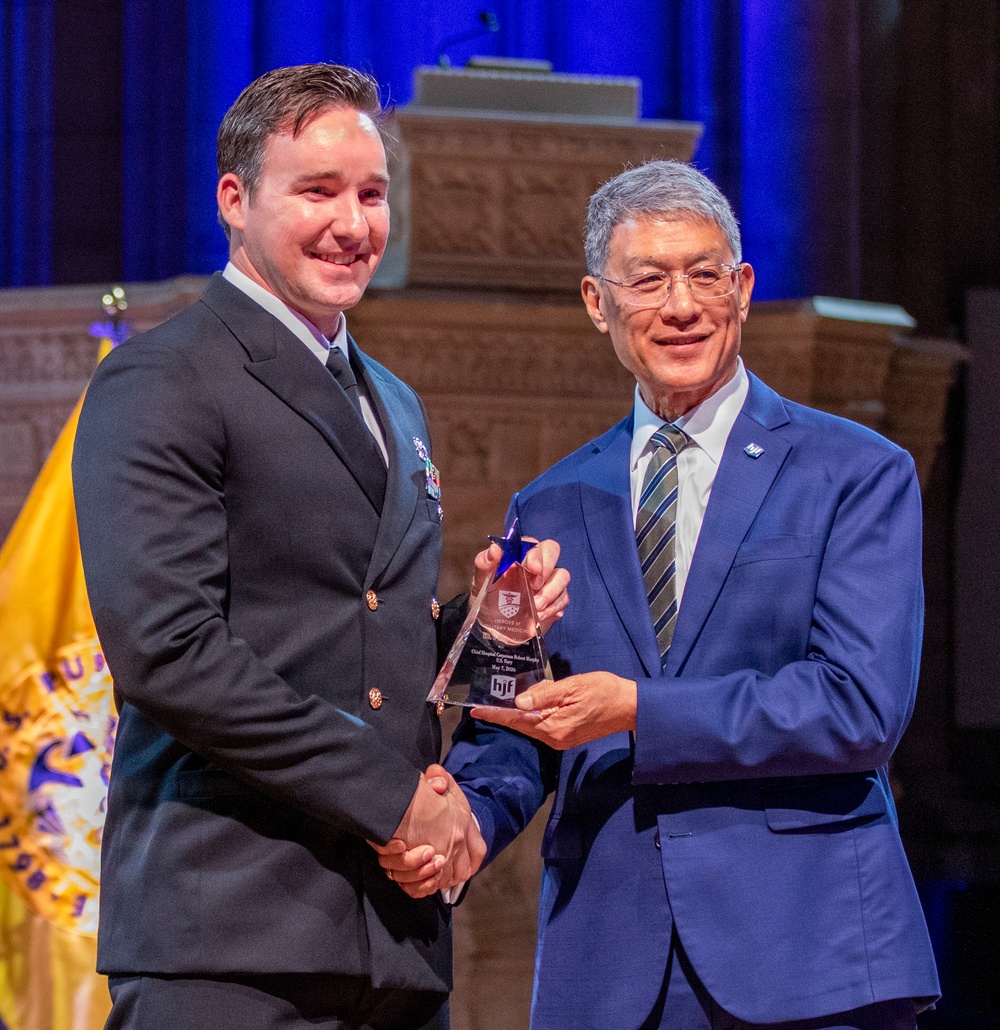
Photo By Sean Metzger | Chief Hospital Corpsman Robert Murphy receives the Hero of Military Medicine Award...... read more read more
 Subscribe
In the Navy, the title of “Doc” isn’t just given; it’s earned through blood, sweat, and unwavering commitment to the Sailors and Marines under a hospital corpsman’s care. For then Hospital Corpsman 1st Class Robert C. Murphy, that commitment was tested in the chaotic waiting room of a foreign hospital where he had to fight not just for his patient’s life, but against a medical system that wouldn’t recognize his own expertise, knowledge, and training.
While participating in an allied submarine rescue exercise with the Turkish Navy near Marmaris, Türkiye, in April 2024, Murphy’s senior medical officer suffered a catastrophichead injury in a fall. As a Deep SeaIndependent Duty Corpsman (IDC) – a highly specialized enlisted medical provider trained to operate alone in austere environments – Murphy’s instincts kicked into gear. He secured the scene, stabilized his officer, and rode with him in an ambulance to the nearby Turkish hospital.
The local staff, seeing a dazed but conscious patient, dismissed the severity of the injury. Murphy, drawing on his advanced education from the Naval Trauma Training Center in the Los Angeles County Hospital, recognized the warning signs of a severe Traumatic Brain Injury (TBI). When the hospital staff refused to admit or evaluate the officer, Murphy built his own trauma bay in the public waiting area. He commandeered a vital sign monitor, positioned his officer to mitigate the rising pressure in his brain, and gathered clinical data with scavenged resources laying around.
After conducting a thorough neurological exam, Murphy went back to the emergency room staff to force them to see the gravity of the situation – intracranial hemorrhage, increased pressure, and herniation. His expertise and unrelenting persistence broke through the language barrier and skepticism. The officer was rushed through to an emergency Computed Tomography (CT) scan, where Murphy’s diagnosis was confirmed: multiple brain bleeds and a life-threatening build-up of pressure.
Knowing that a craniotomy was the only chance of survival for his officer, Murphy contacted the U.S. Embassy to secure authorization for the emergency brain surgery. The procedure went forward, even with a grim prognosis – a low likelihood of survival, let alone neurological recovery.
For the next 48 hours, while the officer was in a coma, Murphy refused to leave his side. He embedded himself into the intensive care unit, managing the intricate details of post-operative care. Even as he slowly regained consciousness, unable at first to speak or understand what was going on around him, Murphy was there, a constant, reassuring presence in a terrifying situation.
To ensure long-term survival and recovery, Murphy needed to get his officer to a U.S. military treatment facility. He coordinated with hospital administrators and a U.S. Air Force Aeromedical Evacuation Team, ultimately accompanying his patient on a two-hour drive in another ambulance to an awaiting C-130 Hercules aircraft, only to be told that he couldn’t board because his rank was too low to warrant a flight with his officer. Many people would have considered his job to be done at this point; his patient was in good hands, on his way to advanced trauma care. Murphy simply turned around and bought himself a commercial plane ticket.
He flew from Türkiye to Germany, making his way to Landstuhl Regional Medical Center. By the time the U.S. neurosurgeon was ready to take over the case, Murphy was standing there waiting for him. He delivered a complete medical turnover, bridging the gap between Turkish civilian and American military healthcare, ensuring that his officer received the exact care needed to make a full recovery. As a deep seaIDC, Murphy’s expertise covers diving physics, hyperbaric medicine, and advanced trauma – all handled with a level of autonomy and trust that few in the medical world ever experience.
In September 2025, in recognition of his sustained superior performance and heroic leadership displayed in Türkiye, Robert Murphy was selected and promoted to the rank of chief petty officer.
The promotion to chief is the most significant milestone in an enlisted Sailor’s career. It signifies the transition from being a technical expert to becoming a true leader – the person the wardroom looks to for truth and junior Sailors look to for help and answers. For Chief Hospital Corpsman Murphy, the transition was natural. He had already been acting with the authority and wisdom of a chief long before the anchors were pinned to his collar.
Murphy currently serves at the Naval Special Warfare Advanced Training Command in Coronado, California, and is the recipient of the Henry M. Jackson Foundation’s 2026 Hero of Military Medicine award. He embodies the core ethos of the U.S. Navy Hospital Corps, proving that when the worst happens in the furthest corners of the world, a hospital corpsman will move mountains to bring their people home.
Navy Medicine's 44,000+ talented and ready forces optimize health readiness, deliver quality healthcare, and provide global expeditionary medical support to warfighters.
| Date Taken: | 05.18.2026 |
| Date Posted: | 05.18.2026 14:15 |
| Story ID: | 565534 |
| Location: | FALLS CHURCH, VIRGINIA, US |
| Web Views: | 103 |
| Downloads: | 0 |

This work, Navy corpsman honored as 2026 Hero of Military Medicine for lifesaving actions overseas, by PO2 Sasha Ambrose, identified by DVIDS, must comply with the restrictions shown on https://www.dvidshub.net/about/copyright.

No keywords found.




