
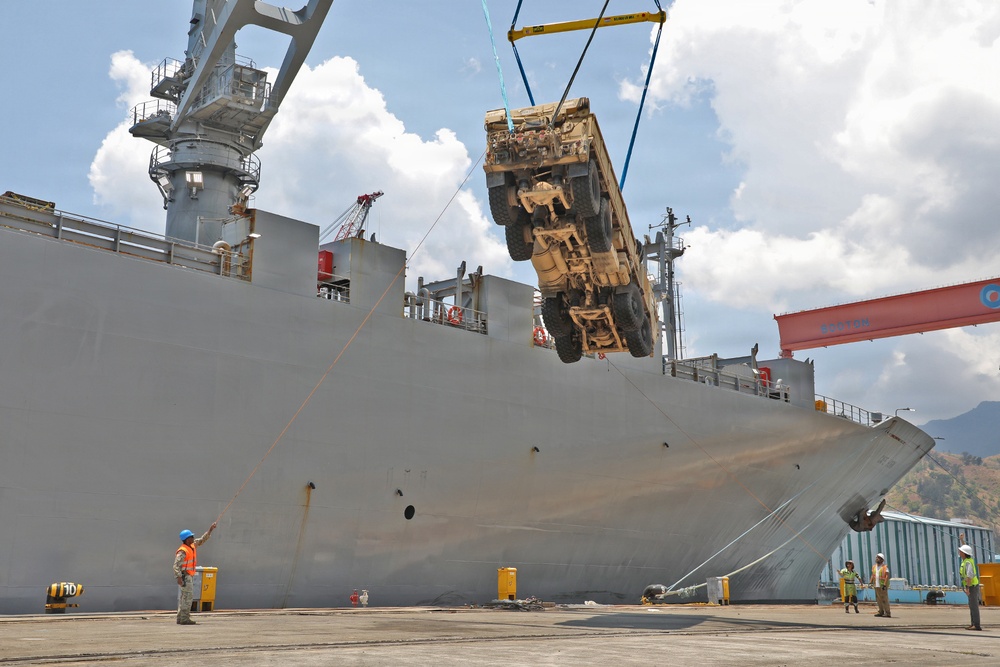
Photo By Master Sgt. P. Behringer | A crane aboard the commercial transport vessel Cape Horn uploads a heavy expanded...... read more read more
SUBIC BAY, PHILIPPINES– In a powerful demonstration of strategic reach and allied cooperation, the 593d Corps Sustainment Command leads the initial sustainment theater opening mission which sets the stage for Balikatan 2026. This exercise is the largest annual bilateral military exercise between the Armed Forces of the Philippines and the U.S. military.
Through two key operations, the 593d CSC paves the way for thousands of U.S. and Philippine service members to train shoulder-to-shoulder, ensuring a combat-credible force stands ready to operate across the Philippine archipelago. “Balikatan,” a Tagalog phrase meaning “shoulder-to-shoulder,” characterizes the spirit of the exercise. It represents our countries’ shared commitment to the U.S.-Philippine alliance, which the Mutual Defense Treaty and subsequent bilateral agreements enshrine.
From February through June 2026, a compact team of approximately 20 personnel from the 593d leads reception, staging, onward movement, and integration (RSOI), as well as base operations support-integrator (BOS-I) operations. They support Balikatan 2026 throughout a broad logistical footprint across Manila and Subic Bay. Lt. Col. Kimberly Osorio-Torres, the 593d CSC Tactical Command Post (TCP) lead, explained the operation functions as a joint endeavor; the 593d CSC manages the arrival and movement of personnel and equipment for the U.S. Army, Marine Corps, and Air Force.
As the cornerstone of the 593d mission, the RSOI process transforms arriving personnel and equipment into a combat-ready force through two main gateways: the airport of debarkation (APOD) at Subic Bay International Airport and the seaport of debarkation (SPOD) at the Port of Agila. The multifaceted process leverages civilian contracts for life support, passenger transit, and heavy line-haul transportation. It involves synchronizing contracted transportation, including buses and commercial trucks, to move forces and equipment from arrival points to final training locations across the Philippine archipelago.
This year's exercise introduces a key objective: deliberately transitioning sustainment responsibilities from an active-duty unit to a reserve component based on specific conditions. The 593d CSC currently provides high-level command, control, and contract management while seamlessly integrating soldiers from the U.S. Army Reserve's 477th Inland Cargo Transport Company, 364th Expeditionary Sustainment Command. Osorio-Torres explained this transition rehearses a scalable and synchronized sustainment architecture, proving the U.S. military's ability to integrate active and reserve components for long-term operations.
"We actively establish relationships between component II (National Guard) and component III (US Army Reserve) elements that would primarily fall under the 593d if we deployed,” Osorio-Torres added. “The 477th works at the port and performs all the functions we previously handled as a staff. Now we possess a unit that accomplishes those tasks for us, allowing our staff to focus on management and oversight.”
The 593d drives the SPOD mission forward as it receives equipment headed for Balikatan 2026 training locations. Meanwhile, 477th Soldiers execute the hands-on mission at the port—guiding trucks, tracking cargo, and managing the marshaling yards. This real-world integration blends active and reserve forces to build long-term sustainment capacity.
Master Sgt. Timothy Sullivan, the assistant operations noncommissioned officer for the 593d TCP, explains the team meticulously choreographs the APOD process at Subic Bay International Airport to handle the rapid influx of incoming troops across multiple main flights within a concentrated three-to-four-day period. Upon arrival, advance teams prepare the site before the main body of troops processes through immigration and customs. Concurrently, troops sort and load baggage onto trucks before fully accounted personnel board buses for onward movement to their training locations. The 593d synchronizes this entire flow to handle hundreds of personnel from multiple flights efficiently.
Additionally, the 593d heavily integrates ammunition logistics into the theater opening process. The 63d Ordnance Battalion operates the ammunition supply point. The unit forms part of the 13th Combat Sustainment Support Battalion, 593d CSC at Joint Base Lewis-McChord, but attaches to the 25th Infantry Division during the exercise. The 63d issues ammunition to Army units, consolidates dunnage, and manages the eventual retrograde load-out.
The sheer scale, efficiency, and capability of the RSOI operations draw significant high-level attention. Maj. Gen. Gavin Gardner, commander of the 8th Theater Sustainment Command, recently hosted Lt. Gen. Michelle Donahue, the Deputy Chief of Staff for Army Logistics, during a site visit. They viewed port and warehouse facility upgrades, inspected improvements to existing infrastructure, and toured the Joint Theater Distribution Center. Delegates from the Japanese Ground Self-Defense Force (JGSDF) also recently visited the port specifically to observe and learn from these operations. They recognized that the U.S. military possesses a unique, unmatched capability to project and sustain forces globally, Osorio-Torres added.
These massive and intricate operations not only set the stage for Balikatan 2026 but also task the 593d CSC to directly enable realistic, combined training. This training demonstrates the strength of the 75-year-old U.S.-Philippine alliance and a shared commitment to a secure and stable Indo-Pacific region. Ultimately, these sustainment activities represent more than just logistics; they send a clear message of partnership and resolve.
| Date Taken: | 04.23.2026 |
| Date Posted: | 05.18.2026 14:25 |
| Story ID: | 565530 |
| Location: | SUBIC BAY, PH |
| Web Views: | 142 |
| Downloads: | 0 |

This work, 593d CSC Spearheads Complex Sustainment Operations for Balikatan 2026, Strengthening U.S.-Philippine Alliance, by MSG P. Behringer, identified by DVIDS, must comply with the restrictions shown on https://www.dvidshub.net/about/copyright.


No keywords found.





