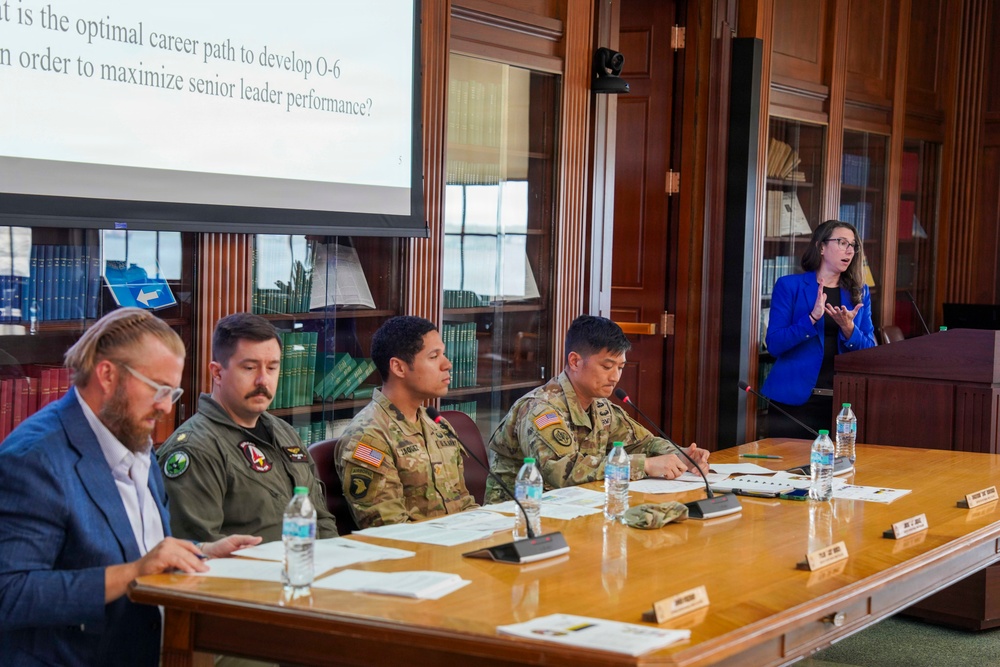
Photo By Petty Officer 2nd Class Connor Burns | NEWPORT, R.I.— Megan Crain, an agent of the Department of State and a student of the U.S. Naval War College (NWC) Stockdale Leader Development Concentration (SLDC) course, delivers remarks to NWC staff and faculty members during the SLDC out brief onboard Naval Station Newport, May 13, 2026. The SLDC cohort addressed the challenges of U.S. Navy O-6 leader development by examining the competencies required for effective leadership at the O-6 level and beyond. Established in 1884, NWC informs today’s decision-makers and educates tomorrow’s leaders by providing educational experiences and learning opportunities that develop their ability to anticipate and prepare strategically for the future, strengthen the foundations of peace, and create a decisive warfighting advantage. (U.S. Navy photo by Mass Communication Specialist 2nd Class Connor Burns) see less
| View Image Page
Stockdale Leadership Development Concentration cohort presents research on senior officer career pathways
The U.S. Naval War College’s Stockdale Leadership Development Concentration (SLDC) 2025-2026 cohort presented its research on senior officer career pathways to a group of war college leaders, including institution President Rear Adm. Darryl Walker, on May 13, 2026.
The 12-student cohort, who participated in the SLDC problem-based learning project on top of their respective master’s degree and Joint Professional Military Education (JPME) program work, conducted research into what traits and experiences are most valuable in ensuring effective officers at the rank of O-6 – the equivalent of a Navy captain or Army colonel.
“It was truly informative and motivating to hear what this year’s SLDC students learned in their research,” said Walker. “Faced with a challenging problem set – and dealing with intangible, hard-to-define variables – this cohort worked overtime to provide additional clarity to the question of how we train and grow future military leaders for the highest levels of command.
“In addition to laying the foundation for future classes to continue refining our understanding of this critical subject matter, by analyzing the experiences of some of today's top officers, these students are leaving this project with a keen awareness of how they can be better prepared for the burdens of command themselves,” he continued.
The SLDC is co-directed by College of Leadership and Ethics (CLE) Associate Prof. Dr. Liz Cavallaro and Associate Prof. Scott Smith.
Cavallaro told Walker and the other war college leaders in attendance that this year’s group was given the broad question of “how to enhance O-6 development in the Navy” and then given the academic year to learn more and develop recommendations for improvements or future research.
The members of the 2025-2026 cohort combed through past and present guiding Navy documents, such as the current Chief of Naval Operations’ Fighting Instructions, to identify enduring traits valued by the service.
They considered the Navy’s core competencies identified for officers – such as complex, high-stakes and multiparty negotiation; and setting a clear vision, while being able to differentiate between assumptions, underlying issues and constraints – and when in their careers officers are expected to learn and master those competencies.
The students also analyzed 268 line officer biographies to better understand and evaluate traditional and non-traditional career pathways, and conducted interviews with senior officers – including 19 flag officers and equivalents – to glean from their firsthand experiences which professional opportunities and characteristics were most helpful and formative.
“Our respondents were clear that judgment cannot be faked and the lack of judgment cannot be hidden at a high level of leadership,” U.S. Navy Lt. Cmdr. Tyler Nimick, one of the SLDC students, said during the research presentation.
The cohort found that, overall, senior military leaders considered joint and international experiences to have had the most profound impact on their abilities to grow into commanders, because those interactions helped them understand and incorporate varied approaches and perspectives.
Those senior leaders also indicated the competencies they most valued were team building and the ability to establish and maintain a command culture, and added that the most significant cognitive shift in their careers happened between the ranks of O-5 and O-6 – or the equivalent of promotion from a Navy commander to a captain.
Based on their findings, the cohort members identified a number of areas for future in-depth research, such as how to ensure judgment is included in professional development and as an explicit criteria considered in selection for promotion; further analysis of the cognitive shift between O-5 and O-6; and development of a way to line ascending officers up with experiences they need to strengthen the competencies they most need to succeed as they become more senior.
Established in 1884, NWC informs today’s decision-makers and educates tomorrow’s leaders by providing educational experiences and learning opportunities that develop their ability to hedge aggressively, innovate continuously, fight distributively, delegate confidently, and command with clarity within complex battlespaces.
NEWS INFO
Date Taken:
05.18.2026
Date Posted:
05.18.2026 12:44
Story ID:
565523
Location:
US
Web Views:
46
Downloads:
0
PUBLIC DOMAIN
This work, Stockdale Leadership Development Concentration cohort presents research on senior officer career pathways, by LCDR Seth Koenig, identified by DVIDS, must comply with the restrictions shown on https://www.dvidshub.net/about/copyright.