
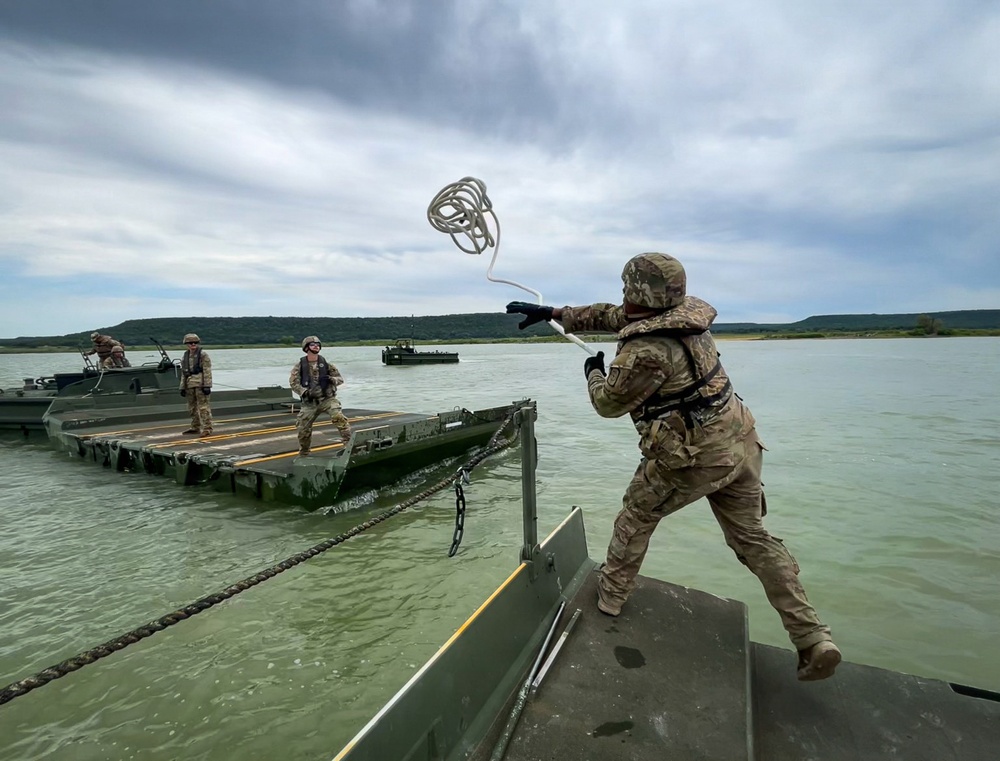
Photo By 1st Sgt. Nina Ramon | The 420th Engineer Brigade, based in Bryan, Texas, alongside supporting engineer and...... read more read more
FORT HOOD, Texas — In a high-intensity fight where seconds and terrain decide the outcome, Army Reserve engineers are proving they can rapidly project combat power across complex water obstacles under intense pressure.
During Operation Hood Strike 26, a premier large-scale exercise hosted by the 416th Theater Engineer Command, the III Armored Corps serves as the critical enabler, providing vital mission resourcing. Together, soldiers are rehearsing complex wet gap crossings. These operations are critical to keeping a large-scale combat operation moving or stopping an enemy advance in its tracks.
The extensive, multi-component training event integrates Army, Army Reserve, and National Guard elements to test tactical equipment and refine the total force's ability to fight as one synchronized unit. At the center of this Reserve force is the Bryan, Texas-based 420th Engineer Brigade, a subordinate unit operating directly under the command structure of the 416th Theater Engineer Command.
"It’s one of the most dangerous operations you can do for the engineer regiment," said Army Lt. Col. Travis C. Shahan, commander of the 961st Engineer Battalion, an Army Reserve unit participating under the tactical command of the 420th Engineer Brigade. "Hood Strike is the crown jewel in the exercise regimen."
For Shahan, a native of Montgomery, Texas, the exercise represents a vital environment for developing leaders and sharpening warfighting capabilities in real-time combat scenarios.
That kind of teamwork is what makes the exercise valuable. The Army is not just testing whether units can build a bridge; it is testing whether they can do it while moving under time pressure, coordinating across components, and adapting to changing battlefield conditions.
“We are here to build combat-ready formations capable of operating in a complex, high-tempo fight,” said Command Sgt. Maj. Paul Ott, command sergeant major of the 961st Engineer Battalion. “We are building disciplined, thinking, lethal teams. Executing with purpose. Moving with direction and leading with confidence.”
For the 420th Engineer Brigade, the mission is especially important because large-scale operations depend on mobility. If a force cannot cross a river, it cannot exploit momentum, reposition quickly, or press an advantage. The 420th’s role helps ensure that maneuver forces can keep moving when terrain becomes an obstacle.
The training highlights the 420th operating as part of a broader system. Bridging units, reconnaissance teams, and maneuver forces each have a distinct role, but success depends on all of them arriving at the right place at the right time. That makes the 420th’s mission essential, not secondary.
In large-scale combat, that kind of engineer support can determine whether an operation succeeds. The commander noted that the team rehearsed the crossing repeatedly before execution to ensure absolute synchronization among all elements.
This iteration highlights tactical partnerships, bringing together the 341st, 401st, and 671st Multi-Role Bridge Companies alongside Texas National Guard aviation assets and a small, vital contingency of Canadian Armed Forces assisting with the integration.
"It speaks to the total Army as a whole . . . that’s how we fight downrange, and that’s how we fight when we train," Shahan said, emphasizing the seamless collaboration among all components.
The training also reflects how the Army is modernizing to counter emerging threats by incorporating robotic systems, including remote-controlled minesweepers, to reduce risk at the breach point.
“We want to embrace technology,” Shahan said. “To save human lives and still enable us to be in the fight . . . people are the most valuable asset that we have in the United States Army.”
For the Army, Operation Hood Strike 26 is more than a training event. It is a rehearsal for how engineers, maneuver units, aviation, and Reserve forces will need to work together in a future fight.
For the 420th Engineer Brigade and its subordinate units, the exercise proves that Reserve engineers are not just supporting the mission, they are a foundational pillar of how the mission succeeds.
| Date Taken: | 05.17.2026 |
| Date Posted: | 05.18.2026 12:36 |
| Story ID: | 565473 |
| Location: | GATESVILLE, TEXAS, US |
| Web Views: | 275 |
| Downloads: | 1 |

This work, Army Reserve engineers play key role in river crossing mission at Hood Strike, by 1SG Nina Ramon, identified by DVIDS, must comply with the restrictions shown on https://www.dvidshub.net/about/copyright.


No keywords found.





