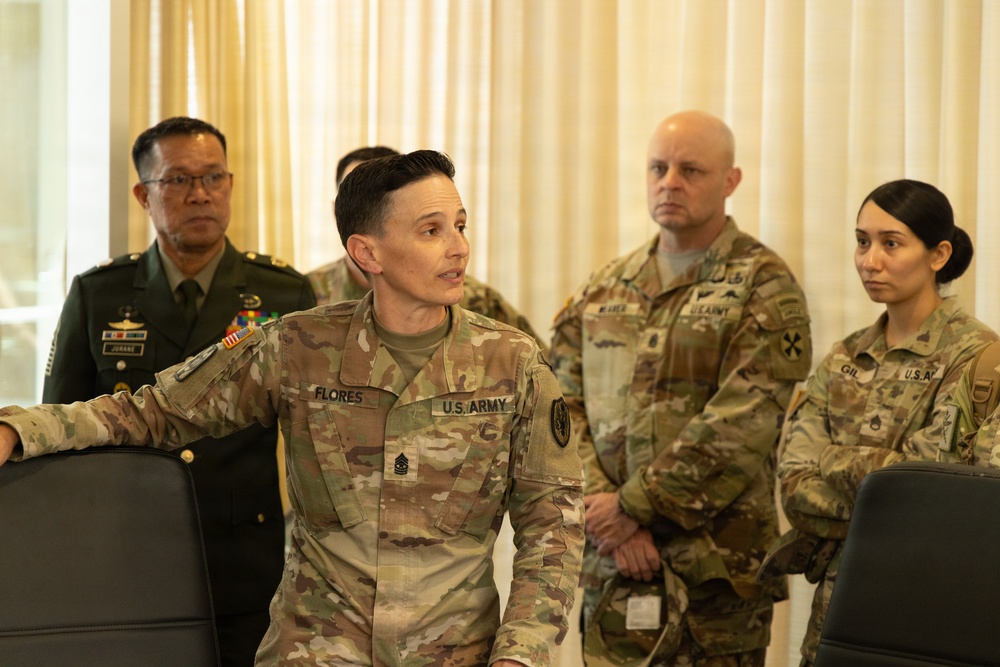
Photo By Pvt. Parker Phillips | U.S. Army Sgt. Maj. Lauren T.S. Flores, senior enlisted advisor at Defense POW/MIA Accounting Agency, leads a tour of DPAA for attendees during the Land Forces Pacific Symposium, at Joint Base Pearl Harbor-Hickam, Hawaii, May 12, 2026. The Senior Enlisted Leaders Forum explores how senior NCOs can champion innovation, facilitate adaptability, and cultivate a culture of modernization within their units. (U.S. Army photo by Pvt. Parker Phillips) see less
| View Image Page
JOINT BASE PEARL HARBOR-HICKAM, HAWAII, UNITED STATES
SELF Leaders Tour DPAA, Reinforce Commitment to Service and Accountability at LANPAC 2026
JOINT BASE PEARL HARBOR-HICKAM, Hawaii — Senior noncommissioned officers and enlisted leaders attending the Senior Enlisted Leader Forum (SELF) during the 2026 Land Forces Pacific (LANPAC) Symposium and Exposition toured the Defense POW/MIA Accounting Agency (DPAA) on May 12, gaining firsthand insight into the agency’s mission to recover and identify missing U.S. service members.
The SELF program brought together senior enlisted leaders from across the Indo-Pacific to discuss the challenges and opportunities of leading today’s force and supporting military families. Through mentorship, communication and leadership at every level, enlisted leaders play a critical role in turning transformational concepts into action across the force.
LANPAC 2026 marked the symposium’s largest attendance to date, bringing together representatives from more than 25 countries across the Indo-Pacific and around the world. The annual event highlights the role of land forces in strengthening regional partnerships and supporting joint operations in both peace and conflict.
U.S. Army Sgt. Maj. Lauren T.S. Flores, DPAA senior enlisted advisor, led the tour of DPAA. Flores highlighted the precision, dedication and accountability required in the mission to bring home America’s fallen.
During the DPAA tour, leaders learned about the agency’s global mission to account for U.S. personnel still listed as prisoners of war or missing in action from conflicts ranging from World War II to present-day operations.
Officials explained how advances in science and forensic technology have transformed the identification process over the years. What was once limited by available technology can now be supported through DNA analysis, forensic anthropology and extensive historical research.
The identification process begins with confirming whether recovered remains belong to an American service member. Investigators then conduct detailed archival and historical research before forensic experts examine the remains for identifying characteristics. Specialists carefully clean and inventory the remains, which can sometimes include commingled casualties recovered from the same site. Analysts develop a possible identification; scientists conduct DNA testing using samples taken from bone fragments and compare the results with DNA provided by surviving family members.
DPAA teams deploy worldwide in support of that effort, working to provide answers and closure to families while honoring the nation’s commitment to those who served.
The LANPAC Symposium and Exposition is an annual forum that brings together Indo-Pacific military leaders, government representatives, industry professionals and academic partners to strengthen cooperation, share best practices and advance integrated land operations across the U.S. Indo-Pacific Command area of responsibility.

 Subscribe






