
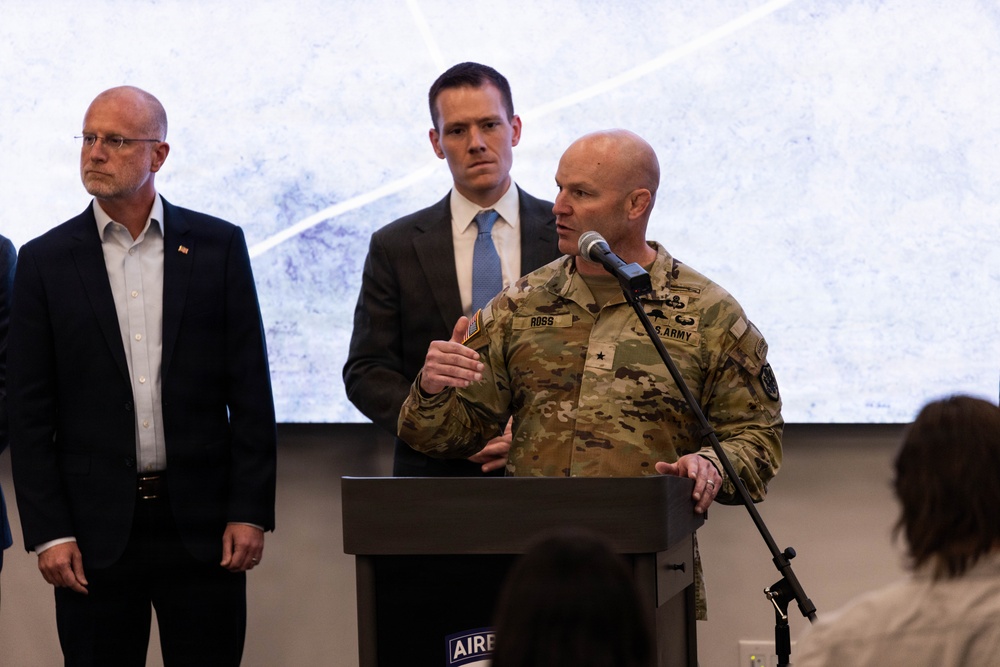
Photo By Cpl. Darius Smith | U.S. Army Brig. Gen. Matthew Ross, Joint Interagency Task Force 401 Director, delivers...... read more read more
 Subscribe
FORT BRAGG, N.C. — Secretary of the Army Dan Driscoll hosted the inaugural Defense Critical Infrastructure Summit at Fort Bragg on May 14, bringing together military leaders, government agencies and private-sector partners to strengthen the resilience of infrastructure critical to Army readiness.
Driscoll convened more than two dozen leaders from the private sector, interagency organizations and local, regional and federal governments to discuss protecting infrastructure that supports Army readiness and power projection.
"We went after four operational challenges: physical threats from drones, cyber impacts, force projection dependencies and information sharing lag,” Driscoll said. “We worked with these partners to start conversations that we think will have a deep impact on our nation’s security."
Brandon Pugh, the principal cyber advisor to the Secretary of the Army and the Army secretariat lead for defense critical infrastructure, moderated the press conference following the summit. During his remarks, he highlighted the volume of Army installations around the globe and how the overwhelming majority of them rely on privately owned utilities.
"This is a no-fail mission and it’s a national security imperative," Pugh said. “Critical infrastructure resilience is a strategic imperative, not a back-office function."
During the closed-door meeting, Lt. Gen. Gregory Anderson, commanding general of XVIII Airborne Corps and Fort Bragg, used Fort Bragg as a case study to examine the interconnectedness between the private sector and military installations. He emphasized how infrastructure surrounding military communities directly affects national security operations.
"We cannot assume utilities like gas, water and electricity will always be available," said Anderson. "A big part of this summit was asking the hard questions to make Fort Bragg more resilient across the board. How do we better secure our infrastructure and build redundancy in case something happens? Whether it’s our power grid, water supply or wastewater removal, we have the right partnerships in place to collaborate and defend our critical infrastructure."
Leaders also identified the growing use of unmanned aerial systems, both domestically and abroad, as a major threat to critical infrastructure.
Federal Communications Commission Chairman Brendan Carr highlighted steps the FCC is taking to safeguard against the growing drone threat.
“We’re working hard to implement President Trump’s vision for American drone dominance,” Carr said. “We have kept foreign-produced drones that may pose an unacceptable national security threat out of the U.S. market.”
Joint Interagency Task Force 401 is leading a whole-of-government effort to counter emerging drone threats. Brig. Gen. Matthew S. Ross, director of JIATF-401, continues to leverage Fort Bragg’s Joint Innovation Outpost to iterate on counter-drone capabilities.
“The proliferation of inexpensive unmanned aerial systems makes counter-UAS capabilities both a warfighting and homeland defense imperative,” said Ross.
Private-sector utility providers also played a central role in the discussions, helping connect operational requirements with real-world infrastructure capabilities. Participants worked to bridge ideas and identify actionable priorities moving forward.
"At Duke Energy, we understand that energy resilience is essential to mission readiness," said Mr. Kodwo Ghartey-Tagoe of Duke Energy. "Preparing for and responding to high-stakes events like the ones we discussed today takes trust, coordination and a shared commitment to getting it right."
Nick Andersen, acting director of the Cybersecurity and Infrastructure Security Agency, added that the summit represented resilience in action, noting that the collaboration allows leaders to solve common challenges before they become crises.
As the press conference came to an end, W. Jordan Gillis, assistant secretary of the Army for Installations, Energy, and Environment, emphasized the importance of sustained collaboration among military, government and industry partners.
The commitment here today and the engagement with state and local municipalities and partners, local providers and the whole of government is a force multiplier to help the Army get after those vulnerabilities and gaps, said Gillis.
Army leaders said the summit is intended to serve as a model for future collaboration across installations nationwide, reinforcing the Army’s broader effort to strengthen infrastructure resilience against evolving physical and cyber threats.
| Date Taken: | 05.15.2026 |
| Date Posted: | 05.15.2026 15:49 |
| Story ID: | 565429 |
| Location: | NORTH CAROLINA, US |
| Web Views: | 143 |
| Downloads: | 0 |

This work, Secretary of the Army hosts Defense Critical Infrastructure Summit at Fort Bragg, by SFC Samuel Northrup, identified by DVIDS, must comply with the restrictions shown on https://www.dvidshub.net/about/copyright.


No keywords found.




