FORT DETRICK, Md. – With the “deadliest days of summer” fast approaching, U.S. Army Medical Logistics Command is taking a proactive, hands-on approach to ensure its workforce stays safe during the high-risk 100-day period between Memorial Day and Labor Day.
AMLC held a comprehensive safety stand-down May 7 at Fort Detrick, moving away from traditional classroom briefings to focus on interactive training and mission readiness.
The event highlighted the command’s ongoing transition to the Army Safety and Occupational Health Management System, or ASOHMS, which emphasizes that safety is a shared responsibility across the entire team.
“Our command continues to mature or evolve into ASOHMS by providing training on Job Hazard Analysis, heat injury prevention and impaired driving,” said Wally Edwards, AMLC’s safety and occupational health manager. “Leadership involvement and teammate participation is the foundation for success in ASOHMS implementation.”
For AMLC leadership, safety directly translates to protecting the workforce so they can execute the mission.
“The mission matters, but our people are the most important,” said Col. Joselito “Joe” Lim, AMLC interim deputy commander and commander of the U.S. Army Medical Materiel Agency, an AMLC direct reporting unit.
“You all matter and you all have a role in our organization.”
To reinforce this culture of accountability, personnel participated in practical exercises rather than just standard lectures.
During a session on the Job Hazard Analysis process, attendees worked together to break down tasks, identify specific risks and develop a hierarchy of controls to prevent injury and property damage.
The interactive approach continued with a heat-related illness station led by Master Sgt. William Harbeson. Personnel practiced applying ice sheets to coworkers exhibiting mock heat stroke symptoms, providing Soldiers and civilians with life-saving skills critical for maintaining readiness during high-temperature training and operations.
Edwards emphasized that this proactive posture extends far beyond Fort Detrick. The command is currently conducting similar safety stand-down days across its global enterprise, including direct reporting units, medical maintenance divisions and Army Prepositioned Stocks sites.
Road safety and impaired driving was another primary focus of the day, led by guest speaker Cliff Jacobs from the Maryland Department of Transportation’s Highway Safety Office.
Jacobs briefed the team on state enforcement efforts like the State Police Impaired Driving Reduction Effort, or “SPIDRE” team, and the vital role of drug recognition experts in spotting drivers under the influence of substances like fentanyl and oxycodone.
The event also addressed hearing conservation, noting that noise remains the top workplace hazard in maintenance shops and ranges. Edwards reminded the workforce that while hearing loss is painless and progressive, it is entirely preventable through the consistent use of personal protective equipment and various control measures.
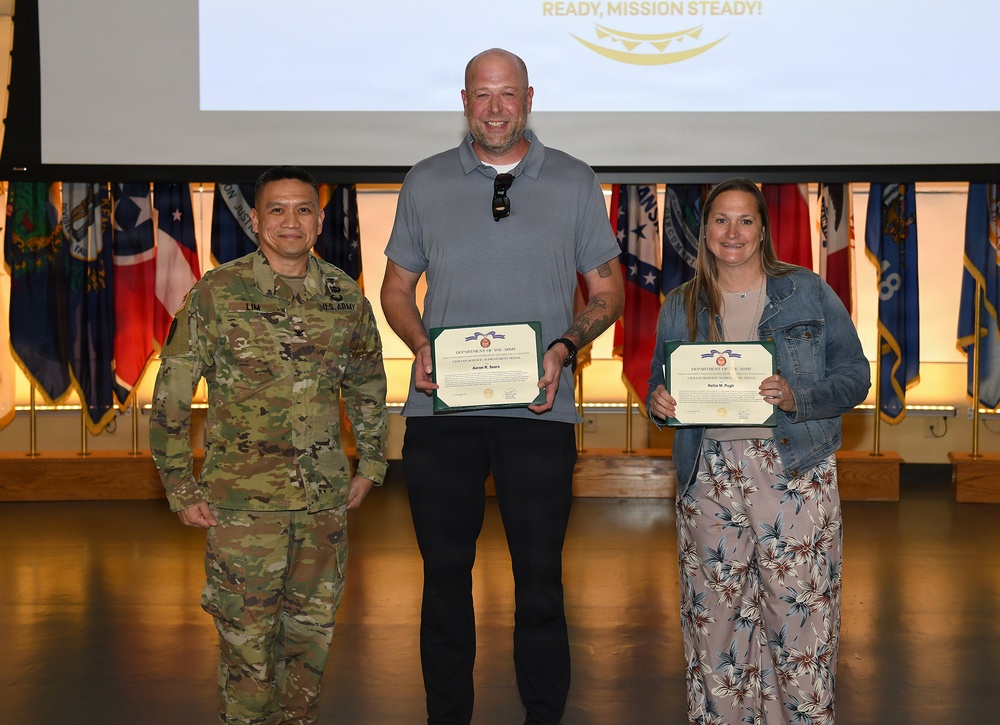
The command’s culture of proactive safety was further exemplified by the recognition of team members Aaron Sears and Kellie Pugh. The two were commended for developing a tracking system within the Theater Enterprise-Wide Logistics System, or TEWLS, that improves accountability for controlled substances, effectively reducing loss and the potential for harm.
Col. Nikki Davis, AMLC chief of staff, concluded the stand-down by urging the workforce to remain vigilant on the roads and during summer activities. Sharing a personal account of a commute delayed by multiple accidents, she reminded the team to slow down, avoid impaired driving and take responsibility for their own safety and that of their teammates.
“Take care of yourself,” Davis said. “Tomorrow is not promised. In everything we do, be safe. You are our family.”
AMLC, a major subordinate command to U.S. Army Communications-Electronics Command, serves as the Army’s Class VIII medical materiel command, delivering integrated medical logistics that enables Army and Joint Forces readiness from the strategic support area to the tactical edge.
| Date Taken: |
05.08.2026 |
| Date Posted: |
05.15.2026 09:56 |
| Story ID: |
565385 |
| Location: |
FORT DETRICK, MARYLAND, US |
| Web Views: |
209 |
| Downloads: |
0 |
PUBLIC DOMAIN

This work, AMLC prioritizes people, readiness through interactive summer safety training, by C.J. Lovelace, identified by DVIDS, must comply with the restrictions shown on https://www.dvidshub.net/about/copyright.