
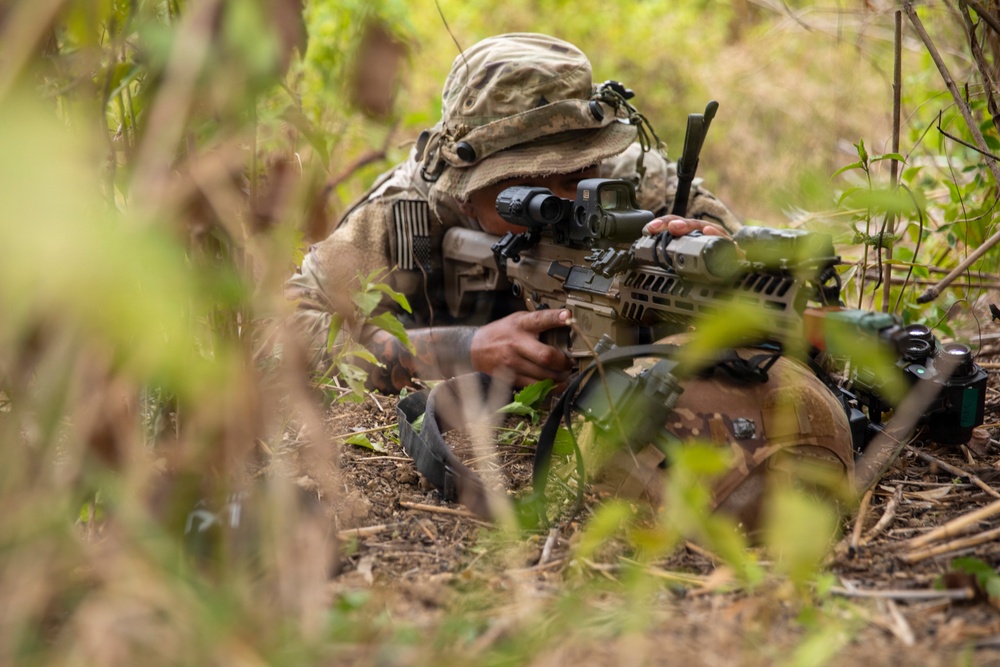
Photo By Staff Sgt. Jameson Harris | U.S. Army Sgt. Jozeph Alvarez, an indirect fire infantryman assigned to 2nd Battalion,...... read more read more
 Subscribe
During a panel discussion at the 2026 Land Forces Pacific Symposium and Exposition, Army Lt. Gen. Matthew McFarlane, I Corps commander, said that to keep pace with the modernization efforts of U.S. adversaries and allies, the Army must continuously push its transformation efforts in the Pacific.
The general outlined his command’s transformation and modernization efforts across the region at the annual symposium held in Honolulu, May 12-14.
“We are transforming at the speed of need right now,” McFarlane said. “We are driving our ability to integrate new technology from the next-generation [command and control], so it's an exciting time to lead in our Army. … We need to change our culture, so we are adapting continuously while training and in the fight. So, I think we'll have to transform in combat.”
In June, the 7th Infantry Division and the 1st Multi-Domain Task Force, both from Joint Base Lewis-McChord, Washington, will combine into the Multi-Domain Command-Pacific (MDC-PAC), a unit capable of synchronizing multi-domain operations for the joint force across the Indo-Pacific theater.
The two-star command will combine Stryker infantry brigades with next-generation, multi-domain capabilities. Members of the 7th Infantry Division are currently simulating multi-domain effects during Exercise Salaknib, a multinational training event held in the Philippines with the U.S. Army, the Philippine Army and the Japanese Ground Self-Defense Force.
The 25th Infantry Division from Schofield Barracks, Hawaii, began the Joint Pacific Multinational Readiness Center-Exportable Exercise, May 8, during which participants take part in exercises tailored to the archipelagic terrain unique to their areas of operation.
The 25th ID has incorporated new technologies during Salaknib, including the integration of the M142 High Mobility Artillery Rocket System, or HIMARS, and the Next Generation Squad Weapon: the M7 assault rifle and M250 light machine gun.
In December, the Army reassigned the 4th Infantry Division at Fort Carson, Colorado, to the I Corps. The division supports operations in the Pacific with additional Stryker brigade teams capable of supporting the I Corps in the region.
“If we're watching the global security environment and what's happening right now in the Ukraine and the Middle East, we are transforming based on the evolution of technology and what friend and foe are integrating into the fight,” McFarlane said.
The general added that the Australian Army has fielded watercraft more quickly than its U.S. counterparts and is incorporating HIMARS and a multi-domain brigade. The Japanese military, like the U.S., has bolstered its long-range precision fires units.
“What I've seen is our allies and partners are modernizing at a significant pace,” McFarlane said. “So, everyone is moving quicker as people have invested more into their military, and everyone sees what's happening around the world on the battlefield and realizes the sense of urgency we all need to have.”
Operation Pathways — which is up to 30 exercises per year with 13 partner nations — continues in the vast Pacific theater. Through this initiative, U.S. Soldiers hold training exercises with allied partners to build operational and tactical readiness.
Operation Balikatan, a large-scale bilateral annual exercise, ended May 8. As part of Balikatan, more than 500 troops from the U.S., the Philippines, New Zealand and Australia simulated a live-fire enemy attack on April 27. McFarlane said Soldier feedback from all ranks provides key knowledge in the service’s larger transformation efforts. Army Command Sgt. Maj. Jonathan Reffeor, I Corps’ top enlisted leader, said the command has empowered its noncommissioned officers to train and build Soldiers’ decision-making capabilities.
“Transformation isn't a future objective, it's a daily discipline, and it turns mindset and equipment into a decisive advantage,” Reffeor said. “And that's our opportunity; as our leaders in the I Corps — across all four of our divisions — [are] making decisions to change the battlefield so we have the upper hand.”
At Joint Base Elmendorf-Richardson, Alaska, the 11th Infantry Division has been building a sustainment brigade to act as a “quick reaction” force in the Indo-Pacific, McFarlane said. The unit includes an airborne brigade and an air assault brigade.
“Bottom line is, the I Corps is a multi-domain operational headquarters that is spearheading our Army's transformational efforts,” McFarlane said. “We are learning faster than our adversary. We are building lethality faster than our adversary, and that will ensure we dominate in the fight.”
| Date Taken: | 05.14.2026 |
| Date Posted: | 05.14.2026 16:12 |
| Story ID: | 565316 |
| Location: | HONOLULU, HAWAII, US |
| Web Views: | 214 |
| Downloads: | 0 |

This work, LANPAC: I CORPS leading transformation efforts in the Pacific, by Joe Lacdan, identified by DVIDS, must comply with the restrictions shown on https://www.dvidshub.net/about/copyright.

No keywords found.




