
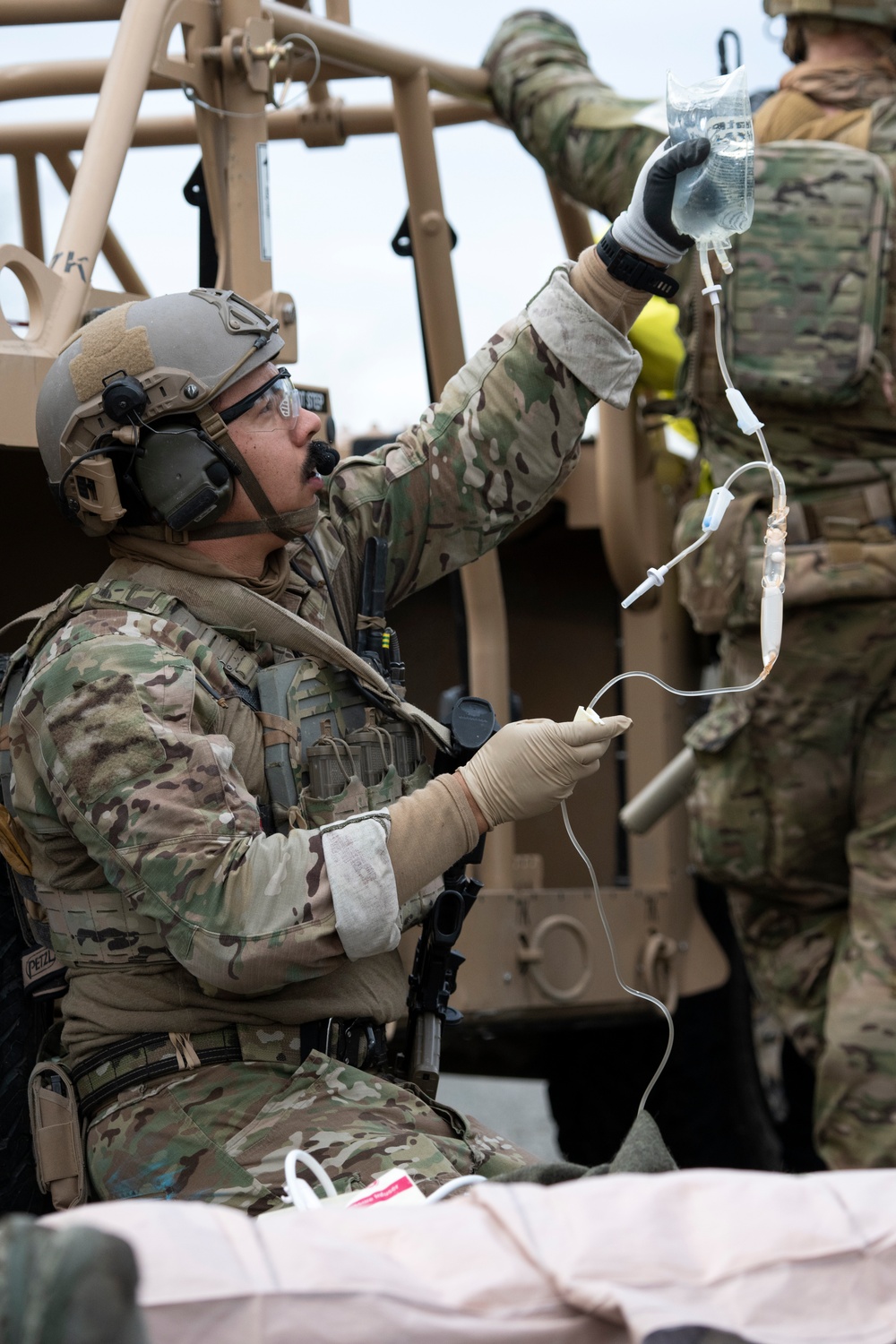
Photo By Alejandro Pena | An Alaska Air National Guardsman assigned to the 212th Rescue Squadron, 176th Wing,...... read more read more
 Subscribe
Three Alaska Air National Guard pararescueman (PJs) of 212th Rescue Squadron provided lifesaving medical care for the rescue effort of the victim of a May 5, 2026, plane crash near Knik Glacier.
Master Sgt. Tyler Albee, 212th RQS pararescueman, said he, Master Sgt. Bill Cenna, and Tech. Sgt. Roman Ramirez were training for glacier rescue operations near the Knik Glacier when the party witnessed the plane crash about 2 kilometers away.
Local aviators, flying mainly small Piper Cubs, were hosting a Cub fly-in at the “Picnic Table” gravel airstrip when disaster struck.
“We were watching all of these Cubs land when Roman and I had our backs turned, and Bill saw the plane crash,” Albee said. “We all turned around and noticed a big fireball.”
The team grabbed a medical rucksack, sufficient to treat three patients, and boarded their SXV tactical side-by-side ATV for the quick ride to the crash site.
What they found was a wrecked Piper Cub that caught fire and was nearly consumed by the flames.
Albee said the trio made contact with the pilot shortly after two good Samaritans extracted him from the stricken aircraft, and PJs then provided immediate lifesaving care for the pilot who suffered a broken leg, had life threatening bleeds, and circumferential burns over much of his body.
“We immediately started doing work on him exposing injuries, severe burns, and a broken leg that was bleeding,” Albee recalled. “So, we controlled arterial bleeding in his left leg while talking to him, reassuring him, and continuing to assess his level of consciousness.”
After about 15 minutes of medical intervention, Albee said he handed care to the other PJs and contacted the Alaska Rescue Coordination Center to find solutions for evacuation from the remote airstrip.
Normally the AKRCC, located at JBER, initiates rescue operations for a plane crash after they receive an emergency call or have notice of an emergency locator transmitter that broadcasts upon crash impact. If the 176th Wing accepts the mission, they could dispatch an HH-60W Jolly Green II helicopter with PJs onboard to search for isolated personnel, treat them on site, and extract them to higher medical care. For longer-range and more complex rescues, or if the rescue requires airborne insertion of PJs, the wing can additionally dispatch an HC-130J Combat King II.
In this case, the process was somewhat in reverse. Armed with the knowledge PJs were already on the ground, usually the most difficult aspect to plan and execute, the AKRCC requested a civilian air ambulance helicopter.
Arriving with a pilot and two flight medics, the PJ trio and civilian aeromedical team worked together to package the pilot for transport to Providence Alaska Medical Center in Anchorage about 40 miles southeast of the glacier.
Albee said he was grateful his team was close enough to help the pilot after the harrowing crash.
“It was a blessing to be in the right place at the right time to have a positive impact on somebody’s life on their worst day ever,” Albee said.
| Date Taken: | 05.13.2026 |
| Date Posted: | 05.13.2026 16:09 |
| Story ID: | 565199 |
| Location: | JOINT BASE ELMENDORF-RICHARDSON, ALASKA, US |
| Web Views: | 107 |
| Downloads: | 0 |

This work, Alaska Air Guard pararescue save pilot near Knik Glacier, by Maj. David Bedard, identified by DVIDS, must comply with the restrictions shown on https://www.dvidshub.net/about/copyright.


No keywords found.




