
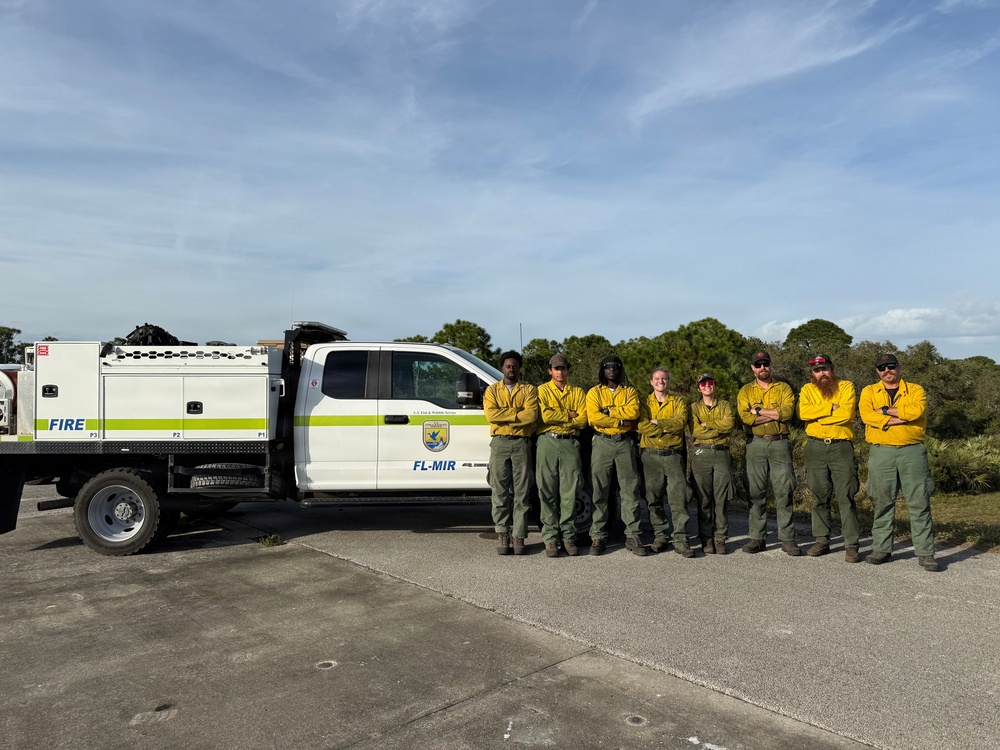
Photo By Joshua Boisvert | Students and staff from Flatwoods and Jacobs Creek Job Corps Civilian Conservation...... read more read more
 Subscribe
Reach for the Sky
Smoke drifted low across the scrub flats of Merrit Island as drip torches traced careful lines. Engines idled along the blackline while ignitions moved steadily through more than 2,600 acres of fire dependent habitat. In the distance, launch infrastructure at Kennedy Space Center in Florida rose above the horizon as controlled fire worked its way across the refuge.
For six days in January, timing governed everything. A narrow weather window, a scheduled Artemis rollout, and one of Florida’s largest remaining populations of the threatened Florida scrub jay converged into a single operational decision point. Once NASA begins final preparation, all burning in and around the secure area shuts down.
Crews from Flatwoods and Jacobs Creek Job Corps Civilian Conservation Centers worked alongside U.S. Fish and Wildlife Service and interagency partners to complete two prescribed burns ahead of the launch schedule. The assignment tied habitat restoration, infrastructure protection, and workforce development into a single mission set.
The burn also delivered a hands-on training model at the core of Forest Service Job Corps. Students worked in active operational roles, gaining real experience while supporting fuels management and habitat restoration.
Shawn Sullivan, Assistant Fire Management Officer, U.S. Fish and Wildlife Service, Region 4 South Zone, said the complexity of the mission centered on balancing habitat needs with critical infrastructure timelines.
“The fuels on Merrit Island are home to very unique and rare types of animals such as scrub jay depend on them being burned,” said Sullivan. “This is a competing priority of future versus nature. Fire is one thing that we can do to lessen risk of one and better the environment for the other.”
Restoring scrub habitat required careful timing within a narrow operational window. The challenge was balancing habitat needs with nationally significant infrastructure.
“Artemis is a NASA priority,” said Sullivan. “It has a hard date of mid-January, and we basically cannot burn in the secure area without potentially affecting it until it lifts off mid-February. Fuel conditions in Florida are historically dry. We had a six-day window where we could burn before we get into severity on the back side of the Artemis launch.”
Safety guided every planning decision despite the fixed deadline. Training and preparation allowed crews to expand risk margins without compromising standards.
“I want to say we should never let that affect safety,” said Sullivan. “However, we mitigate things every day as a fire culture. We train, we read, we get fit, we experience, we do things that are similar to martial arts that separate us from the regular person.”
Timing influenced every aspect of the burn plan. Weather, fuel conditions, and experience levels had to align within a narrow window.
“Fixed internal schedules are real,” said Sullivan. “Timing it not a factor, it is the factor. Fuel conditions is timing, experience is timing, training is timing, poorly planned timing is unsafe. Perfectly planned timing is as safe as you could be.”
Bobby Davis, Hand Crew Supervisor at Jacobs Creek Job Corps CCC in Tennessee, said preparation focused on clear communication and defined roles before ignition began.
“Preparation focused on clear roles, strong briefings, and contingency planning,” said Davis. “This assignment involved two prescribed burns totaling 2,600 acres on Merrit Island National Wildlife Refuge, located on NASA property. With launch windows and a cold front passage influencing timing.”
Multiple agencies coordinated to complete the burns safely and on schedule. Job Corps crews integrated directly into that structure.
“The burn was treated as an operational assignment first, with training embedded through real task responsibility,” said Davis. “Students were assigned firing, holding, and mop-up roles appropriate to their experience, while leadership maintained oversight to ensure objectives and safety were met.”
Conditions shifted throughout the operation, requiring disciplined communication. Conservative decision making helped maintain control.
“Risk management became more conservative, with strict adherence to conditions, trigger points, and communication,” said Davis. “Students performed professionally in a complex, time-sensitive environment. They adapted well to firing, holding, and mop-up operations, and several integrated effectively with other agencies’ crews and equipment.”
Job Corps contributes personnel who can support complex prescribed fire operations. That support strengthens overall workforce capacity.
“Job Corps crews bring motivated personnel, strong leadership, and the ability to perform reliably in complex, multi-agency operations while building long-term workforce capacity,” said Davis. “Job Corps has many qualified personnel that can be a huge asset for our partner agencies.”
Gabriel Bray, a Welding Student at Jacobs Creek Job Corps CCC, said the environment demanded heightened focus.
“The fuels, the terrain, the weather, the leadership,” said Bray. “It made it much more important to make no mistakes.”
Working alongside familiar teams requires adaptability. Exposure to engines and new crew configurations built confidence.
“In my mod we have multiple students,” said Bray. “I was split up from my usual team members and put on an engine. It made me comfortable with new people.”
Regional differences in fuels and weather conditions shape every fire assignment. Experiencing that variability prepares students for future roles.
“It gave me a good taste of how different and how quickly things can change from region to region,” said Bray.
Spot fires tested preparation and communication. Crews responded quickly within established control measures.
“We had a spot fire,” said Bray. “We effectively pushed dozer lines around it and had boots on the ground ready to tackle it.”
Seeing direct impact strengthens connection to the work. Prescribed fire protects both habitat and surrounding communities.
“It means that I am actually making an effect on the areas and people that surround it,” said Bray.
Xavier McClinton, a carpentry student at Jacobs Creek Job Corps CCC, said the burn was his first assignment off center.
“This was my first burn off center and was a much larger operation,” said McClinton. “I tried to maintain a good level of professionalism and awareness despite being new and not knowing a lot of the nuances.”
Hands-on learning builds foundational knowledge quickly. Students have assignments with practical experience they can carry forward.
“I’ve learned a little bit about engines and hoses and what a holding resource does,” said McClinton. “It gave me my first look into this field and can help me build in my experience going forward.”
Nabieu Kamara, a Carpentry Student at Flatwoods Job Corps CCC in North Carolina, said the assignment carried personal significance.
“I came to Job Corps to give myself a change in lifestyle to set myself up for success,” said Kamara. “This RX fire was my first ever.”
For Kamara, the scale of the assignment added perspective. The national context did not change performance expectations, but it did shape how the work felt.
“Knowing the burn was on a national level didn’t affect my performance in any way, but it did give me a bigger sense of pride in my work,” said Kamara. “Responsibilities I held were the maintenance of our rig and its contents such as cleanliness, prepping tools and gear.”
Early responsibilities often center on readiness and equipment discipline. These fundamentals support the larger operation.
“The most challenging thing we faced was when we had a couple of spot fires over the line,” said Kamara. “But with guidance, we were able to troubleshoot any issues.”
Leroyce Markiest Durham Jr., a Heavy Equipment Operator Student at Jacobs Creek Job Corps CCC, said the level of coordination stood out.
“The Merrit Island burn had a lot more coordination and planning than the one I’ve worked on at center,” said Durham Jr. “Every role mattered.”
The assignment carried a national level context, and that changed how students approached the work. For Durham Jr., the pace and complexity reinforced a tighter focus on safety and teamwork.
“Supporting a national level mission made me more focused and committed to safety and doing the job right with the team,” said Durham Jr. “It gave me real exposure to wildfire and fuels operations.”
For students, that kind of exposure turns into usable experience fast. It also clarifies how different roles fit together on a large operation.
“I’m proud to know my work supported national operations,” said Durham Jr. “Extremely grateful that I was a part of and able to meet amazing people and would love to do it again.”
As the operation wrapped up, the emphasis stayed on repetition and growth. The work was difficult, but the model was simple. Train, execute, and return better.
“Keep doing it,” said Sullivan. “It’s truly about the people next to you in that moment and figuring out how to do impossible tasks together. That is building the future.”
| Date Taken: | 05.13.2026 |
| Date Posted: | 05.13.2026 13:15 |
| Story ID: | 565160 |
| Location: | FLORIDA, US |
| Web Views: | 104 |
| Downloads: | 0 |

This work, Reach for the Sky, by Joshua Boisvert, identified by DVIDS, must comply with the restrictions shown on https://www.dvidshub.net/about/copyright.


No keywords found.




