
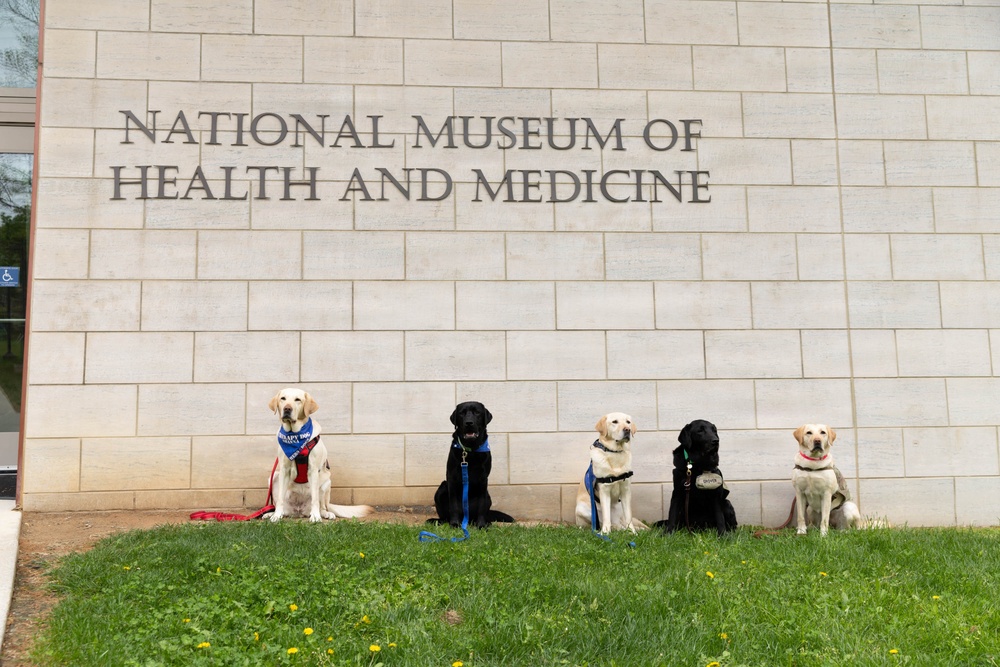
Photo By Chuck Kennedy | Therapy dogs from a local non-profit and Uniformed Services University facility dogs...... read more read more
What do food safety, vaccines, and working dogs have in common? They are all aspects of Veterinary Medicine that support military readiness, and visitors to the National Museum of Health and Medicine saw that up close during Veterinary Medicine Day.
Dozens of visitors attended the event on Saturday, April 25. Guests met experts, explored hands-on activity stations, and learned how veterinary medicine helps keep service members healthy and ready to do their jobs.
Veterinary medicine in the military is about more than caring for animals. It helps protect the force every day. Dr. William Fugina, a veterinarian with the U.S. Army Veterinary Corps, said, “We do so many different things that protect our service members as well as our service animals.” One key job is food safety. Veterinary teams inspect food and make sure it is safe for our service members to eat. This helps prevent illness across the force.
Another focus is stopping the spread of disease. Army Lt. Col. Jimmy Corrigan, an active-duty veterinarian, said, “Up to 80% of all new… diseases are zoonotic.” This means they can spread between animals and humans. Because of this, watching animal health helps protect service members, especially when they deploy, he explained.
Veterinary medicine also supports research by assisting with the development of vaccines and new treatments. These efforts protect service members around the world. Dr. Lynn Miller, U.S. Army Veterinary Corps, said, “Our work keeps service members healthy by advancing vaccines and therapeutics against a wide variety of viral and bacterial diseases.”
The field also supports military working animals, facility dogs, and service dogs. Paula Bellini, a Uniformed Services University facility dog handler, explained how service dogs enable service members to live more independently. They help with medicine retrieval and symptoms of all sorts of physical or mental health conditions, she added.
The museum preserves the history of veterinary medicine and shares it with the public, while supporting the training and education of Army Veterinary Corps personnel. Through the museum’s collections, visitors can learn how veterinary medicine has shaped military medicine and continues to support the people who provide care today.
Alan Hawk, historical collections manager of the National Museum of Health and Medicine, said, “We’re preserving the history and the material culture of veterinary medicine… we’re supporting the people who do provide the care.”
Missed the event? Stay tuned for next year’s Veterinary Medicine Day for a chance to meet experts, connect with animals, and learn how veterinary medicine helps keep our Armed Forces healthy, prepared, and ready to serve.
To learn about upcoming events, visit @medicalmuseum
| Date Taken: | 05.13.2026 |
| Date Posted: | 05.13.2026 09:16 |
| Story ID: | 565125 |
| Location: | SILVER SPRING, MARYLAND, US |
| Web Views: | 338 |
| Downloads: | 3 |

This work, More Than Pet Care: How Veterinary Medicine Supports Military Readiness, by Kenya Baylor, identified by DVIDS, must comply with the restrictions shown on https://www.dvidshub.net/about/copyright.


No keywords found.





