
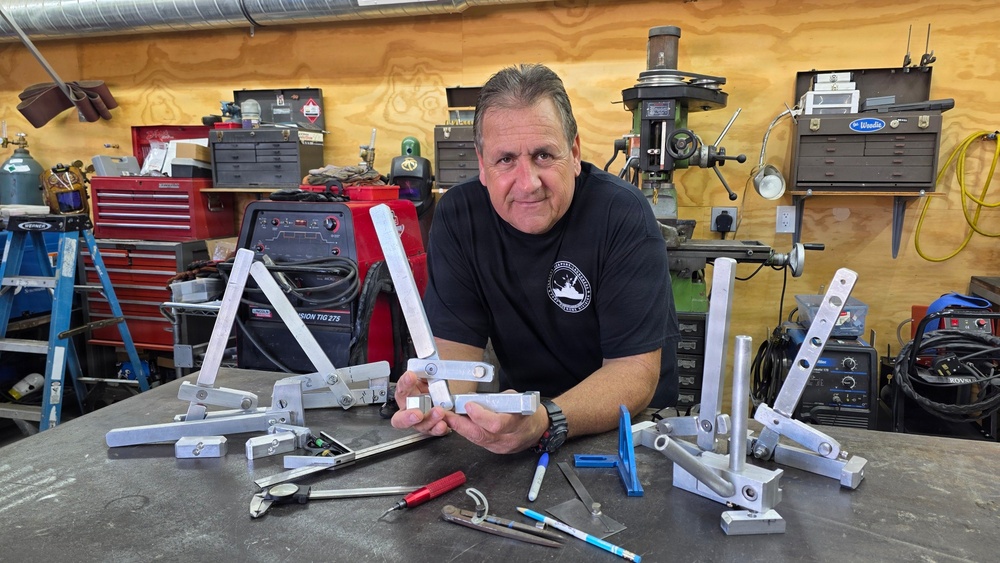
Courtesy Photo | Eric Csorba, a Vertical Launching System (VLS) canister and launcher support equipment...... read more read more
 Subscribe
Launcher support personnel at Naval Surface Warfare Center, Port Hueneme Division (NSWC PHD) in California have developed and tested a new tool to aid Navy sailors in maintaining MK 41 Vertical Launching System (VLS) cell hatches without damaging them in the process.
Eric Csorba, a VLS canister and launcher support equipment engineering technician at NSWC PHD, designed the tool to help sailors keep VLS latch rods moving freely. The latch rods secure the hatches that cover the launcher’s missile cells.
“It’s about making sure VLS is prepared and ready at any time,” Csorba said.
The effort came in response to ship’s force feedback at the VLS Fleet Symposium that NSWC PHD hosted in 2024. Sailors who attended that event highlighted the difficulty of dealing with stuck VLS latch rods, and the new tool addresses that issue, according to Richard Langley, launching system In-Service Engineering Agent program manager at NSWC PHD.
“It will save effort and time for the sailors,” Langley said.
Csorba said the tool also offers the potential to save the Navy money in cell hatch repairs while avoiding downtime, boosting readiness for the missile launcher that provides critical firepower for Navy destroyers and cruisers.
Exercise regimen
As specified in a maintenance requirement card, sailors have to exercise VLS latch rods — in other words, move them back and forth — every other month to ensure they don’t seize up due to corrosion or cold weather. They also conduct the procedure two weeks before onloading missiles.
Sailors have been employing other tools like screwdrivers, pry bars and locking pliers to exercise the latch rods, but those can gradually damage the knife edge — a metal lip that surrounds the cell opening. Damaged knife edges, in turn, can cut the seal inside the cell hatch when it opens and closes, compromising its protection against saltwater and sea air intruding into the below-deck launcher modules.
Replacing a knife edge costs about $12,000, according to Csorba, and typically would need to be done during a maintenance availability at a Regional Maintenance Center (RMC).
Based on quotes from machine shops, the latch rod tool that Csorba designed could cost as little as $200 per unit to manufacture. He said the goal is to get two of them aboard each ship equipped with VLS, of which there are now about 80 in the U.S. Navy fleet.
“It needs to be part of their regular equipment,” Csorba said, referring to a shipboard maintenance kit with specialized tools for sailors working on VLS.
Finding the right fit
Command VLS personnel developed a list of criteria for the design of the proposed latch rod tool.
It would have to be lightweight and portable, employing aluminum in the construction, while also durable enough to withstand the rigors of shipboard use. And it would need a protective coating to resist corrosion in marine environments.
Ease of use was a critical facet for the tool, avoiding the need for specialized skills and minimizing user error and physical strain.
Manufacturing simplicity was another key factor. The design had to incorporate basic measurements and readily available components to make sure it can be manufactured and procured for many years to come.
The tool also had to fit the VLS hatch latches and work both ways — left or right — because there are latches on opposite sides of the hatches.
And, of course, someone would need to design the tool to meet those specifications. Csorba volunteered.
“Eric took the initiative to do this himself,” Langley said. “He’s very enthusiastic about helping the fleet.”
In his element
Csorba worked on the project in his home shop on evenings and weekends. The former welder has furnished his 2,000-square-foot facility with a full range of fabrication equipment, which he has used to build race cars as well as custom tools for Navy destroyers.
For the latch rod tool, he cut sections of metal, milled them, drilled them and used a lathe to size them.
Csorba borrowed left and right latches from the command’s VLS module production facility, which enabled him to find the right fit. His own mental vision also guided the design process, he said.
“I see a finished product in my mind and just work my way to it, evolving as I go,” Csorba said.
Torrence Pineau-Brown, VLS automated test equipment manager at NSWC PHD, pitched in with his own Computer Numerical Control machine, or CNC, to mill sections of the prototype.
Csorba and Pineau-Brown have collaborated on other VLS-related items that the command now uses in various locations, such as launch sequencer test stands, missile simulator carts, redesigned canister support rollers, canister adapter rotation equipment and assembly jigs.
Csorba demonstrated an early version of his latch rod tool design for Langley on a VLS deck and hatch — the top part of the module — at NSWC PHD. Then Csorba incorporated Langley’s input into the next version of the prototype.
The third iteration became the final prototype. It features a pivoting base section that engages the latch rods inside a VLS cell, and a lever that sailors hold from above the cell to move the rod back and forth.
Csorba and his colleagues have tested the prototype on VLS hatches in NSWC PHD facilities. Those tests confirmed that the tool works in VLS cells containing any type of missile canister, and it actuates the latch rod without damaging the cell mouth or compromising the hatch seal, according to the team’s report on the project.
Now the RMCs are testing and evaluating the tool. Csorba said several of them have already provided positive feedback.
“They say the latch tool works great,” he said.
Once the design is finalized, command engineers will use Csorba’s sketches and prototype to reverse engineer the tool and create a drawing package for it.
Langley said he hopes to finalize the design and approve the drawing package by the end of February and start production of the latch rod tool in March. He added that NSWC PHD and Program Executive Office Integrated Warfare Systems (PEO IWS) 3L will determine the best steps forward for procuring the tool after receiving all of the quotes from prospective manufacturers.
Funding from PEO IWS 3L, which oversees surface ship launchers, will pay for producing the latch rod tools for the fleet.
Fleet connection
As to why there wasn’t already a tool for exercising latch rods in VLS, Langley’s own experience in the fleet sheds some light.
As a sailor prior to his civilian career, Langley served as a VLS technician aboard destroyers. He said he recalls struggling to move stuck latch rods at times and grabbing whatever tool was handy to pry them loose.
The VLS Fleet Symposium provides a venue for sailors to bring up challenges like this directly with engineers and technicians who can help them.
“That’s exactly the reason why we do it,” Langley said of hosting the annual event.
The 2026 VLS Fleet Symposium is slated for May 18-22 in Moorestown, New Jersey.
| Date Taken: | 05.12.2026 |
| Date Posted: | 05.14.2026 12:56 |
| Story ID: | 565074 |
| Location: | PORT HUENEME, CALIFORNIA, US |
| Web Views: | 120 |
| Downloads: | 2 |

This work, Warfare Center Develops New Tool to Help Sailors Keep Vertical Launching System Latch Rods Moving, by Thomas McMahon, identified by DVIDS, must comply with the restrictions shown on https://www.dvidshub.net/about/copyright.


No keywords found.




