
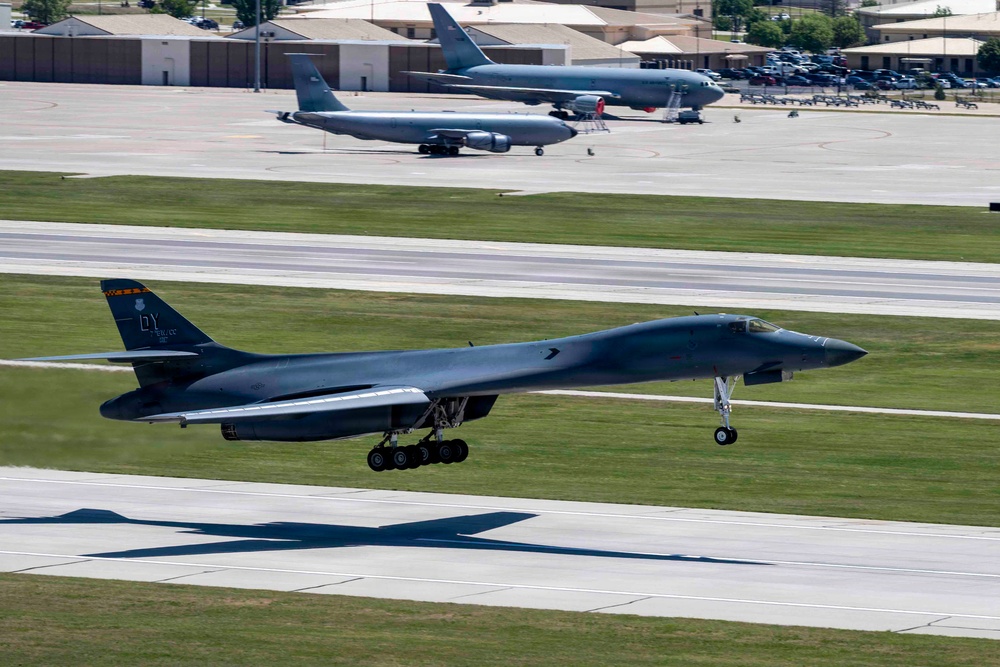
Photo By Staff Sgt. Joshua Hoskins | A B-1B Lancer from Dyess Air Force Base, Texas, takes off from McConnell Air Force...... read more read more
 Subscribe
**MCCONNELL AIR FORCE BASE, Kan. –**A B-1B Lancer that arrived at McConnell Air Force Base last September for a massive structural repair is heading back to the fleet significantly ahead of schedule, proving that digital engineering can revolutionize legacy aircraft sustainment.
The bomber, which underwent a preemptive replacement of its Forward Intermediate Fuselage (FIF) at Wichita State University’s National Institute for Aviation Research (NIAR), departed on May 11. The repair, part of the BackBONE Project, replaced a critical 33-foot component in the aircraft’s upper spine section.
Originally slated to take a full year, the joint Air Force and NIAR team completed the structural repair in record time.
“When we started work on the aircraft, we were looking at a 12-month repair,” said Abigail Ngo, program manager with the Air Force Life Cycle Management Center’s B-1 Program Office. “All in all, we were three-and-a-half months ahead of schedule. That is a good news story in itself—just the speed at which we were able to do a really hard thing."
“We’re glad to return the aircraft to the fleet early,” added Joe Stupic, Senior Material Leader and Division Chief of the B-1 Program Office. “It was a big team effort, a great win, and the field gets back a better jet. A jet that will require fewer inspections because of this repair.”
Part of the secret to this accelerated timeline was the use of a high-fidelity digital twin. Since 2020, NIAR has been scanning disassembled retired B-1s and legacy drawings of the aircraft*,* to build 3D models. Before wrench ever met metal on the operational jet, the repair was sequenced digitally, then physically on a prototype.
When it came time to install the newly manufactured FIF onto the operational aircraft, the digital modeling paid massive dividends. Using a laser measurement system, the measurements from the aircraft were transferred directly to the fixture where the FIF was built.
With quality audits complete, maintenance teams from the 22nd Maintenance Group at McConnell and the 7th Maintenance Group from Dyess Air Force Base restored the aircraft's systems for its return flight to Air Force Global Strike Command.
The success of this prototype repair sets a precedent and new standard for complex sustainment.
As the Air Force extends the service life of the B-1, digital repair strategies will play a key role in maintaining readiness.
"The B-1 is the backbone of America's bomber force, and proves it every day," Stupic said. "This repair keeps it in the fight longer."
| Date Taken: | 05.12.2026 |
| Date Posted: | 05.12.2026 13:02 |
| Story ID: | 565017 |
| Location: | MCCONNELL AIR FORCE BASE, KANSAS, US |
| Web Views: | 102 |
| Downloads: | 0 |

This work, B-1 Bomber Departs Wichita Months Ahead of Schedule Following Historic “Backbone” Surgery, must comply with the restrictions shown on https://www.dvidshub.net/about/copyright.

No keywords found.




