
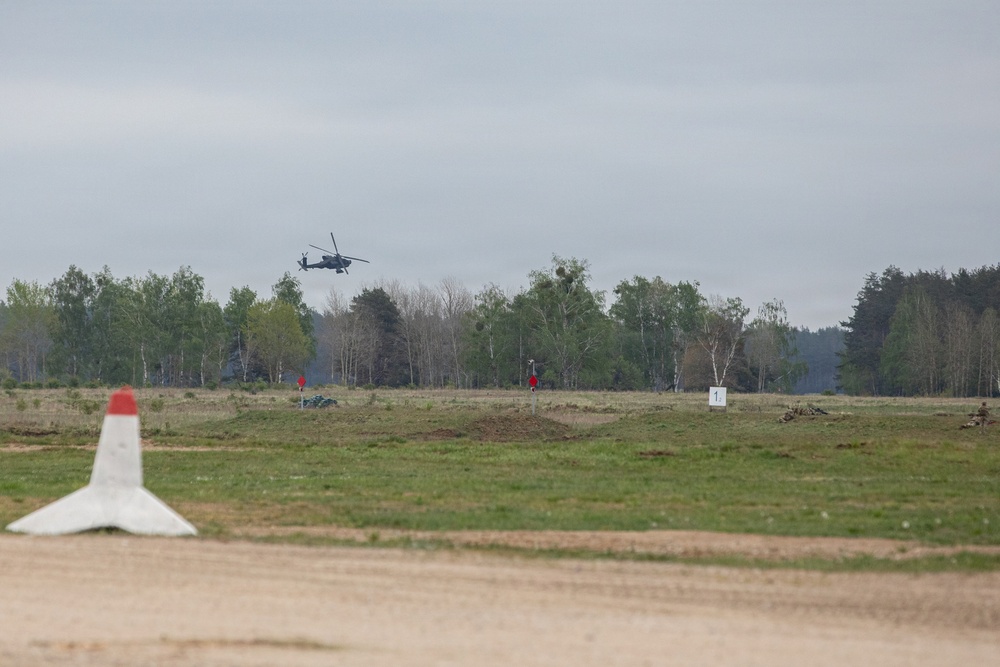
Photo By Pfc. Luis Torres | A U.S. Army AH-64E Apache helicopter flies during a live-fire field training exercise...... read more read more
 Subscribe
Bemowo Piskie, Poland — U.S. Soldiers with 1st Squadron, 2nd Cavalry Regiment (1/2 CR), conducted dry and live-fire training, integrating new technologies, such as unmanned aerial systems (UAS), during a fire support coordination exercise at Bemowo Piskie Training Area, Poland, May 6-7, 2026, in support of Saber Strike, a multinational exercise.
The integration of aerial drone reconnaissance, one-way attack drones, air support, direct fire, and indirect fire allows for efficient targeting and neutralization of enemy targets.
The use of technologies such as artificial intelligence command and control, UAS, and live data networks provides real-time video and information to higher commands. Commands can then take this footage and decide how to move and fight effectively within the battlefield.
“This is the first time we've been able to test these types of systems and technologies in a live-fire environment,” said U.S. Army Capt. Andrew Solomonides, Commander of Bravo Troop, 1/2 CR.
“Our main objective is coordinating fire, but with applications of new capabilities… All the fundamentals stay the same when it comes to intelligence handover and incident command fire coordination,” Solomonides added, “but it's a fairly new application… especially for reconnaissance and surveillance.”
Enhancing the capabilities of surveillance is essential for operational success, for enhanced nighttime detection, tracking, and monitoring of targets and preemptively tackling impending threats while also sharing information between all levels of command from the frontlines, to Headquarters allowing for instant visual communication.
“Having these drone capabilities attached to us and at our disposal gives us a broader scope of the battlefield… both day and night with a clear picture of the ground and giving us a winning edge,” said U.S. Army 1st Lt. Micheal Ignacio, executive officer, Charlie Troop, 1/2 CR.
The information provided by drones can be used by soldiers on the frontlines. This information helps soldiers by allowing them to be notified, see upcoming targets and the direction of enemy movements without jeopardizing their location and allowing them to shift to more optimal positions.
Some of the new UASs have built-in infrared to provide views of the battlefield during day and night operations, which provide intelligence information that is required to make informed decisions.
The training exercise is part of a culminating event from April 27 to May 31, 2026, in which U.S. and allied forces are exercising the North Atlantic Treaty Organization’s (NATO) Eastern Flank Deterrence Initiative.
The exercise demonstrates NATO’s ability to fight on the modern battlefield in an effort to simulate real-world operations and challenges for units to validate their training.
“There's conflict all around the world, and month by month it’s constantly changing…I know this is the future of warfare; it’s happening right here and now, and we’re going to adapt to avoid the consequences of not doing so,” said U.S. Army Staff Sgt. Tabias Kohl, a UAS squad leader with 1/2 CR.
Kohl continued, "Being here in Poland proves that we can not only mobilize quickly and effectively while utilizing our drones but also adapt to new types of warfare.”
| Date Taken: | 05.06.2026 |
| Date Posted: | 05.13.2026 04:08 |
| Story ID: | 565015 |
| Location: | PL |
| Web Views: | 12 |
| Downloads: | 1 |

This work, New technologies integration during 1st Squadron, 2d Cavalry Regiment’s live-fire exercise during Saber Strike, by PFC Luis Torres, identified by DVIDS, must comply with the restrictions shown on https://www.dvidshub.net/about/copyright.


No keywords found.




