
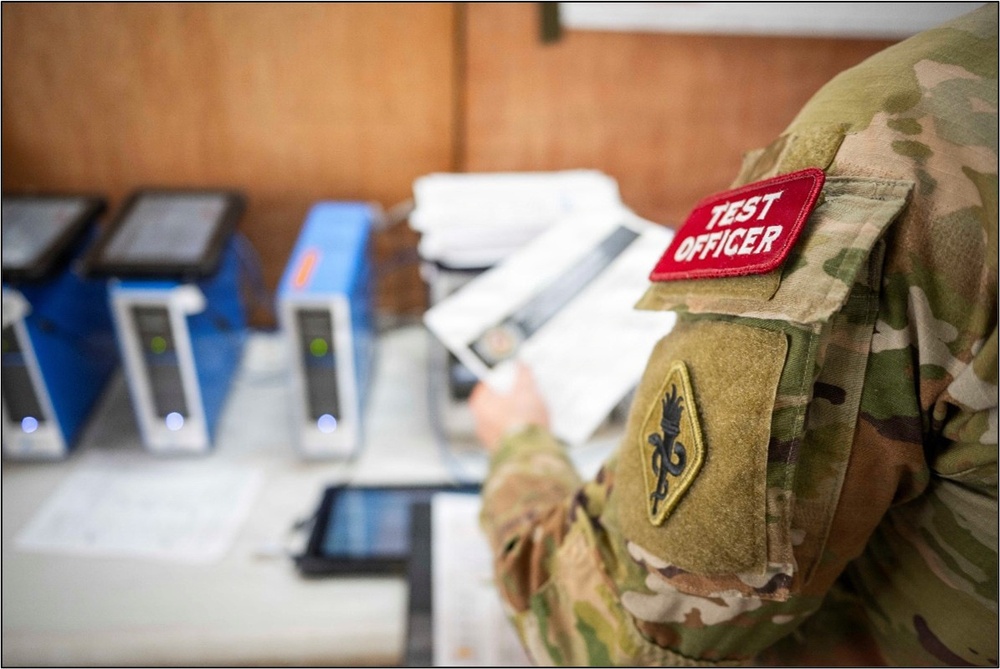
Courtesy Photo | FORT MAGSAYSAY, Philippines — An MTEAC Test Officer reviews MPDS documentation while...... read more read more
 Subscribe
Fort Magsaysay, Philippines – Deep in the training areas of Fort Magsaysay, military medical providers are confronting some of the world's most dangerous infectious diseases, and they are doing it with a state-of-the-art laboratory device powered by a standard tactical battery.
From April 27–30, 2026, during the multinational Balikatan 26 exercise, the U.S. Army Medical Test and Evaluation Activity put the new Man Portable Diagnostics System through a grueling operational assessment to see if its compact, ruggedized system can deliver rapid, lifesaving diagnostic data in an austere, expeditionary environment.
Working alongside the MTEAC assessment team, the medical personnel the 3rd Brigade, 25th Infantry Division Logistics Support Battalion, integrated the MPDS directly into their Role 2 medical facility. Throughout the exercise, the Role 2 team conducted patient care scenarios testing whole blood samples for high-consequence pathogens—including malaria, dengue fever, Lassa fever, Ebola, leptospirosis, and Zika. The MPDS Operational Assessment was a combined effort between MTEAC, the Capability Program Executive for Chemical, Biological, Radiological and Nuclear Defense, the Defense Health Agency, 18th Theater Medical Command, the U.S. Air Force Medical Command Operational Medicine Test and Evaluation, the U.S. Navy Operational Test and Evaluation Force, and the U.S. Army Medical Center of Excellence.
Historically, running real-time polymerase chain reaction tests to identify these specific diseases required shipping samples back to established, fixed-facility laboratories, resulting in a delay that could cost lives in a rapidly evolving theater of operations. The MPDS is designed to dramatically reduce that wait.
Operating as a true "lab-in-a-box," the in vitro diagnostic device automates the entire testing process. From sample preparation to nucleic acid amplification and sequence detection, the system provides hands-off processing of patient specimens. It pushes critical, detailed test results directly to a ruggedized tablet. Because battlefield medicine cannot rely on pristine conditions or standard power grids, the MPDS was heavily modified for the warfighter. The entire system, complete with specialized cords, assay kits, and an Amazon Web Services (AWS) box application, is packed into a rugged shipping container and configured to run on a standard tactical battery.
The hands-on feedback gathered from the 3/25th Logistics Support Battalion operators during Balikatan 26 is critical. By putting the MPDS in the hands of the end-users in a high-humidity, high-stress field environment, MTEAC captured the hard data required to determine if the system is truly suitable and effective for widespread use across the joint services.
Aligned under the U.S. Army Medical Center of Excellence, MTEAC is the Army’s only independent operational test and evaluation agency for medical and medical-related materiel and information technology. MTEAC plays a vital role in the military's acquisition process, ensuring that the equipment placed in the hands of service members is effective, suitable, and safe. To learn more, visit https://medcoe.army.mil/usamteac.
| Date Taken: | 05.12.2026 |
| Date Posted: | 06.11.2026 20:20 |
| Story ID: | 564998 |
| Location: | PH |
| Web Views: | 69 |
| Downloads: | 0 |

This work, MTEAC assesses Man Portable Diagnostics System, by Benjamin Coburn, identified by DVIDS, must comply with the restrictions shown on https://www.dvidshub.net/about/copyright.


No keywords found.




