
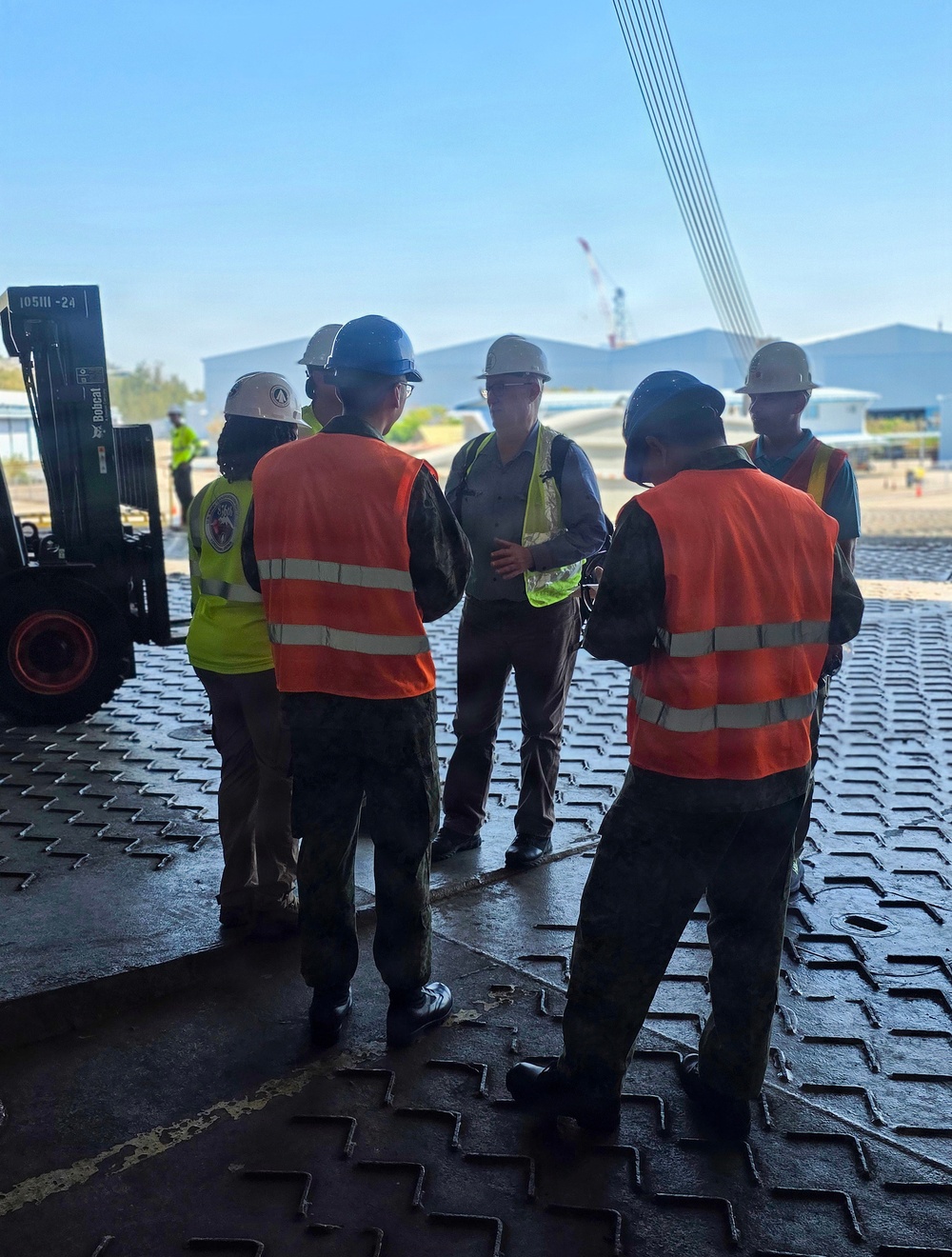
Photo By Grady Fontana | A team from Military Sealift Command Far East, discuss port operations with...... read more read more
 Subscribe
Military Sealift Command Far East has recently validated the “float-in” concept of moving Port Management Unit (PMU) Reservists to the mission by embarking on an MSC vessel they’ll support (as supercargo), instead of relying on airlift/commercial flights.
On 13-16 April, a team of six from Navy Reserve (NR) MSC Far East Units embarked Maritime Administration ship MV Cape Horn (T-AKR 5068) at Subic Bay, Philippines, executed port operations, and sailed to Puerto Princesa, Philippines, to conduct follow-on cargo movements and port operations.
“This is an absolute game changer in how we execute our missions in theater,” said NR Capt. Jessica S. Pender, Commanding Officer, NR MSC Far East HQ Unit.
“The float-in concept removes logistical friction points and potential restrictions on access, placement and timing that is sometimes present with air movement-while concurrently mitigating risk to force.”
Previously, MSC Reservists used commercial airlift to transit ports in the Indo Pacific area of responsibility. However, there are many challenges associated with airlift only mode of travel.
PMU mobilization timelines can outpace transportation timelines. In some cases, Reservists can be mobilized and ready to deploy around M+30, but the movement schedule may not deliver airlift until roughly M+90. That creates a substantial gap where teams are available and trained for the mission but cannot physically reach the port where support is needed.
Even when air movement is planned, availability is often uncertain due to competing priorities, and many target locations have fragile air access that can strand personnel in transit.
In practice, small teams frequently rely on commercial or contracted flights, which can be expensive and schedule-limited, while moving sensitive communications equipment by air can introduce host-nation customs and clearance friction.
The net effect is a single-option dependency—if the airport is degraded or unavailable, deployment pauses unless alternatives like float-in, bus, ferry, or rail are built into the plan.
However, the float-in concept yields many benefits for the reserve team.
The float-in concept closes a key deployment timing gap by giving PMU Reservists a way to reach the mission when airlift is delayed.
“If teams are be mobilized and ready, but air movement is not concurrently available, embarking on the MSC vessel allows personnel to arrive and execute port operations aligned with when the ship and cargo mission actually need support,” said Pender. “It also reduces dependence on aircraft availability, weathered-in airfields, and limited routes by adding a second transportation option commanders can employ based on conditions.”
In some locations, floating in may be the only practical way to deploy personnel, and it can support a more protective posture by enabling teams to live and operate from the vessel instead of transiting through airports, hotels, and terminals when those nodes are degraded or unsafe.
Logistically, float-in is designed to be low-impact: reservists ride as supernumeraries using space-available berthing without displacing crew, hot-racking, or violating union/crew rules, with typically minor added cost (often limited only to incremental rations).
Finally, the afloat training improves mission readiness by giving Reservists valuable “sea time” underway and direct exposure to shipboard constraints and cargo-handling realities. It also allows reach into restrictive environments and move sensitive mission equipment with fewer air-travel and customs clearance friction points.
PMUs are highly mobile Navy Reserve units capable of deploying worldwide to establish port operations in locations without existing MSC or U.S. Navy infrastructure.
MSC Far East supports the U.S. 7th Fleet by ensuring ships throughout the Indo-Pacific region are manned, trained and equipped to deliver fuel, cargo and supplies to forces operating at sea and ashore. The U.S. 7th Fleet is the Navy’s largest forward-deployed numbered fleet and routinely operates with allies and partners to promote a free and open Indo-Pacific.
| Date Taken: | 04.16.2026 |
| Date Posted: | 05.11.2026 21:54 |
| Story ID: | 564979 |
| Location: | SUBIC BAY, PH |
| Web Views: | 126 |
| Downloads: | 0 |

This work, MSCFE Reservists Expand Port Management Capability by Floating to the Mission, by Grady Fontana, identified by DVIDS, must comply with the restrictions shown on https://www.dvidshub.net/about/copyright.

No keywords found.




