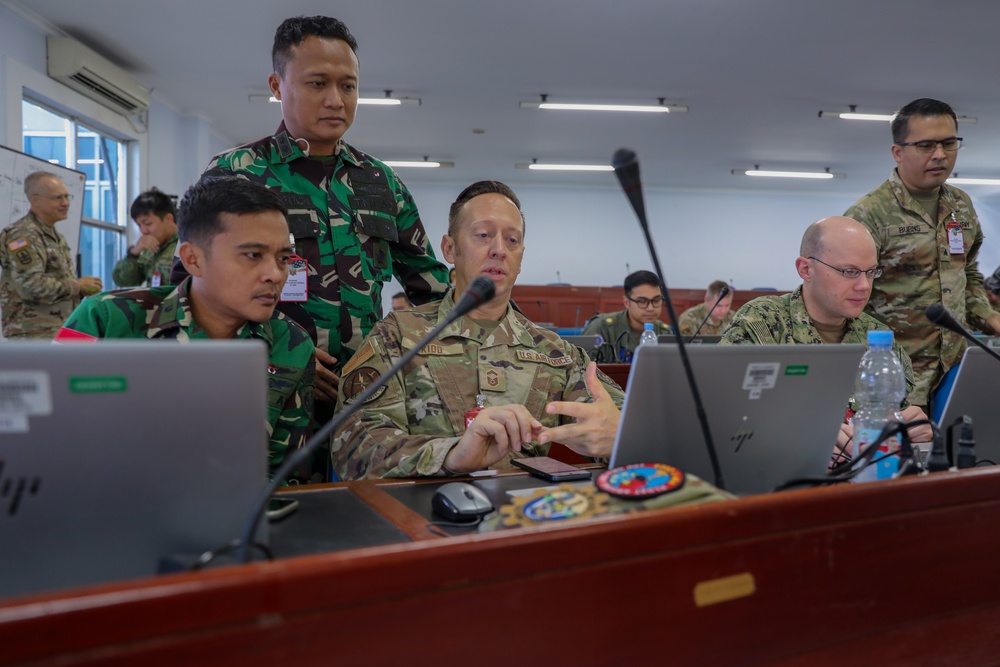
Photo By Sgt. Sean Walker | Joint and multilateral military personnel converse at a Joint Staff Exercise during Super Garuda Shield 25 in Jakarta, Indonesia, Aug. 29, 2025. Super Garuda Shield is an annual exercise between the Indonesian National Armed Forces and U.S. Military designed to strengthen bilateral interoperability, capabilities, and cooperation. (U.S. Army National Guard Photo by Sgt. Sean Walker) see less
| View Image Page
PMTEC and U.S. Army Enhance Joint C2 for Super Garuda Shield 2026
JAKARTA— As the Indo-Pacific operational environment becomes increasingly complex, the need for enhanced information sharing, synchronized operations, and rapid decision-making among U.S. and partner forces has grown more critical.
During the Super Garuda Shield 2026 mid-planning conference, April 6-10, Kerri Wood, U.S. Indo-Pacific Command J7 Pacific Multi-Domain Training and Experimentation Capability Joint Interface Control Officer, led efforts to help U.S., Indonesian, and regional allied and partner forces lay the groundwork to integrate emerging command and control technologies across some of the most austere training environments in the world.
Working with joint service components, coalition partners, and industry experts, Wood and the J7 PMTEC team are spearheading a theater-first initiative to exercise and integrate the U.S. Army’s Next Generation Command and Control architecture with joint and coalition tactical systems during Super Garuda Shield 2026, scheduled later this year. The integration process connects tactical and operational communications, data pathways, and intelligence, surveillance, and reconnaissance feeds to support unified, multi-domain operations.
A key focus is to validate how NGC2 interoperates with joint and coalition architectures to support Combined Joint All Domain Operations By integrating data fusion tools, Wood and the PMTEC team will synthesize information from multiple sensors, platforms, and networks into a shared operational picture.
“This integration supports real-time situational awareness,” said Wood. “By coordinating fires, maneuvers, and effects across multiple domains; synchronizing ISR and targeting data, and sustained operations, even in degraded and distributed environments.”
This shared operational picture, often referred to as a Common Operating Picture , is a critical enabler for accelerating the speed of command. By fusing data into a single, comprehensive display, the COP provides commanders with immediate, unambiguous situational awareness. This eliminates critical delays caused by manually compiling information from different sources, allowing leaders to see threats and opportunities as they emerge and to direct forces across multiple domains with a confidence and tempo that outpaces adversaries. The result is a more agile and decisive combined and joint command structure, capable of making faster, better-informed decisions under pressure.
Staff Sgt. Hayden Susee, with Marine Rotational Forces, Darwin , said effective communication with allied forces on the battlefield is crucial to mission success.
“It facilitates the provision of geographically unique support, intelligence coordination as well as a comprehensive overview of the USINDOPACOM and MRF-D area of operation,” said Susee. “Anticipating the integration of rapidly evolving equipment capabilities with partners and allied forces presents an exceptional opportunity to prepare our position, evaluate and demonstrate the performance and proficiency of our troops and joint systems, thereby assessing our ability to seamlessly collaborate and contribute effectively to one another.”
The result is a more resilient, more connected, and more capable combined force — one that can adapt quickly to the demands of the Indo‑Pacific theater.
Indonesia’s diverse terrain and austere infrastructure provide robust settings to test emerging C2 technologies. From Super Garuda Shield 2026 planning through execution, the J7 PMTEC team will work with the Tentara Nasional Indonesia (TNI-Indonesian National Military), U.S. military units, and regional allies and partners to assess system performance under conditions that replicate real-world operational challenges, such as extreme heat, humidity, and limited bandwidth. These training conditions provide essential lessons for enhancing operational planning and interoperability in the theater.
These conditions challenge every layer of the architecture — from transport and data synchronization to coalition interoperability — and generate lessons that cannot be replicated in a laboratory or stateside training environment.
“Every day in Indonesia teaches us something new,” said Wood. “We’re learning how these systems behave in heat, humidity, distance, and limited bandwidth — and we’re doing it with our partners right beside us.”
Interoperability with allies and partners is an asymmetric advantage, according to Capt. Aidan Kerchner, U.S. Army 4th Infantry Division. “This accomplishment will prove our collective strength and adaptability, showing we can rapidly learn and implement new tech together to enhance our combined operational effectiveness,” said Kerchner.
Super Garuda Shield 2026 highlights the growing importance of rapidly implementing and demonstrating emerging technologies across the USINDOPACOM area of responsibility. As competitors accelerate their own modernization efforts, exercises like Garuda Shield ensure the United States and its allies and partners stay ahead.
J7 PMTEC Program Manager Dr. Andre J. Stridiron III, said lessons learned during Super Garuda Shield 2026—from data sharing to coalition synchronization—will influence future modernization efforts.
Since 2022, PMTEC has successfully integrated live, virtual, and constructive training environments to deliver realistic, high-end scenarios that support the National Defense Strategy. Its central role in exercises like Super Garuda Shield 2026 is critical for validating technological innovations and ensuring that U.S. and allied forces are ready to face the operational challenges of the future with a united, technologically superior and operationally resilient posture.
“Our focus on interoperability reflects our commitment to ensuring that U.S. and partner forces can prevail together seamlessly across all domains,” said Stridiron. “This is essential for executing deterrence and homeland defense strategies.”
About PMTEC: Established in 2022, the USINDOPACOM J7 Pacific Multi-Domain Training and Experimentation Capability is a U.S. Indo-Pacific Command initiative that enhances joint, combined, and coalition warfighting readiness in the Indo-Pacific. PMTEC has developed and continues to enhance the world’s largest fully instrumented coalition range system, linking geographically dispersed ranges, training areas, and warfighters across the Indo-Pacific theater and beyond. A cornerstone of the Pacific Deterrence Initiative, PMTEC aligns with U.S. National Security and U.S. National Defense strategies—strengthening homeland defense, empowering allies and partners, and delivering deterrence against emerging threats. By integrating advanced technologies, PMTEC drives military modernization, fosters innovation, and drives U.S. and allied forces’ technological superiority and asymmetric advantage over adversaries.

 Subscribe






