
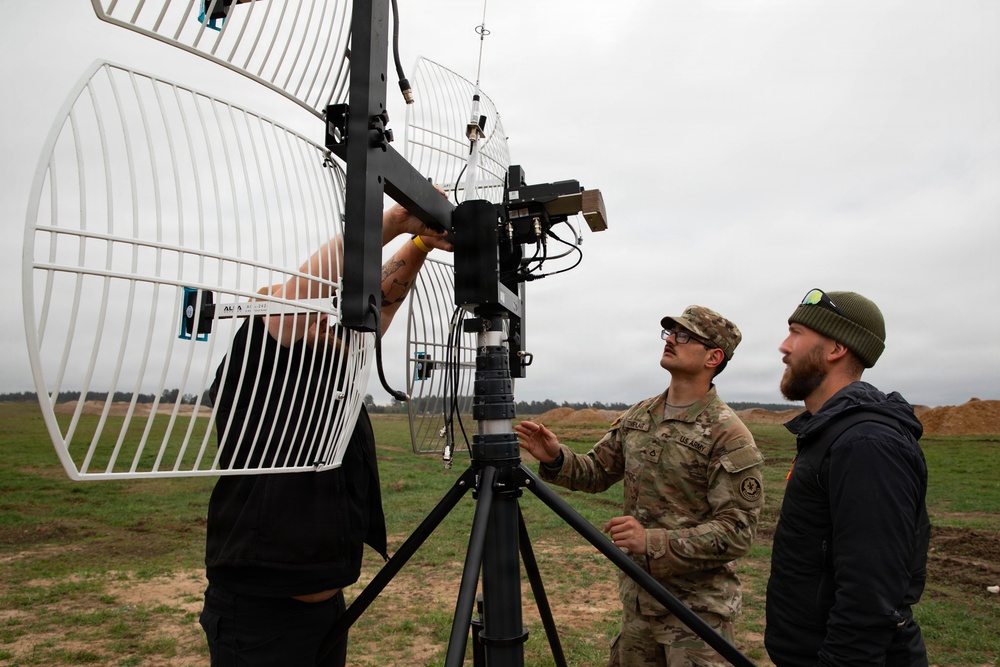
Photo By Staff Sgt. Emilie Lenglain | U.S. Army Spc. Mason Tomplait, drone operator, assigned to the 409th Military...... read more read more
 Subscribe
Bemowo Piskie, Poland — On May 7, 2026, at Bemowo Piskie Training Area in Poland, three Soldiers from the U.S. Army’s 2nd Cavalry Regiment (2CR) tested a Group 3 unmanned aircraft system (UAS) with a vendor during the Saber Strike combined arms live-fire exercise (CALFEX) to explore a potential partnership.
A Group 3 UAS weighs greater than 55 pounds and can fly longer distances than smaller sized systems.
“This Saber Strike CALFEX is showing that right now our platoons have a Group 3 asset, where they're able to communicate with the intel cell and the fire cell,” said 1st Lt. Ethan Moore, UAS platoon leader, 409th Military Intelligence Company, 2CR. “Our drone can cue on the fire's assets and call for fire on enemy positions at a greater distance than we've had before.”
At the CALFEX, Moore was joined by U.S. Army Staff Sgt. Dalton Kastner, the standardization officer, and Spc. Mason Tomplait, the drone operator. The trio met with the Group 3 UAS vendor to evaluate its technology.
There are many advantages to utilizing a Group 3 UAS, which is considered medium-sized among drone capabilities
“Our short-range reconnaissance drones only go from five to seven kilometers; a medium-range reconnaissance might go 30 or more,” said Moore.
The RQ 7B Shadow is what Kastner knows to be the U.S. Army’s medium-sized drone for roughly 20 years.
Comparing this updated medium-sized drone to the Shadow, Kastner said, “This system has extremely similar capabilities, with a much smaller footprint and a much smaller weight, and for me, that's a positive. This system also has the vertical takeoff and landing, or VTOL kit, so it's able to just take off straight up and then transition into forward movement.”
After the drone flew out, mission sets were sent to Moore, who coordinated with Tomplait in control of the gimbal camera on the system.
In real time, they could fly to specific areas of the training area and confirm friendly forces, possible enemy camps and target accuracy – all part of intelligence, surveillance and reconnaissance (ISR).
Today, ISR relies more on machine-driven intelligence rather than the previously human-centered model.
"They're able to get that long range, very good camera view to see the targets on the ground, to provide accurate targeting grids for us to push fires and to get faster reports,” explained Kastner, “to make those jumps even quicker with accurate and rapid intelligence.”
The combat-support training exercise lasted around 41 hours.
“They'll be able to use infrared capabilities, and we'll be able to do everything at night as well,” said Kastner.
With eight years of experience with drones, Kastner feels that the drone was easy to put together and use.
“They even have the controller for manipulating the camera and some of the programmable features in the camera as well, so it's very user friendly,” said Kastner.
Moore, who’s also an intelligence officer, said the Army needs equipment like this in order for intel cells to find the enemy.
Moore added, “Not only is this craft able to fill a regimental gap in intelligence collection, but it's also something that's valid and capable in today's conflict that we need to enable us for the intelligence collection and fires.”
Moore said when choosing a vendor, they must be able to modify and adapt as new technologies and capabilities emerge.
After departing Poland to evaluate other vendors' drone systems, Moore and his team went to Project Flytrap in Lithuania — part of a series of exercises (including Sword 26, Saber Strike, Immediate Response, and Swift Response) that turn experimentation into capability.
Project Flytrap is a counter-unmanned aerial system exercise designed to integrate emerging technologies and inform future Army requirements and doctrine.
The Army stays innovative by partnering with vendors and the UAS industry, alongside the real-world feedback from Soldiers.
| Date Taken: | 05.10.2026 |
| Date Posted: | 05.12.2026 03:14 |
| Story ID: | 564958 |
| Location: | US |
| Hometown: | KOKOMO, INDIANA, US |
| Hometown: | LOS ANGELES, CALIFORNIA, US |
| Hometown: | NEW CANEY, TEXAS, US |
| Web Views: | 232 |
| Downloads: | 0 |

This work, Aerial intel and tech adaptation: 2nd Cavalry Regiment tests innovative drone technologies at Saber Strike 26, by SSG Emilie Lenglain, identified by DVIDS, must comply with the restrictions shown on https://www.dvidshub.net/about/copyright.


No keywords found.




