PROTECTING THE ARTEMIS II MISSION ACROSS EVERY DOMAIN
Photo By Michael Sparks |
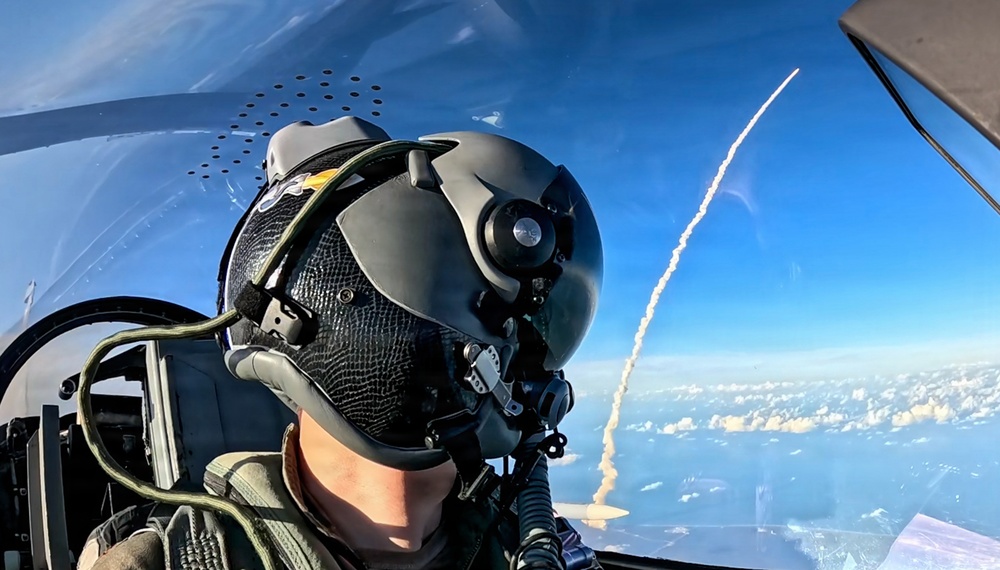
A NORAD fighter pilot monitors the Artemis II launch from the cockpit on April 1,......read moreread more
Photo By Michael Sparks | A NORAD fighter pilot monitors the Artemis II launch from the cockpit on April 1, helping secure the airspace over Cape Canaveral as the crewed mission heads toward the moon. see less
| View Image Page
PROTECTING THE ARTEMIS II MISSION ACROSS EVERY DOMAIN
TYNDALL AIR FORCE BASE, Fla. — When the Artemis II crew launched toward the moon on April 1, 2026, their safety relied on a massive, invisible shield stretching from the stratosphere to the global ocean. First Air Force executed its multi-domain responsibilities as the Continental U.S. NORAD Region (CONR), Air Forces Northern (AFNORTH), and Air Forces Space (AFSPACE). Tasked with dual, no-fail missions, this quad-hatted command was responsible for both defending the launch airspace and orchestrating the astronauts' safe return. This mandate required not only securing the skies over Cape Canaveral, but also strategically pre-stationing specialized search and rescue assets globally to ensure an immediate, highly trained response in the event of an off-nominal launch or landing emergency.
Under NORAD’s enduring mission of aerospace warning, aerospace control and maritime warning for North America, 24/7/365, thefoundational missionofCONR is the air defense of the continental United States. This responsibility takes on heightened significance during a NASA crewed launch. In the hours leading up to and during the launch of the Artemis II mission,the Federal Aviation Administration (FAA) established a NORAD-enforced 30 nautical-mile Temporary Flight Restriction (TFR) area. This created a secure airspace bubble, ensuring that no unauthorized aircraft interfered with the launch vehicle's trajectory. Through the diligent watch of the 601st Air Operations Center (AOC), commonly referred to as America’s AOC, and CONR’s Eastern Air Defense Sector (EADS),it directsa network of radars, sensors, and fighter aircraft to monitor and, if necessary, intercept any airborne threats, guaranteeing the safety and security of the mission and its crew from the ground up.
Planning for these types of events begins months in advance of the actual event. NORAD, including members of the 601st AOC, works closely with interagency partners in advance security planning to ensure a synchronized approach to airspace security for not just this event, but similar events such as the Super Bowl, FIFA World Cup, and United Nations General Assembly. Those partners include NASA, the FAA, FBI, Customs and Border Protection Air and Marine Operations, and local law enforcement agencies. Coordination and cooperation between NORAD and interagency partners ensure a layered air defense system that provides a safe and secure North American airspace 24/7/365.
“The air defense of North America is a 24/7 responsibility that demands absolute precision, especially when the eyes of the world are on a historic milestone like Artemis II,” said Royal Canadian Air Force MGen. Paul Doyle, CONR deputy commander. “Just as the Artemis II crew represents a profound partnership between the United States and Canada, NORAD stands as a symbol of our shared commitment to continental defense. We stand ready to secure the skies, not only over the crewed NASA missions, but across all of North America, so the astronauts aboard can continue making history and inspiring the next generation worldwide, knowing the airspace around them is safe and secure.”
While CONR successfully secures the launch environment and defends the skies, the mission's focus simultaneously expands globally. Transitioning to roles outside of NORAD and CONR, the AFSPACEcomponent is already in motion. U.S. Space Command is the Department of War Human Space Flight Support manager, with AFSPACE delegated responsibility for this critical mission. This mission is managed byitsspecialized unit, First Air Force, Detachment 3, which has supported every American crewed space program since Project Mercury.
Det 3 leads the planning and preparation for the recovery of Artemis II astronauts and their Orion capsule, operating at the intersection of NASA and Department of War requirements. A primary responsibility for Det 3 is the development and integration of specific capsule recovery techniques and procedures tailored to the U.S Navy’s recovery ship specifications in strict accordance with Navy regulations. During the execution of the mission, Det 3’s team serves as the central coordination cell for all recovery operations, managing the vital interface between NASA leadership and the crew of the USS John P Murtha. Furthermore, Det 3 identifies, sources, and provides specialized training to U.S. Navy medical units stationed on the vessel, ensuring they are proficient in the complexities of space medicine as defined by NASA requirements. This global effort involves prepositioning Search and Rescue (SAR) elements and conducting rigorous Underway Recovery Tests (URTs) to ensure highly trained personnel, including pararescuemen and dive teams, are prepared to safely extract the crew at a moment's notice. “This is fundamentally a team sport. Our success is built upon the hundreds of hours we spend training alongside our joint partners in the Navy and our interagency partners at NASA,” said Col. Jason Gingrich, Deputy Commander, Air Forces Space. “The meticulous planning and constant rehearsals are what allow us to synchronize our efforts, so that when the call comes, our teams are not just ready, but have practiced every contingency to ensure we are providing the safest possible recovery for the crew."
The culmination of theAFSPACEmission occurs the moment the Orion capsule splashes down. The SAR forcesthat were pre-positioned arethe first to arrive, initiating a carefully rehearsed sequence to secure the capsule and ensure the well-being of the astronauts. Whether the recovery requires helicopter hoists, specialized rafts like the "front porch," or direct shipboard recovery via a Navy well deck,these teams areequipped and trained for any contingency.
This recovery mission is a powerful demonstration of joint-force integration.It combinesthe global reach of the Air Force, the maritime dominance of the Navy, and the pioneering spirit of NASA into a single, unified effort.The command'sexpertise in coordinating complex rescue operations is brought to bear to guarantee that an astronaut's most vulnerable moments are their safest.
"A seamless recovery operation is the successful culmination of our joint partnerships," said Lt. Col. Kevin Pieper, 1 AF Det 3 commander. "It’s the result of years of planning and coordination across combatant commands, services and agencies. When air, maritime, space and rescue forces integrate across the globe, it ensures unity of effort and brings our astronauts home safely.”
From safeguarding the skies above Cape Canaveral to orchestrating a global recovery network, CONR-1AF (AFNORTH & AFSPACE) provides an indispensable, end-to-end support structure for human space exploration.The command standsas a testament to the seamless integration of air and space power, ensuring that as America reaches for the Moon and beyond,its astronauts are provided a secure launch environment and a safe recovery.
"Securing an Artemis launch is a strategic imperative that demonstrates our integrated approach to homeland defense. As CONR, we deter and deny any airborne threat, ensuring mission assurance at its most critical phase,” said Lt. Gen. Luke Ahmann, CONR-1AF (AFNORTH & AFSPACE) commander. “This defensive posture is inextricably linked to our AFSPACE responsibility. We see it as a continuum of support, defending the launch, and planning for the recovery."

 Subscribe






