
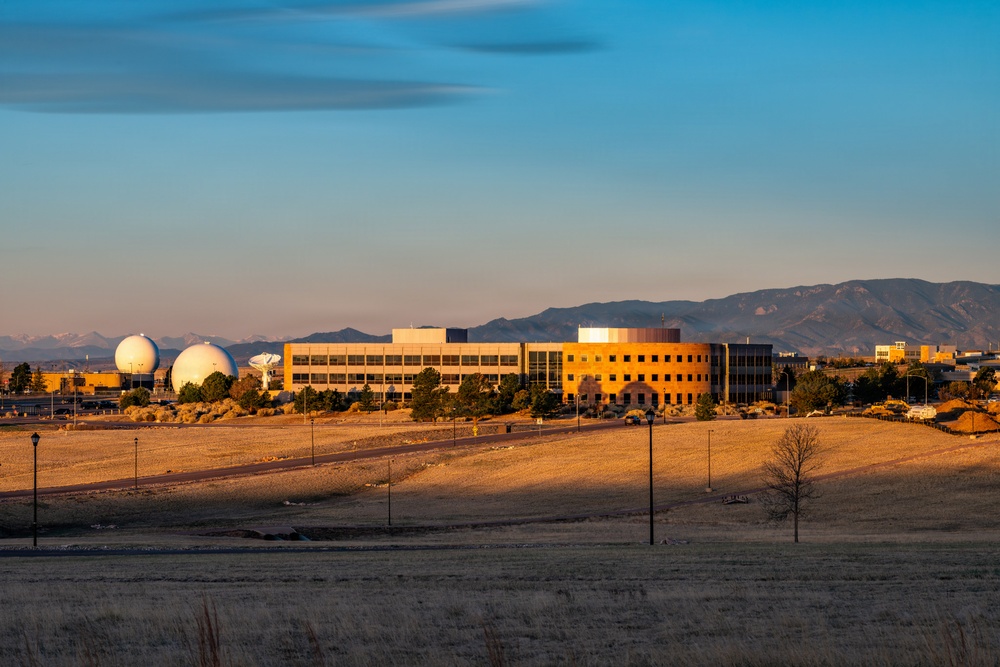
Photo By Dalton Prejeant | A landscape photo of Schriever Space Force Base, Colorado, April 26, 2026. Located...... read more read more
Space Base Delta 41 is the first command in the U.S. Space Force to initiate the Space Operations Installations Compatible Use Zones study, known as SOICUZ.
The study is designed to inform off-base development of compatibility with space operations. It is modeled after the U.S. Air Force’s Air Installations Compatible Use Zones study program, or AICUZ.
The contracted study, awarded in 2025 and expected to be completed by the end of fiscal year 2026, will identify compatible and incompatible development from both a space mission and community perspective and develop recommendations applicable to Schriever Space Force Base and the surrounding region.
“This study will help ensure future development can move forward with a clear understanding of mission needs, allowing growth to occur in a way that remains compatible with long-term, evolving space operations,” said U.S. Space Force Col. Eric Bogue, SBD 41 commander.
At a minimum, the SOICUZ study may address electromagnetic spectrum concerns; visual and physical obstructions; and noise and vibration impacts. The effort will also include interviews with space operations mission owners, reviews of local policies and municipality zoning codes, and the development of a roadmap defining the various types of encroachment for each location, outlining potential compatibility considerations and mitigation approaches.
The study will examine factors ranging from building height to more technical considerations such as ensuring electromagnetic activity tied to space operations does not unintentionally affect, or be impacted by, nearby consumer electronics, such as garage door openers, consumer Wi-Fi or telecommunication signals.
However, there are other considerations that may not necessarily fall within the scope of SOICUZ but must also be accounted for by base officials. Those considerations include environmental factors, physical security and foreign investment.
Modern Considerations
When the site for what would become Schriever SFB was selected decades ago, many of today’s technologies either did not exist or were not widely available, making their future impact difficult to predict.
Today, advances incapabilities have introduced modern considerations and challenges for federal installations, to include managing electromagnetic interference from local cellular providers and power companies; addressing cybersecurity requirements; and maintaining appropriate visual line-of-sight and force protection measures against malicious surveillance activities.
The increasing availability and capability of small, unmanned aircraft systems, commonly known as drones, presents an emerging risk to federal installations.
“Real Estate located near Department of War installations presents a potential proximity threat,” said Special Agent Tyisha Wright, Air Force Office of Special Investigations Region 8 technology protection subject matter expert. “The threat is not always what people may expect, like a terrorist or a spy. Sometimes disruptions to military operations can be caused by someone operating a drone near an installation that was purchased from a local store.”
These factors, malicious and non-malicious alike, must be measured when determining whether new development poses a risk to installation operational security.
Staff Sgt. Colton Heinrich, 50th Security Forces Squadron electronic security systems and counter-sUAS noncommissioned officer in charge, oversees SBD 41’scounter drone programs and efforts.
“Coordinating closely with mission partners and local law enforcement agencies, we employ a layered approach to detecting, tracking and defeating drones here at Schriever SFB,” Heinrich said.“ Even if it’s later determined to be a non-malicious drone, we have to neutralize the threat as we are responsible for operations security and protecting everyone on the installation.”
Designed with Growth in Mind
Once the original home of numerous space missions that now operate out of Schriever SFB, Sunnyvale Air Force Station, California — later renamed Onizuka Air Force Station —became incompatible with surrounding development in the 1970s as Silicon Valley rapidly expanded, necessitating the relocation of key space missions.
Schriever SFB’s remote location, approximately 10 miles east of Peterson Space Force Base, Colorado, was selected deliberately to support space operations and long-term installation growth. Established in the early 1980s as Falcon Air Force Station, the site was chosen away from population centers to provide the clear operational environment, security buffers and expansion potential required for emerging space missions.
As mission requirements expanded, the installation was redesignated as Falcon Air Force Base in the late 1980s, reflecting its growing role in space operations and the need for additional infrastructure to support those missions.
During the early 1990s, Falcon AFB played a significant role in supporting Operation Desert Storm through space-based command and control of critical space missions. The conflict marked one of the earliest large-scale uses of space systems for position, navigation, and timing; missile warning and military communications.
The base was eventually renamed in June 1998 to Schriever Air Force Base and then in July 2021 was redesignated a space force base.
“From the beginning, the installation was designed with mission growth in mind,” said James Mesco, SBD 41 historian. “The location provided the flexibility to expand mission facilities, maintain security buffers and adapt as operational requirements evolved over time. That long-term planning enabled Schriever to grow in a deliberate and measured way over several decades.”
Today, Schriever SFB is home to various global space operations that affect the joint force, commercial industry and daily life of every civilian across the globe, including Intelligence, Surveillance, and Reconnaissance; Position, Navigation and Timing; Military Satellite Communications; Orbital and Cyberspace Warfare operations and more.
Community Partnership
Protecting critical space missions while supporting responsible growth requires close coordination between military installations and the communities that surround them. At Schriever SFB, that coordination is built on understanding, partnerships and collaboration with the private sector, local governments, state agencies and federal stakeholders.
A tool supporting that collaboration is the DoW’s Readiness and Environmental Protection Integration program. REPI promotes compatible land use near military installations through voluntary, partnership-based approaches with state, local governments and private organizations to prevent, address or remove land-use conflicts near installations that impact military activities.
The program provides funding to the base for conservation easements, land acquisitions and natural infrastructure solutions via collaborative partnerships to curb encroachment.
“We must work alongside our neighbors to identify solutions that support both responsible community development and mission sustainment,” said Mary Barfield, 50th Civil Engineer Squadron deputy base civil engineer. “Programs like REPI give us the ability to pursue options that are collaborative, flexible and focused on long-term compatibility.”
In addition to compatible land use planning coordination, installations also work within established federal review processes, such as the Committee on Foreign Investment in the United States, which evaluates certain transactions involving foreign investment to ensure they do not pose risks to national security.
“The most significant threat is from foreign nationals with connections to foreign intelligence services purchasing property near military installations,” Wright said. “The proximity of these properties allows for visual surveillance of the installation, the ability to collect signals intelligence using commercially obtained equipment, and pattern-of-life analysis over months or years.
“There are also potential cyber threats, to include interception of installation Wi-Fi, cellular and radio frequency emissions or creating staging points for future cyber operations,” Wright continued. “The close proximity to the installation increases signal strength and reliability of malicious collection devices.”
To help address these concerns, installations rely on established federal review processes that guide development and investment near military sites.
“These processes exist to provide transparency and consistency as communities grow and investments occur,” said Jeff Bohn, SBD41and SBD 1 community partnership manager. “They help ensure development can move forward in a way that remains compatible with mission requirements and broader national security considerations.”
Through these partnerships and processes, SBD 41 leadership continues to engage with stakeholders to support sustainable development while safeguarding the long-term viability of space operations.
“The SOICUZ study is going to help us deliver data-driven results to the surrounding community,” Bogue said. “We understand that expansion and development are not going to stop, so it’s on us to provide our neighbors with answers to ensure responsible growth that will protect the missions at Schriever for decades to come.”
| Date Taken: | 05.08.2026 |
| Date Posted: | 05.11.2026 11:35 |
| Story ID: | 564918 |
| Location: | COLORADO, US |
| Web Views: | 405 |
| Downloads: | 0 |

This work, Schriever SFB first in USSF to initiate SOICUZ study, by Keefer Patterson, identified by DVIDS, must comply with the restrictions shown on https://www.dvidshub.net/about/copyright.

No keywords found.





